PayPal (PYPL -1.00%) is one of the world’s largest digital payments companies, and it’s a stock many investors consider when looking for exposure to fintech. The company’s technology powers online and in-store payments for consumers and merchants, with widely used products like Venmo and the Honey shopping platform, along with buy now, pay later financing.
In 2024, PayPal processed about $1.7 trillion in total payment volume across its ecosystem and served more than 434 million active users worldwide -- scale that helps explain why the stock draws investor interest.
Here’s a step-by-step guide to how to buy PayPal stock, plus key factors to weigh before deciding whether it belongs in your portfolio.
How to buy PayPal stock
You can buy shares of PayPal through any brokerage account. If you still need to open one, these are some of the best-rated brokers and trading platforms. Here's a step-by-step guide to buying PayPal stock:
- Open your brokerage app: Log in to your brokerage account where you handle your investments.
- Search for PayPal: Enter the ticker "PYPL" into the search bar to bring up the stock's trading page.
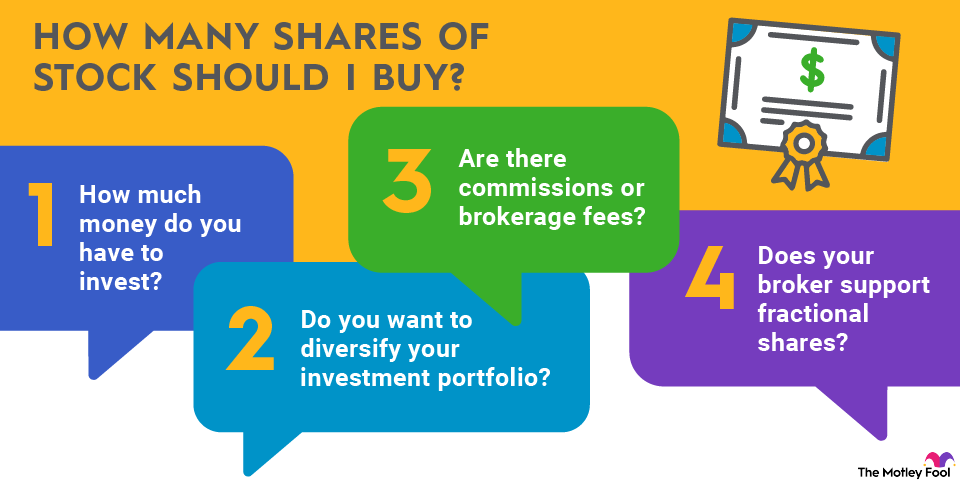
- Decide how many shares to buy: Consider your investment goals and how much of your portfolio you want to allocate to this stock.
- Select order type: Choose between a market order to buy at the current price or a limit order to specify the maximum price you're willing to pay.
- Submit your order: Confirm the details and submit your buy order.
- Review your purchase: Check your portfolio to ensure your order was filled as expected and adjust your investment strategy accordingly.
Alternative ways to invest in PayPal stock
Instead of actively buying shares of PayPal directly, you can also passively invest in the financial technology company through a fund holding its shares. Exchange-traded funds (ETFs) are an easy way to gain exposure to PayPal stock.
According to ETF.com, 344 ETFs held 163.7 million shares of PayPal as of mid-2025. The biggest holder was the Vanguard Total Stock Market ETF (VTI +0.66%) at 31.8 million shares.
Exchange-Traded Fund (ETF)

NASDAQ: PYPL
Key Data Points
Is PayPal profitable?
Profit growth is a big factor in powering stock price appreciation over the longer term. It's an ideal area for beginning investors to focus on before buying shares of any company.
PayPal produced $1.3 billion of net income in the first quarter of 2025. That was up more than 45% from the previous period. PayPal's earnings have generally risen over the years:
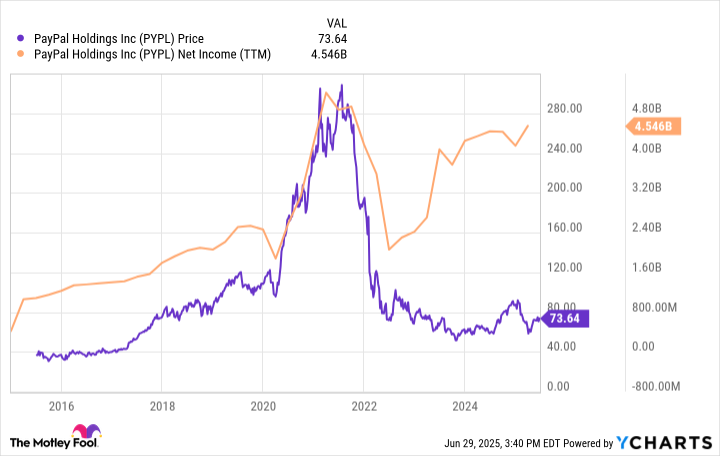
PayPal also produces lots of cash. It generated $6.8 billion of free cash flow in 2024 and expects to produce $6 billion to $7 billion in 2025. The company returns most of its free cash flow to PayPal shareholders by repurchasing shares.
That cash flow doesn’t come from just one source -- PayPal has a few different levers. PayPal’s business model relies on transaction fees, value-added services, and other monetization tools across its payments ecosystem.
PayPal revenue
Revenue growth also helps drive stock price appreciation, especially for companies earlier in their growth cycle. PayPal generated $7.8 billion of net revenue in the first quarter of 2025, a 1% increase from the first quarter of 2024. Rising active accounts and total payment volumes are helping drive revenue growth. The company expects to continue growing revenue at a solid rate. PayPal sees its revenue rising 4% to 5% in 2025.
Revenue
PayPal valuation
PayPal's stock price has fallen sharply in recent years. As a result, its valuation has become more attractive. With a forward price-to-earnings (P/E) ratio of less than 15 times in mid-2025, PayPal traded at a relatively low valuation. In mid-2025, the S&P 500 traded at about 23 times its forward P/E, and the Nasdaq Composite index was even higher at over 29 times its forward P/E. PayPal's lower forward P/E multiple means it's cheaper than the broad market indexes.
Does PayPal pay a dividend?
PayPal does not pay a dividend. However, it does return cash to investors by repurchasing shares. The company repurchased $6 billion in shares in 2024 and plans to buy back a similar level in 2025. During the 12 months through mid-2025, it had reduced its shares outstanding by 6%.
Cash Flow
Has PayPal stock split?
As of mid-2025, PayPal had never completed a stock split. The payments giant seemed unlikely to split its stock anytime soon. Although shares had surged more than 600% at one point after its separation from eBay (EBAY +0.03%), the stock had returned most of that gain by mid-2025 (doubling to about $75 per share). The stock would need to surge again before PayPal would likely consider a split.
The bottom line
PayPal is a leading digital payment platform that's highly profitable. Although PayPal's profits dipped in recent years, the company resumed its upward trajectory.
The speed bump caused shares to plunge from their peak, which has the stock trading at a very reasonable valuation. PayPal's improving profitability, value-enhancing share repurchases, and attractive valuation mean it could be an incredibly enriching stock to buy for the long term.
Related investing topics
FAQ
About the Author