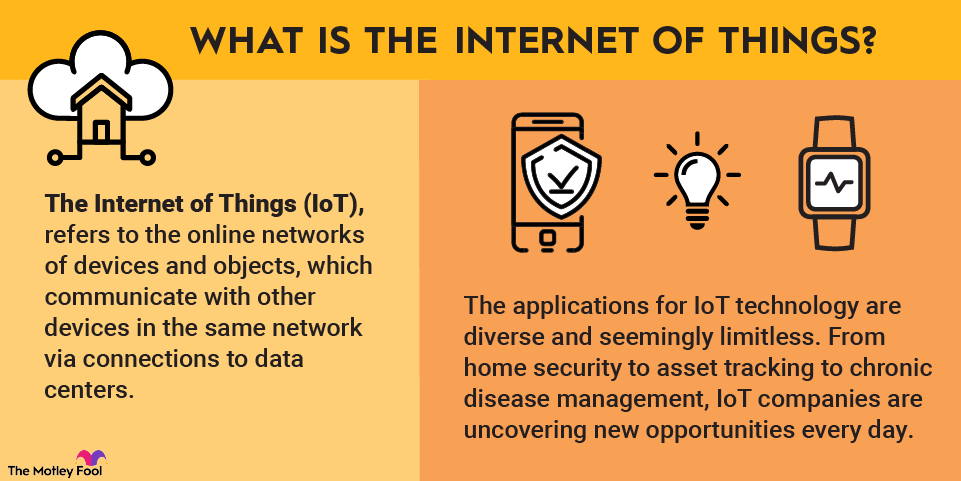
Computers and smartphones aren't the only devices connecting to the internet. Everyday objects such as lights, televisions, major appliances, cars, and even doorbells are being brought online -- and they're frequently found in American homes. According to Horowitz Research, 48% of U.S. homes have at least one smart device. The Internet of Things (IoT) refers to the networks of devices and objects that communicate with other devices in the same network via connections to data centers.

Best IoT stocks in 2026
These six top IoT stocks range from a diversified tech giant to a pure-play IoT company:
| Name and ticker | Market cap | Dividend yield | Industry |
|---|---|---|---|
| Cisco Systems (NASDAQ:CSCO) | $294.7 billion | 2.20% | Communications Equipment |
| Alarm.com (NASDAQ:ALRM) | $2.4 billion | 0.00% | Software |
| DexCom (NASDAQ:DXCM) | $28.4 billion | 0.00% | Healthcare Equipment and Supplies |
| Impinj (NASDAQ:PI) | $4.8 billion | 0.00% | Semiconductors and Semiconductor Equipment |
| Intel (NASDAQ:INTC) | $224.7 billion | 0.00% | Semiconductors and Semiconductor Equipment |
| Samsara (NYSE:IOT) | $18.5 billion | 0.00% | Software |
1. Cisco Systems

NASDAQ: CSCO
Key Data Points
Cisco Systems (CSCO +0.35%) is the leading provider of enterprise networking hardware. Because its products form the backbone of the internet, the tech giant benefits from the explosion of internet-enabled devices.
Cisco sells networking hardware designed for handling large numbers of connected devices, including rugged, durable products aimed at industrial applications. On the software side, the company provides the Cisco Edge Intelligence platform and other tools for managing IoT data and devices.
Cisco is also one of the largest cybersecurity companies. The company offers hardware, software, and services aimed at securing networks against threats, including those specifically targeting IoT systems.
Cisco is a low-risk way of investing in IoT. The company is supremely profitable, having generated net income of $10.3 billion on revenue of $53.8 billion in fiscal 2025. And it's not only on the income statement that Cisco shines. In fiscal 2025, Cisco generated about $13.3 billion in free cash flow.
The company is sensitive to global economic conditions, given that its customer base includes many large companies, organizations, and governments. However, investing in the stock is a good way to gain exposure to IoT without taking big risks. Cisco remains as dominant as ever, and the company is poised to benefit from the growth of the IoT market.
2. Alarm.com

NASDAQ: ALRM
Key Data Points
While Cisco's (ALRM -3.11%) market cap borders $274 billion, cloud software provider Alarm.com is valued at just a few billion. Its relatively small size makes it riskier than the tech giant, but the company has plenty of growth potential.
Alarm.com provides a cloud-based software platform for managing a connected home or business. Subscribers use the software to manage internet-enabled devices, including security cameras, lights, locks, thermostats, and a range of other supported products.
Alarm.com partners with service providers to sell its platform to consumers and businesses. The company currently works with about 12,000 service providers in more than 70 countries, and its products are found in about 67 million properties worldwide.
Recognizing both steady top- and bottom-line growth from 2016 through 2024, Alarm.com has increased revenue at a 17.4% compound annual growth rate (CAGR) and adjusted earnings before interest, depreciation, and amortization (EBITDA) at a 17.3% CAGR.
In addition to revenue of $990 million to $996.4 million, Alarm.com projects adjusted EBITDA of $195 million to $196.5 million for 2025. Should the company achieve the midpoints of both of these metrics, it will recognize year-over-year growth of 5.7% and 11.2%, respectively.
Revenue
Management recognizes ample growth opportunities, identifying more than 500 million serviceable properties. Since only a small fraction of homes are currently using Alarm.com’s platform, the IoT company has a long growth runway.
With the smart home trend here to stay, Alarm.com -- and its millions of subscribers -- is an early leader.
3. DexCom

NASDAQ: DXCM
Key Data Points
The Internet of Things goes far beyond consumer devices. DexCom (DXCM -1.31%) is focused on medical devices used to continuously monitor glucose for diabetics. The company's G7 system delivers real-time data to smartphones and smartwatches without the need for finger sticks.
The number of people in the U.S. with diagnosed diabetes grew from 1.58 million in 1958 to 23.35 million in 2015, according to data from the Centers for Disease Control and Prevention. Today, about 38 million Americans have diabetes, and approximately 98 million American adults have prediabetes.
The combination of growing rates of diabetes and the transition to continuous glucose monitoring will give DexCom plenty of growth opportunities in the coming years. According to its preliminary results, DexCom booked revenue of $4.7 billion in 2025, a 16% increase over 2024. Management projects continued growth in the coming year, forecasting 2026 sales of about $5.16 billion to $5.25 billion. With respect to profitability, Dexcom projects an adjusted gross profit margin of 63% to 64% and an adjusted operating margin of 22% to 23% for 2026.
DexCom has historically traded at expensive multiples, but for those willing to take on some risk to gain exposure to both IoT and healthcare, it's a stock to consider.
4. Impinj

NASDAQ: PI
Key Data Points
Impinj (PI -0.73%) specializes in solutions involving radio-frequency identification, or RFID. Impinj's RFID tags are used by retailers, manufacturers, and logistics companies to track inventory and assets.
The market for RFID products, including tags, readers, software, and services, was worth $12.6 billion in 2025, according to Markets and Markets, and it's expected to grow at a CAGR of more than 9% through 2033. Apparel retail is so far one of the biggest markets by volume for RFID technology, but the technology also has applications in supply chain logistics.
Impinj had a rough go of it during the COVID-19 pandemic, partly due to retail store closures, but the company has bounced back in a big way. Sales soared from $190.3 million in 2021 to $366.1 million in 2024. The company is growing profits, too. In January 2025, it stated in a report of its preliminary results that it anticipates 2025 adjusted EBITDA of $16.2 million to $16.9 million, up from $15 million during the same period in 2024.
Impinj estimates that just 0.3% of connectable items are connected today. In the long run, trillions of consumable objects, ranging from food packaging to tires, could be tracked using RFID technology. Each RFID endpoint costs only pennies, making the technology economical for a wide array of uses.
Impinj has shipped more than 100 billion RFID endpoints over its lifetime, and the number could rise substantially in the coming years. Impinj is far from a sure thing as an investment, but it's a company to watch in the IoT space.
Total spending on consumer and industrial IoT technology is expected to pass $1 trillion in 2025.
5. Intel

NASDAQ: INTC
Key Data Points
Semiconductor
6. Samsara

NYSE: IOT
Key Data Points
As developer of the Connected Operations Platform, (IOT -0.03%) Samsara has created a platform that integrates data from IoT devices and other connected assets to provide customers with actionable insights from the ample data that the IoT devices collect. Samsara estimates that in fiscal 2025, its Data Platform processed more than 14 trillion data points -- everything from video footage to people and motion detection to GPS location and a wide variety of other pieces of data.
The company has achieved considerable growth in the 10 years since its founding. In fiscal 2018, for example, Samsara had more than $10 million in annual recurring revenue (ARR), yet in the third quarter of fiscal 2026, the company reported ARR in excess of $1.75 billion.
Unsurprisingly, Samsara has also achieved impressive growth with respect to the income statement. From the $119.9 million that it reported on the top line in fiscal 2020 to the sales of $1.25 billion it reported for fiscal 2025, Samsara has grown revenue at a near 60% CAGR. For fiscal 2026, Samsara projects further growth, forecasting sales of $1.595 billion to $1.597 billion.
Despite the company's success in emerging as an IoT leader, it's still early in the company's development, and with management estimating it has a total addressable market approaching $200 billion, it's clear that Samsara has the potential for further growth in the years ahead.
How to invest in IoT stocks
If you think you're ready to start investing in IoT stocks, there are a few basic steps you must take.
- Open your brokerage app: Log in to your brokerage account where you handle your investments.
- Search for the stock: Enter the ticker or company name into the search bar to bring up the stock's trading page.
- Decide how many shares to buy: Consider your investment goals and how much of your portfolio you want to allocate to this stock.
- Select order type: Choose between a market order to buy at the current price or a limit order to specify the maximum price you're willing to pay.
- Submit your order: Confirm the details and submit your buy order.
- Review your purchase: Check your portfolio to ensure your order was filled as expected and adjust your investment strategy accordingly.
Related investing topics
What to look for in IoT stocks
Just as there are various ways to gain IoT exposure, investors should look for different things in IoT stocks. While all companies should be reporting increases in revenue, investors should recognize that more established companies may be growing revenue at a slower rate than younger companies.
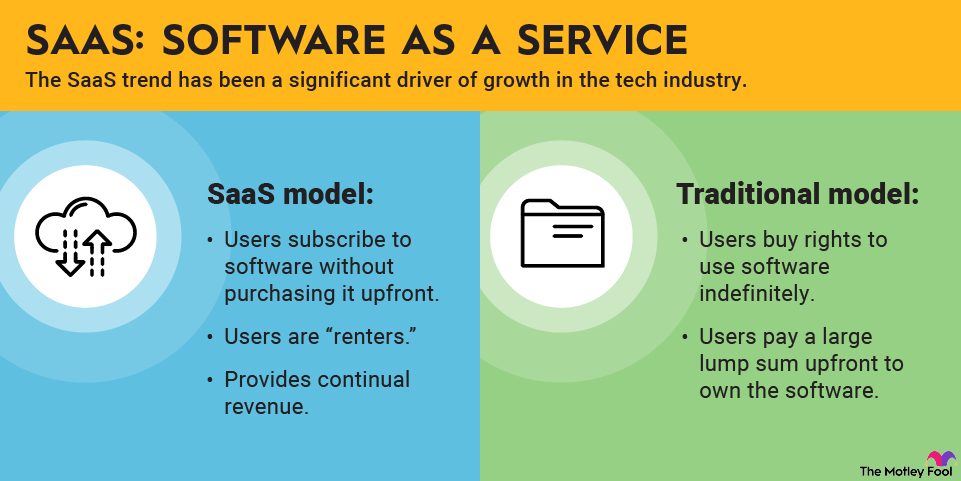
For companies offering software-as-a-service (SaaS), like Alarm.com, investors will want to see that the company has achieved a high SaaS revenue retention rate, indicating that customers are happy with the company's offerings and are maintaining their relationships. Similarly, investors will want to look for companies that report strong ARR, such as Samsara does as another green flag.
Perhaps the most favorable quality for investors to see in IoT stocks is strong free cash flow. Since many IoT companies don't require consistently hefty capital expenditures, they're far more capable of generating free cash flow than companies in other industries. While Intel hasn't generated positive free cash flow recently, it's worth remembering that the company's IoT exposure is far less than some of the other companies on this list.
Future of the IoT industry
For those questioning whether there's much growth opportunity left for companies specializing in the IoT, the answer is a resounding Yes. According to research from business intelligence provider IoT Analytics, the number of connected devices totaled about 21 billion at the end of 2025 and is expected to soar to 39 billion in 2030, representing a 13.2% CAGR.
Unsurprisingly, perhaps the greatest tailwind for the IoT right now is AI. From the increasingly advanced ability of generative AI to aggregate data that IoT devices produce and present it to users in a simplified manner to the advantages of using AI in edge computing, the growth potential for the IoT is substantial.