Insurance stocks are publicly traded securities that represent ownership interests in insurance companies.
Insurance stocks can make a great addition to any investor’s stock portfolio. Not only does the insurance business have the potential to deliver excellent long-term returns, but it’s also a business that performs well in good times and bad.
With that in mind, here’s an overview of how the insurance business works, some important concepts to know, and three insurance stocks that investors should keep on their radar in 2026 and beyond.

Three top insurance stocks for 2026
1. MetLife

NYSE: MET
Key Data Points
MetLife (MET +0.42%) is a great option for investors seeking insurance exposure with low volatility. It’s the largest U.S. life insurer, and it also has a huge retirement solutions business.
MetLife has a straightforward business model and a history of generating strong returns on equity. For context, it has produced a 78% total return for investors over the past five years (about 12% annualized). Additionally, the company offers one of the highest dividend yields among its peer group, which can significantly enhance total returns over time.
2. Markel

NYSE: KNSL
Key Data Points
Kinsale Capital Group (KNSL +0.55%) could be a great insurance stock for investors who want something a bit more exciting than a large, long-established insurance company.
If you aren't familiar with the company, Kinsale is the only pure-play specialty insurance company (in insurance terms, excess and surplus) in the market. This means the company specializes in assessing high-risk situations and complex challenges. For example, if you wanted to open a high-risk business like a demolition company, you would probably need a specialty insurer like Kinsale.
Specialty insurance is a difficult business, but there is a lot of money to be made if you're good at it -- and Kinsale definitely is. The average company in Kinsale's peer group has generated an 8.3% underwriting profit margin over the past three years, and Kinsale's was about three times that.

Warren Buffett chose the insurance industry as the backbone of his empire.
How insurance companies make money
One of the most important things to understand before buying any stock is how the company makes its money. This may seem simple, but it’s frequently misunderstood in the insurance industry.
The most obvious way insurance companies can generate revenue is by selling insurance policies and collecting premiums that exceed the amount paid out in claims. This is known as an underwriting profit.
The second, and more important, way insurance companies make money is by investing the money they take in before it is paid out for claims. This money is known as the float. Most insurers invest their float in safe places, such as high-quality bonds, but some choose to be a little more adventurous and buy other types of investments (like Markel does).
Obviously, this is a simplified explanation. Insurance companies have alternative ways to generate revenue, and two of the companies discussed in this article also have substantial non-insurance operations. However, this is the primary concept behind how the business operates.
Three important metrics for insurance investors to know
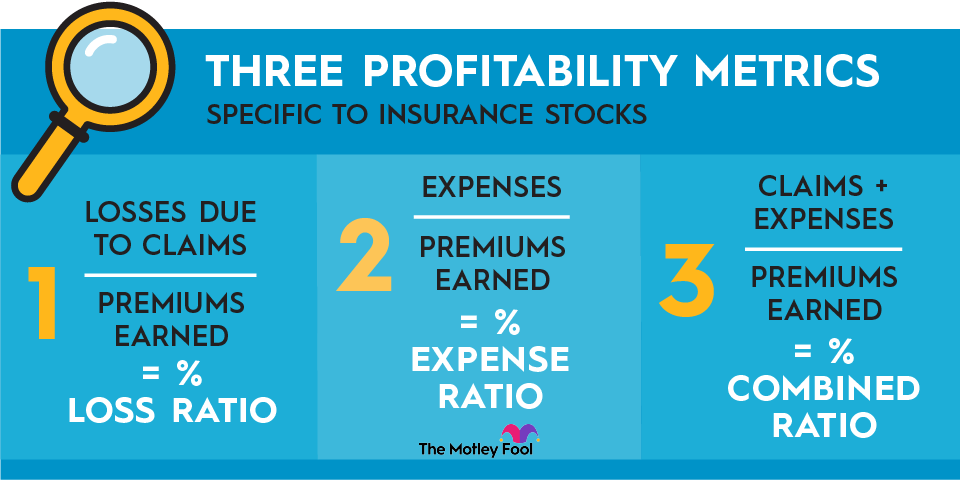
To analyze insurance stocks, most standard metrics work, such as return on equity (ROE) and net margin. However, there are three insurance-specific profitability metrics that you should know before getting started:
- Loss ratio: This is the percentage of an insurer’s premiums paid out as claims. For example, if an insurer collects $100 million in premiums and pays out $70 million for claims, the insurer has a loss ratio of 70%.
- Expense ratio: This is the percentage of premiums that an insurer spends to run its business. For example, expenses might include employee salaries and office equipment. An insurer with $100 million in collected premiums and $20 million in expenses would have an expense ratio of 20%.
- Combined ratio: The sum of the loss ratio and the expense ratio. An insurer with $100 million in premiums and $90 million in losses and expenses would have a combined ratio of 90%. A combined ratio of less than 100% shows an underwriting profit and is a sign of good risk management.
Types of insurers
Like most industries, insurance companies can be divided into subcategories, so here’s a quick explanation of the main types of insurers and what they do:
- Property and casualty: Property and casualty (P&C) insurers write insurance policies that cover property damage and provide liability protection. Auto and homeowners insurance are two common forms. Renters insurance and pet insurance are two other common examples. P&C insurance is typically the easiest type to understand and analyze, especially for beginners.
- Life: Life insurance provides money to a designated beneficiary upon the death of the insured person.
- Health: As the name implies, health insurance helps cover healthcare expenses for the insured. Health insurance products vary significantly in type and scope, and they have their own unique risks, particularly in terms of regulatory issues.
- Specialty: Specialty insurance, also known as the excess and surplus (E&S) lines, includes anything that cannot be covered by a standard insurance company. This includes difficult-to-assess situations and high-risk versions of other types of insurance. For example, liability insurance for a demolition business could fall under the category of specialty insurance.
- Reinsurance: Insurance for insurance companies. To protect themselves against catastrophic losses, insurers often purchase reinsurance policies that cover losses above a certain threshold. This can be extremely important in the event of natural disasters or mass-casualty incidents.
Benefits and risks of investing in insurance stocks
Insurance stocks can be a great way to build wealth over time without excessive risk. Since insurance companies generate revenue not only from profitable underwriting but also from investments, they can be excellent total return investments. This is especially true with companies like Markel, which branches out into stock and venture capital investing with its float.
Of course, there's no such thing as a risk-free stock investment, and insurance stocks aren't an exception. By nature, insurance has an element of unpredictability -- after all, the definition of insurance is transferring risk from one party (customers) to another (the insurance company). For example, if a particularly severe natural disaster occurs, it can be potentially devastating to insurance company profits.
How to invest in insurance stocks
The process of investing in insurance stocks is pretty straightforward:
- Open your brokerage app: Log in to your brokerage account where you handle your investments.
- Search for the stock: Enter the ticker or company name into the search bar to bring up the stock's trading page.
- Determine the number of shares to purchase: Consider your investment objectives and the percentage of your portfolio you wish to allocate to this stock.
- Select order type: Choose between a market order to buy at the current price or a limit order to specify the maximum price you're willing to pay.
- Submit your order: Confirm the details and submit your buy order.
- Review your purchase: Check your portfolio to ensure your order was filled as expected and adjust your investment strategy accordingly.
Future outlook for insurance companies
One big trend we're seeing in insurance is the rapid evolution in technology. Telematics in the auto insurance industry is a good example. You may be familiar with the devices that some insurance companies send to their customers, which plug directly into your vehicle and record driving behavior and relevant data. Not only can using a telematics device help you qualify for a discount if you're a safe driver, but it can also provide valuable driver data to help the insurance company underwrite more efficiently.
We're also seeing a big trend of artificial intelligence (AI) being incorporated into insurance businesses. AI can be used to help process claims, detect fraud, approve new policies, and improve efficiency.
Related investing topics
A recession-resistant business with excellent return potential
Insurance companies have highly attractive economics. Other people give them money to hold until a claim needs to be paid, and the insurer can invest it for its own benefit in the meantime. This is why Warren Buffett is so attracted to insurance and chose it as the backbone of Berkshire Hathaway’s empire.
Insurance is a recession-resistant business as well. During tough times, people still need to maintain auto and homeowners coverage, for example. In short, insurance is a business that can produce excellent long-term returns without too much volatility.
FAQ
Insurance stock FAQ
About the Author