As an increasing number of everyday objects, such as lights, televisions, major appliances, cars, and even doorbells, are brought online, Internet of Things (IoT) stocks are attracting a growing number of investors. According to Horowitz Research, for example, 48% of U.S. homes have at least one smart device.
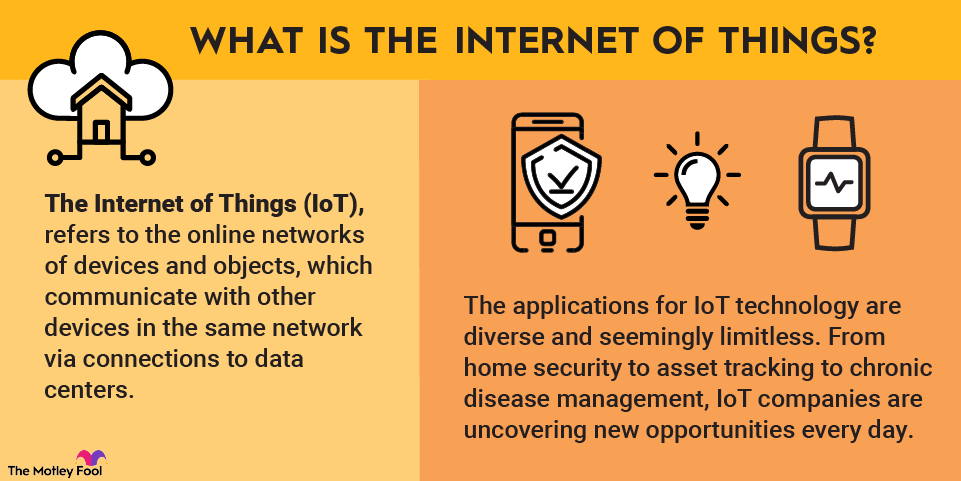
While it may sound complicated, the IoT simply refers to the networks of devices and objects that communicate with other devices in the same network via connections to data centers.

Best IoT stocks in 2026
These six top IoT stocks range from a diversified tech giant to a pure-play IoT company.
| Name and ticker | Market cap | Dividend yield | Industry |
|---|---|---|---|
| Cisco Systems (NASDAQ:CSCO) | $326.3 billion | 2.00% | Communications Equipment |
| Alarm.com (NASDAQ:ALRM) | $2.2 billion | 0.00% | Software |
| DexCom (NASDAQ:DXCM) | $24.2 billion | 0.00% | Healthcare Equipment and Supplies |
| Impinj (NASDAQ:PI) | $3.2 billion | 0.00% | Semiconductors and Semiconductor Equipment |
| Intel (NASDAQ:INTC) | $320.4 billion | 0.00% | Semiconductors and Semiconductor Equipment |
| Samsara (NYSE:IOT) | $15.4 billion | 0.00% | Software |
1. Cisco Systems

NASDAQ: CSCO
Key Data Points
Cisco Systems (CSCO +0.33%) is the leading provider of enterprise networking hardware. Because its products form the backbone of the internet, the tech giant benefits from the explosion of internet-enabled devices. On the software side, the company provides the Cisco Edge Intelligence platform and other tools for managing IoT data and devices.
One of the largest cybersecurity companies. Cisco offers hardware, software, and services to secure networks against threats, including those targeting IoT systems.
Cisco is a low-risk way of investing in IoT. The company is supremely profitable, having generated earnings per share (EPS) of $2.61 on revenue of $56.7 billion in fiscal 2025, and it projects fiscal 2026 revenue and EPS of about $61.5 billion and $3.04, respectively. And it's not only on the income statement that Cisco shines. In fiscal 2025, Cisco generated about $13.3 billion in free cash flow.
Investing in the stock is a good way to gain exposure to IoT without taking on significant risk. Cisco remains dominant as ever and is poised to benefit from the growth of the IoT market.
2. Alarm.com

NASDAQ: ALRM
Key Data Points
Revenue
Management recognizes ample growth opportunities, identifying more than 500 million serviceable properties. Since only a small fraction of homes are currently using Alarm.com's platform, the IoT company has a long growth runway.
3. DexCom

NASDAQ: DXCM
Key Data Points
The Internet of Things goes far beyond consumer devices. DexCom (DXCM -0.27%) focuses on medical devices that continuously monitor glucose levels for diabetics. The company's G7 system delivers real-time data to smartphones and smartwatches without the need for finger sticks.
The number of people in the U.S. with diagnosed diabetes grew from 1.58 million in 1958 to 23.35 million in 2015. In 2023, the estimated total of individuals with diagnosed or undiagnosed diabetes in the United States reached 40.1 million.
The combination of rising diabetes rates and the transition to continuous glucose monitoring will create significant growth opportunities for DexCom in the coming years.
The company booked revenue of nearly $4.7 billion in 2025, a 16% increase over 2024, and management projects continued growth in 2026, forecasting 2026 sales of about $5.16 billion to $5.25 billion. With respect to profitability, Dexcom projects an adjusted gross profit margin of 63% to 64% and an adjusted operating margin of 22% to 23% for 2026.
For those interested in exposure to both IoT and healthcare, DexCom is a stock to consider.
4. Impinj

NASDAQ: PI
Key Data Points
Impinj (PI +1.56%) specializes in solutions involving radio-frequency identification, or RFID. Impinj's RFID tags are used by retailers, manufacturers, and logistics companies to track inventory and assets.
The market for RFID products, including tags, readers, software, and services, was worth nearly $14.6 billion in 2025, according to Markets and Markets, and it's expected to grow at a CAGR of 8.5% through 2034.
After a rough period during the COVID-19 pandemic, partly due to retail store closures, Impinj has roared back. Sales soared from $190.3 million in 2021 to $361.1 million in 2025. The company is growing profits, too. In 2025, Impinj reported adjusted EBITDA of $69.6 million, up from $65.9 million in 2024.
Impinj estimates that just 0.5% of connectable items are connected today. In the long run, trillions of consumable objects could be tracked using RFID technology. Each RFID endpoint costs only pennies, making the technology economical for a wide array of uses.
The company is far from a sure thing as an investment, but it's one to watch in the IoT space.
5. Intel

NASDAQ: INTC
Key Data Points
IoT isn't Intel's (INTC -2.21%) core market, but the semiconductor giant's data center chips power the cloud data centers that link IoT devices. Despite rising competition, Intel still dominates the data center CPU market.
Beyond powerful chips crunching data in the cloud, Intel also sells edge computing chips with built-in AI for IoT applications that can operate in harsh, rugged conditions.
In 2015, Intel acquired Altera to expand its exposure to the IoT. In April 2025, the company sold a 51% stake in Altera, retaining the remaining 49%.
Intel also owns a majority stake in Mobileye (MBLY +2.01%), a leading developer of autonomous driving and advanced driver assistance systems. There are more than 1 billion cars on the road globally, and the fleet will become smarter and more connected.
With its sizable investments in expanding manufacturing capacity and developing its own foundry business, Intel can further tap into the growing demand for IoT devices by manufacturing the chips other companies need.
Intel isn't a pure-play IoT stock, but it has multiple ways to benefit from IoT industry growth.
Semiconductor
6. Samsara

NYSE: IOT
Key Data Points
Related investing topics
FAQ
Internet of Things Stocks FAQ
About the Author
Scott Levine has no position in any of the stocks mentioned. The Motley Fool has positions in and recommends Cisco Systems and Intel. The Motley Fool recommends Alarm.com, DexCom, Impinj, Mobileye Global, and Samsara and recommends the following options: long January 2027 $65 calls on DexCom, short February 2026 $9 puts on Mobileye Global, and short January 2027 $75 calls on DexCom. The Motley Fool has a disclosure policy.