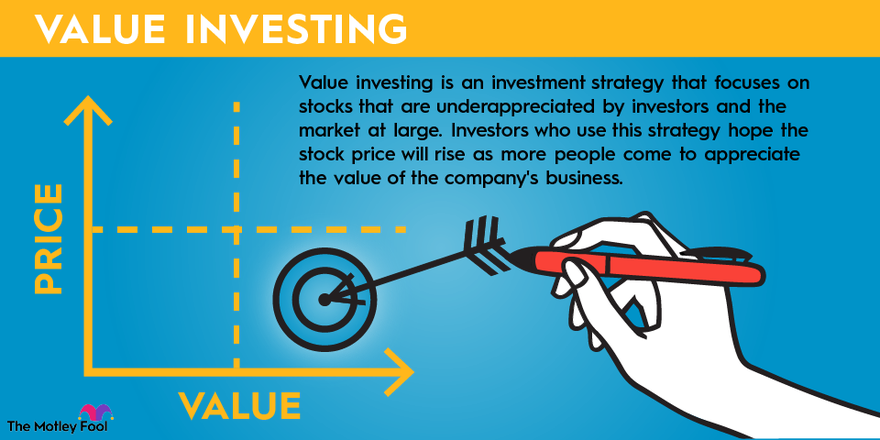
Value investing is one of the oldest and most proven strategies in investing. The idea is simple: find companies the market has mispriced, buy them at a discount, and wait.
The hard part is doing it well.

Where it came from
Value investing traces back to Benjamin Graham and David Dodd, two Columbia University professors who began teaching a framework for rational, research-driven investing in 1928. Their book Security Analysis, published in 1934, laid the intellectual foundation for the strategy. Graham's follow-up, The Intelligent Investor (1949), remains one of the most influential investing books ever written.
Graham's most famous student was Warren Buffett, who used the strategy to build Berkshire Hathaway into one of the most successful companies in history, nearly doubling the S&P 500's annualized return over more than 55 years. Buffett's own thinking evolved beyond pure Graham-style value investing over time. Rather than simply hunting for cheap stocks, he came to favor high-quality businesses at fair prices: "It's far better to buy a wonderful company at a fair price than a fair company at a wonderful price."
That evolution is worth keeping in mind as you develop your own approach.
The core idea: intrinsic value and margin of safety
Every value investor is trying to answer the same question: what is this business actually worth? That's the intrinsic value, an estimate of the company's true worth based on its assets, earnings power, and future cash flows, independent of what the market says today.
The gap between intrinsic value and current stock price is the margin of safety. If a stock is worth $100 and trades at $80, the margin of safety is 20%. The larger that cushion, the more room you have to be wrong about your estimates and still come out ahead.
Most value investors target a margin of safety of at least 20–30%. It's not just about upside, it's about protecting against downside when things don't go as planned.
How to find value stocks
Value investors often begin their search with a stock screener. Stock screeners return a list of public companies that meet set criteria, such as:
- Maximum P/E ratio. P/E ratios vary dramatically by industry, but many value investors like to see this number below 15 or 20.
- Maximum P/B ratio. A P/B ratio below 1 can indicate the company is undervalued, but this number should not be analyzed in isolation. A low P/B ratio could also result from a fundamental problem with the business.
- Minimum ROE. Return on equity (ROE) indicates how well the company produces returns from its net assets. This metric is also industry-dependent, with higher values indicating better performance.
- Minimum dividend yield. Dividends provide some certainty in returns. The minimum dividend yield an investor requires is a personal decision. Often, value investors will target a range of yields that is higher than the average market yield but not so high as to be unsustainable.
- Five-year EPS growth outlook. Value stocks that are expected to grow their earnings per share (EPS) are more likely to gain investors' attention and support.
- PEG ratio. The price-to-earnings-to-growth (PEG) ratio is calculated by dividing the stock's P/E ratio by its expected EPS growth rate. Near or less than 1 is a preferred value here.
Once you have a list of candidates, the real work begins: estimating each company's intrinsic value and comparing it to the current stock price. Popular methods include discounted cash flow (DCF) analysis and peer comparisons using the ratios above. Expect to run through a lot of stocks before finding one that clears your margin of safety threshold.
Avoiding value traps
A value trap is a stock that looks cheap on the surface but is priced fairly, given the company's ability to create value.
Here are two situations to watch for:
- Cyclical stocks: Companies in manufacturing, construction, and similar industries earn a lot during boom times and much less during downturns. When investors anticipate a bust, the stock's valuation looks cheap relative to recent peak earnings. It may not look cheap at all once earnings normalize.
- Companies relying on expiring intellectual property: A drug company with a blockbuster treatment loses a significant chunk of revenue when patent protection expires, unless there's a strong pipeline behind it. The same dynamic can hit tech companies that were first movers in a category but have stopped innovating.
Value traps have weak growth outlooks in the short or intermediate term. To avoid them, include a review of EPS outlooks and PEG ratios in your analyses. These items address the company's future, while other valuation metrics, such as the standard P/E ratio, only measure the company's past performance.
Growth vs. value investing
Value and growth investing are often framed as opposites, but the real difference is in what you're paying for.
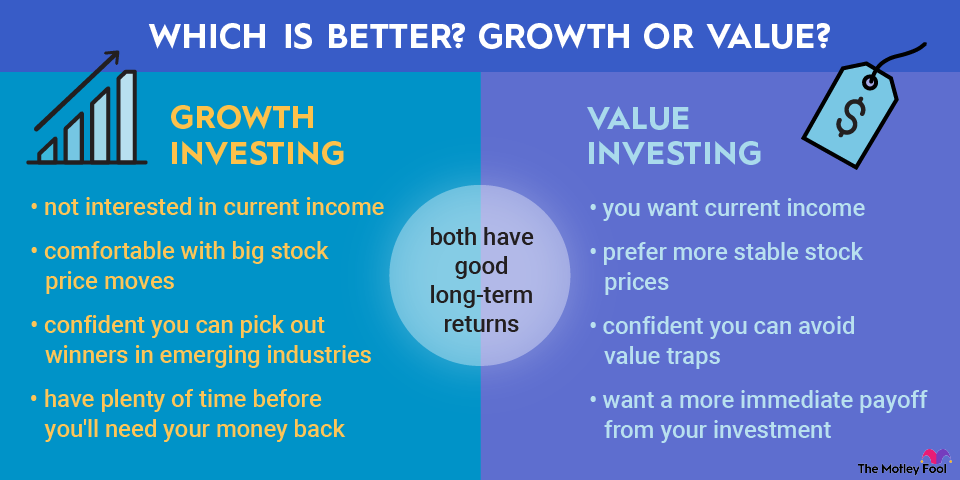
Value investors pay for what a company is today -- stable earnings, assets, cash flow -- and wait for the market to recognize it. Growth investors pay for what a company could become, accepting higher valuations in exchange for the possibility of faster appreciation.
In practice: value stocks tend to be mature businesses with lower P/E ratios, steadier earnings, and dividends. Growth stocks tend to have high P/E ratios, reinvest earnings rather than paying dividends, and carry more volatility in both directions.
Neither strategy is universally better. Growth stocks tend to outperform in bull markets; value stocks tend to hold up better when markets turn. Many investors hold both.

Is value investing right for you?
If your primary investing goal is to keep your risk of permanent losses low while increasing your odds of generating positive returns, you may be a value investor at heart. Know that value investing requires resilience. The value-finding process eliminates far more stocks than it uncovers, and this can be frustrating, particularly during bull markets.
Many stocks you eliminate during your search will appreciate in bull markets, even though you found them too expensive at the start. The payback comes when the bull market ends. That's when your margin of safety protects you from the most extreme value losses. The dividend income you earn from value stocks also encourages you to stay invested through downturns, keeping you in contention for recovery gains.
By contrast, if you prefer trading the hottest companies in the market, you may be bored by value investing. Value stocks are not trendy. They may not even be interesting in terms of their business model.