Dividends are payments companies make to their shareholders. If you receive a dividend, you'll most likely have to pay taxes on it. But how much you pay in taxes will depend on whether the payout is a qualified or a nonqualified dividend.
The difference can be substantial. Depending on a few factors, many nonqualified dividends are taxed at your marginal tax rate, which could be as much as 37%. A qualified dividend is a dividend that meets a series of criteria that results in a lower long-term capital gains tax rate or no tax at all for some investors.
The potential tax-saving implications can be enormous. A qualified dividend may result in significantly more money remaining in your pocket than a nonqualified dividend. Keep reading to learn more about a critically important topic every dividend investor should understand.
Qualified dividend requirements
For a dividend to be considered qualified, it must meet certain requirements. These include:
- It was paid either by a U.S. corporation or by a qualified foreign corporation. (Foreign corporations qualify if they are incorporated in a U.S. possession, are located in a nation covered by an income tax treaty with the U.S., or their stock is readily tradable in the U.S. securities market.)
- It was a regular dividend and not capital gains distributions, dividends from tax-exempt organizations, or payments in lieu of dividends. Ordinary dividends are shown in Box 1a of the Form 1099-DIV tax document that each company sends out.
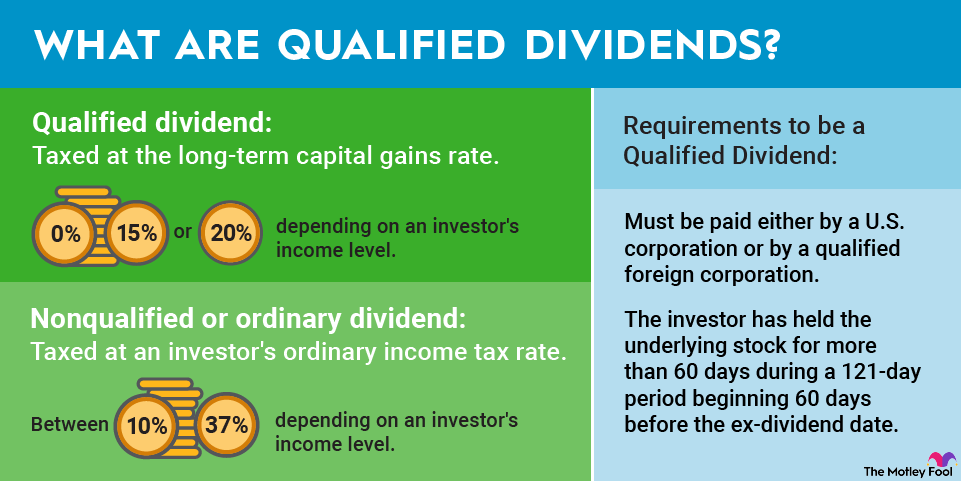
- The investor held the underlying stock for more than 60 days during a 121-day period beginning 60 days before the ex-dividend date.
It's important to note that being a corporation is a requirement for qualified dividends. Not all U.S. companies are corporations. For example, real estate investment trusts (REITs) and master limited partnerships (MLPs) are not structured as corporations for tax purposes. Because of that, they pay nonqualified dividends.
In summary, a qualified dividend is always a regular dividend, but a regular dividend isn't always a qualified dividend. Why does this matter? Because there are a number of dividends and distributions that are not regular dividends that may have different tax implications.
Why qualified dividends can be advantageous
The biggest advantage of qualified dividends is that they qualify for the lower long-term capital gains tax rate.
As previously noted, the difference in the tax burden can be substantial. For example, let's say you're in the 28% income tax bracket, and you received $2,000 in dividends this year. If these dividends were qualified dividends, you'd pay taxes at a rate of 15%, which would come to $300. However, if these were nonqualified ordinary dividends, you'd pay taxes on them at a 28% rate -- producing a tax bill of $560. In short, owning stocks that pay qualified dividends could cut your taxes on those dividends almost in half.
We see a similar impact for those in lower tax brackets. For example, if you made less than $40,400 in 2021 (or $80,800 for those married and filing jointly), you wouldn't have to pay any taxes on qualified dividend income. However, you'd have to pay a 10% to 12% tax on nonqualified dividends. So, if you received $2,000 in dividends in 2021, you wouldn't pay any tax if they were qualified dividends. However, you'd pay $200 to $240, depending on your income level, if they were nonqualified dividends.
Taking advantage of the rules to do what already works best
Earning dividend income is an excellent way to build long-term wealth. It rewards the patient investor who's willing and able to buy stocks in great companies and to keep holding them while getting paid as those businesses get bigger and stronger. Simply put, buying great businesses and then sitting on your hands works great for dividend investing.
Smart tax planning should play a big role in how you optimize your results. That includes taking advantage of tax-deferred accounts, such as an IRA, or tax-free accounts, such as a Roth IRA, that can help you avoid almost all taxes, even on most dividend income.
But when you're investing in a taxable account, the tax man cometh every year. So, focusing your dividend stock portfolio toward stocks that pay a qualified dividend can make a big difference in how much wealth you can build -- and retain -- before you're ready to start enjoying the fruits of your investing labors.
Related dividend stocks topics
Ordinary vs. qualified dividends: What's the difference?
Put simply, a qualified dividend qualifies that payment for a lower dividend tax rate. Meanwhile, nonqualified or ordinary dividends get taxed at an investor's ordinary income tax rate. The difference can be significant:
- Qualified dividend: Taxed at the long-term capital gains rate, which is 0%, 15% or 20%, depending on an investor's income level.
- Nonqualified or ordinary dividend: Taxed at an investor's ordinary income tax rate, which can range between 10% and 37%, depending on income level.
However, it's important to note that investors only pay taxes on dividends paid by stocks held directly or in a regular brokerage account. Dividends paid by stocks held in a tax-advantaged account such as an IRA aren't taxable in the year paid. Consequently, it often makes sense to hold dividend-paying stocks -- especially shares of companies paying nonqualified dividends -- in a tax-advantaged account to avoid paying taxes on the payments altogether.
Example of qualified dividends
For an example of a qualified dividend in action, let's take a look at the payout of tech giant Apple (AAPL -0.35%). In 2021, the U.S. corporation made regular quarterly dividend payments of $0.22 per share to its investors. Because it's a U.S. company and paid regular cash dividends, Apple's dividend qualifies for a lower tax rate. The only factor that would disqualify Apple's dividend from a lower tax rate is if the investor didn't meet the required holding period for Apple's shares.
Another example of a qualified dividend is the one paid by energy infrastructure giant Enbridge (ENB +0.76%). In 2021, the Canadian corporation, which trades on the New York Stock Exchange, paid out $3.34 Canadian dollars (approximately $2.62 to U.S. investors) per share in dividends. Even though it's a foreign company, Enbridge's dividend qualifies for a lower tax rate for U.S. citizens as long as they met the holding period requirement.
About the Author