Self-directed Roth IRA rules
The main advantages of a self-directed Roth IRA are that you have control over the investments in the account, and you have many more investment options than you get with a standard Roth IRA. You'll be subject to the same IRS-provided income limits (using modified adjusted gross income, or MAGI) and annual contribution maximums.
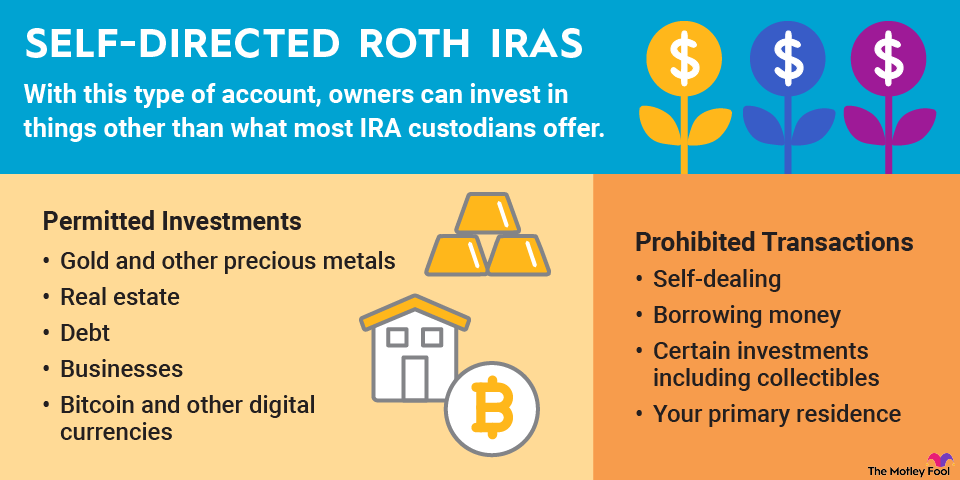
Here’s a list of permitted investments that extend beyond the traditional investment menu.
Gold and other precious metals
Physical gold and precious metals are popular investments for self-directed Roth IRAs. Precious metals are often used by investors to diversify their holdings and preserve wealth, regardless of the state of the economy. Gold is often cited as a common hedge against inflation.
Real estate
Self-directed Roth IRA account holders can buy investment properties through their IRA. However, there are lots of rules to abide by.
First, you can't buy property you intend to live in either full-time or part-time. Also, the process can be complicated and time-consuming, as you must ensure that you don't mix personal and IRA funds with a real estate investment. All expenses, taxes, and insurance for the investment property must be paid from the IRA.
Debt
Through a self-directed Roth IRA, it is possible to purchase a variety of debt instruments. Tax liens are one popular example. You can also purchase loans (or an interest in a loan) through debt-investing platforms.
Businesses
You can invest in businesses within a self-directed Roth IRA, either in their entirety or in part. For example, if you want to use your self-directed IRA to buy a convenience store, you can do that. However, there are several rules governing the ownership of businesses in self-directed IRAs, so it's a good idea to reach out to a professional financial planner before you get started.
Bitcoin and other cryptocurrencies
Cryptocurrencies like Bitcoin (BTC -0.87%) are still relatively new investments, and they're often predicted to play a central role in a digitized financial future. Like the other items here, cryptocurrencies can further diversify retirement assets.
Since cryptocurrencies are considered capital assets, they're subject to capital gains taxes when sold at a profit, so holding them in a tax-advantaged account can make a lot of sense. Reputable self-directed IRA custodians also provide secure digital currency storage.
Prohibited transactions
Certain types of investments and transactions are prohibited under the rules governing self-directed Roth IRAs.
Self-dealing
Self-dealing refers to conducting business with yourself -- that is, buying assets from, or selling them to, your own IRA. Self-dealing prohibitions apply not just to you as an individual but to all "disqualifying persons," which include your spouse, your beneficiaries, or your business.
A prohibition against self-dealing is in place to prevent fraudulent transfers, which are often conducted to evade taxes. It also limits the temptation to initiate transactions that may appear legitimate but have no underlying economic substance.
Borrowing money
You are not permitted to borrow money from your self-directed Roth IRA, or any IRA for that matter. Borrowing money is also a form of self-dealing in that, by borrowing from your IRA, you're essentially conducting business with yourself.
There is a loophole, known as the 60-day rollover rule. You can make a withdrawal from an IRA, including a self-directed Roth IRA, if you redeposit the entire amount in a qualified retirement account within 60 days. The retirement account could be a new account or the same account from which you withdrew the money. This effectively allows for a short-term IRA loan, but you can only do one IRA rollover per 12-month period.
Certain investments
Collectibles and life insurance are the two primary types of prohibited investments for a self-directed IRA. Collectibles include art investments, antiques, jewelry, stamps, and most other items the IRS deems to be collectible.
Life insurance offers contracted protection for those who depend on your income. Due to its very nature, life insurance is not appropriate for a self-directed IRA.
Other prohibited investments include complex derivatives and shares of S corporations.
Your primary residence
As noted above, your self-directed Roth IRA is not the place to hold your home. This gives the appearance of self-dealing, and you're also not allowed to live in a property owned by your self-directed Roth IRA
Is a self-directed Roth IRA right for you?
A self-directed Roth IRA may be right for you if you're knowledgeable about alternative investments and want to use them as part of a well-rounded retirement strategy.
This type of IRA has its pros and cons, and it's definitely not for everyone. Alternative investments can be risky, so it's essential to have a thorough understanding of them before investing any money. Most people are better off sticking to a standard Roth IRA, but a self-directed Roth IRA can be a valuable tool for some investors.