Last year, shares of space exploration company Rocket Lab (RKLB 1.50%) soared by 174% -- making it one of the standout stocks on the Nasdaq Composite.
While this type of momentum may seem overpronounced, Rocket Lab's rally was validated by an improving financial profile and changing perception of the company's business model.
Let's dig into Rocket Lab's milestone 2025 and assess what could be in store for this year. While the company remains one of the hottest growth stocks outside of artificial intelligence (AI), smart investors understand that nothing goes up in a straight line forever.

Image source: Getty Images.
Rocket Lab had an impressive 2025
Rocket Lab is not just a launch business. The company operates across various aspects of the space value chain, including designing services and manufacturing spacecraft components. While the space economy remains a relatively niche market, Rocket Lab's diversified business model is gaining traction.
Through the first nine months of 2025, the company generated $422 million in revenue -- representing an increase of 39% year over year. In addition, Rocket Lab's gross profit has nearly doubled -- growing from $79 million to $140 million as of the third quarter.
On top of that, the company's backlog of $510 million has grown by 56% over the last year -- providing Rocket Lab with much-needed revenue and cost planning visibility.
The one slight blemish on the company's financial profile is profitability. Launching and designing rockets and satellites is extremely capital-intensive and time-consuming. Given the lag between Rocket Lab building its products, winning contracts, and actually recognizing revenue, it's not surprising to learn the company remains unprofitable.
Nevertheless, during the third quarter, Rocket Lab reported a narrower loss per share of ($0.03) compared to ($0.10) during the same period in 2024.

NASDAQ: RKLB
Key Data Points
What caused Rocket Lab stock to soar last year?
Given the company's improving financial profile and ability to secure additional contracts across the public and private sectors, Rocket Lab's rising valuation could suggest that more investors are beginning to buy into the broader space exploration thesis.
As it pertains to Rocket Lab specifically, I think "smart money" is starting to see Rocket Lab as a vertically integrated player fueling space infrastructure -- touching everything from rocket launches, satellite components, and specialized manufacturing. In essence, Rocket Lab sits at a unique intersection of aerospace, defense contracting, and private sector space exploration.
Outside of its business results, however, sits another tangential catalyst for Rocket Lab. Potentially the most obvious, or at least most cited, comparable business to Rocket Lab is Elon Musk's SpaceX.
At the end of 2024, SpaceX was valued at $350 billion. However, in July, the company completed a tender offer that valued SpaceX at a reported $400 billion. Just months later, SpaceX subsequently completed a secondary sale that pushed the company's valuation to $800 billion. Notably, these deals took place as rumors swirled about a potential SpaceX IPO in 2026.
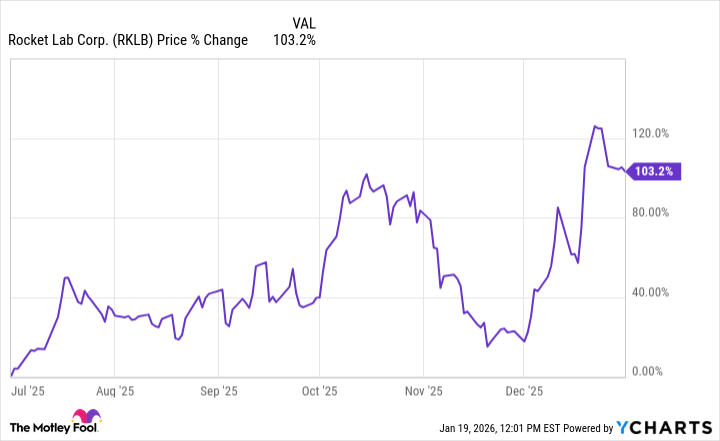
Between SpaceX's two transactions, shares of Rocket Lab soared 103%. Now, to be clear, I'm not saying that the news around SpaceX fueled some sort of meme-induced rally in Rocket Lab stock.
What I am saying, though, is that SpaceX's popularity could, in some ways, validate the highly speculative commercial space market. In turn, Rocket Lab began attracting additional capital in hopes of finding the "next SpaceX."
Is Rocket Lab a good buy for 2026?
So here's the big question: Why am I anticipating Rocket Lab will return from orbit in 2026?
It all has to do with a recent interview I watched. There is a popular business podcast on YouTube called All-In, which features four entrepreneurs and Silicon Valley veterans. One of them is a former employee of both AOL and Facebook (now Meta Platforms), named Chamath Palihapitiya.
During a recent episode, Palihapitiya revealed that his contrarian investment idea for 2026 is that SpaceX will not go public. Instead, he thinks the company will reverse merge into Tesla.
First thing's first -- do not get overwhelmed by the term "reverse merger," it's just fancy finance jargon. Essentially, a reverse merger allows a private company to go public by merging with an existing public company rather than going through the traditional IPO underwriting process.
What Chamath is explaining here is really nuanced. He's not suggesting that SpaceX won't go public. He's saying that the company will merge with Tesla, creating a giant holding company for Musk's two most influential creations.
In my opinion, Palihapitiya could be spot-on here. Musk has long refrained from taking SpaceX public. In fact, the serial entrepreneur has expressed a vision to control Tesla, SpaceX, and xAI under one roof for quite some time -- stitching together his ambitions among sustainable energy, autonomous systems, batteries, AI, and the final frontier.
Should Musk pursue this avenue, Rocket Lab investors don't have anything to worry about. Rocket Lab's business profile is improving, and the company certainly has a lot of catalysts.
If SpaceX does not IPO in 2026, investors could see some waning enthusiasm in adjacent players such as Rocket Lab. This would be purely an emotional reaction, not rooted in business fundamentals.
Against this backdrop, I do not think Rocket Lab stock is a prudent buy given its run-up over the last year. Risk-tolerant investors with a stomach for volatility could consider a position in Rocket Lab. But for those seeking more durable opportunities, I would wait for a pullback in Rocket Lab before buying.