The Nasdaq-100 is an index of the top 100 companies (by value) listed on the Nasdaq stock exchange, excluding banks and financial institutions. The Nasdaq is typically the exchange of choice for small technology companies looking to go public, because it offers lower fees and fewer hurdles compared to alternatives like the New York Stock Exchange.
Many of those companies -- like Nvidia -- have become multitrillion-dollar giants and consistently drive most of the upside in the Nasdaq-100. In fact, the technology sector has grown to account for over 60% of the index.
The Invesco QQQ Trust (QQQ -0.13%) is an exchange-traded fund (ETF) that tracks the performance of the Nasdaq-100 by holding the same stocks. Is it still a buy with the index at record highs?

Image source: Getty Images.
High exposure to the AI boom is a double-edged sword
The Nasdaq-100 technology sector is home to seven out of the 10 American companies worth $1 trillion or more, and each is contributing to the artificial intelligence (AI) boom in some way. Together, they make up a sizable chunk of the Invesco QQQ ETF thanks to their substantial valuations:
|
Stock |
Invesco ETF Portfolio Weighting |
|---|---|
|
1. Nvidia |
8.16% |
|
2. Apple |
7.28% |
|
3. Alphabet |
6.77% |
|
4. Microsoft |
5.32% |
|
5. Micron Technology |
4.80% |
|
6. Broadcom |
3.37% |
|
7. Meta Platforms |
2.97% |
Data source: Invesco. Portfolio weightings are accurate as of May 30, 2026, and are subject to change.
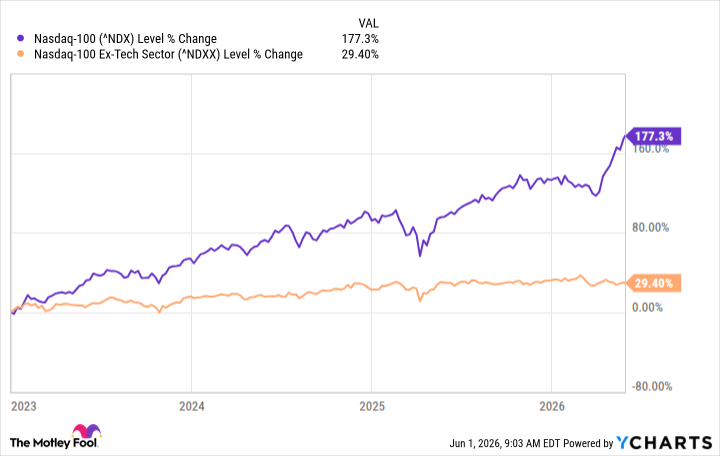
The AI boom started gathering momentum in early 2023, when OpenAI's ChatGPT application surpassed 100 million users. Since then, the Nasdaq-100 has soared by 177% -- but if you exclude the technology sector, that return crashes to just 29%. Therefore, while tech has helped the Nasdaq-100 outperform other indexes like the S&P 500, its reliance on just one sector could lead to weak returns if the AI industry falters.
Data by YCharts.
Semiconductor stocks are leading the charge higher. Nvidia supplies the world's best graphics processing units (GPUs) for data centers, which are the main chips used in AI training and inference workloads. Broadcom competes in that market with its AI accelerators, which can be customized to suit the needs of specific data center clients. Alphabet teamed up with Broadcom to design and manufacture its eighth-generation Tensor Processing Units (TPUs) for AI workloads.
Micron supplies memory, a key component of the AI hardware stack. It stores information in a ready state for when GPUs and accelerators need it, which maximizes processing speeds. There is a severe shortage of high-bandwidth memory for data centers right now, which is driving a surge in the company's revenue and earnings.
Alphabet and Microsoft use AI chips to develop their own software, but they also build centralized data centers and rent the computing capacity to enterprises through their respective cloud platforms. This has become a very lucrative practice because most businesses can't afford to build their own infrastructure, but they still want a ton of computing power to deploy AI. Both Microsoft Azure and Alphabet's Google Cloud delivered accelerating revenue growth in the recent quarter ended March 31.
Time in the market beats timing the market
Investing in the stock market at record highs can be unnerving, because it can feel like the best gains have already been made. However, investors who bought at any record high in the Invesco QQQ ETF since its inception in 1999 eventually made money, even if they jumped in right before the dot-com internet bubble burst in 2000, or ahead of the pandemic crash in 2020, or right before the inflation-driven bear market in 2022. Simply put, time in the market matters more than timing the market.
In fact, the ETF has delivered a compound annual return of 10.6% over the last 27 years, even after accounting for every sell-off, correction, and bear market along the way.
QQQ Invesco QQQ Trust
NASDAQ · As of 4:00 PM ET 10/15/26
That said, certain parts of the tech market are showing bubble-like characteristics right now. For example, Micron stock has surged by over 900% in the last 12 months alone due to the high-bandwidth memory shortage I mentioned earlier. Memory prices will almost definitely normalize as suppliers build more manufacturing capacity over the next couple of years, so the company's recent earnings growth -- which is fueling the gains in its stock -- probably isn't sustainable.
But a future potential correction in the Nasdaq-100 isn't a reason to stay on the sidelines; it just means investors should be strategic about how they enter the market. First, it's important to be diversified by adding the Invesco QQQ ETF to a portfolio of other ETFs that are less exposed to the tech sector. Second, rather than parking all of their investible cash in the Invesco ETF today, investors could scale in with small, consistent monthly purchases, which will allow them to dollar-cost average at lower prices if the Nasdaq takes a tumble.
Technologies like AI will likely deliver strong returns for the Invesco fund over the long term, and many others, such as autonomous vehicles, robotics, and even quantum computing, are also waiting in the wings to become the next big market drivers.