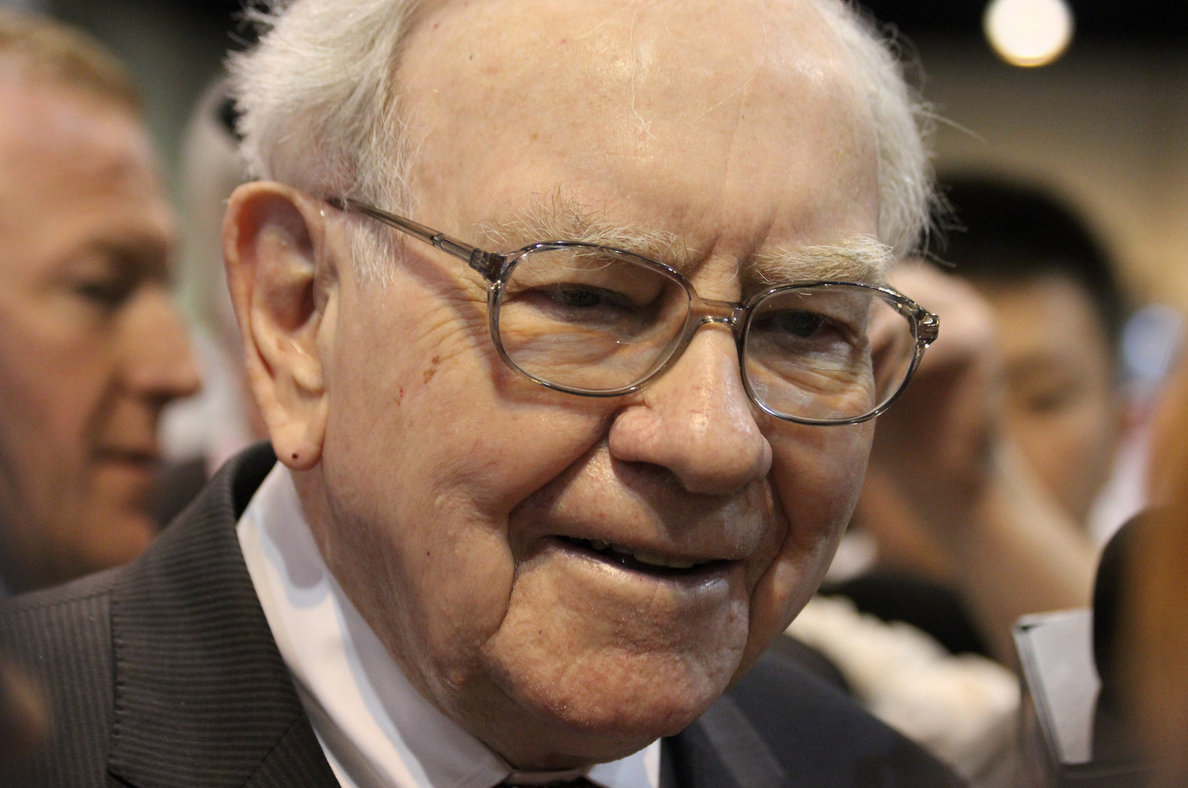
Here's something that might surprise you. If you want to invest like Warren Buffett, you don't need to do anything extraordinary.
In fact, many new investors are surprised at the uncomplicated investment style of the Oracle of Omaha. Buffett invests in great businesses that trade for less than their intrinsic value and holds the investments for as long as they remain great businesses.
Of course, there's a little more to the story than that.
In this article, we'll dig into the investment style of the legendary investor. We'll provide some real-world examples of how he's implemented his investment philosophy and discuss the stocks he does (and doesn’t) invest in.

Warren Buffett's investing philosophy
As you might expect, much of Buffett's investment process is proprietary, so we don't know exactly how he researches investments. However, here are some of the most important Buffett investing principles that you can incorporate into your own investing strategies:
Intrinsic Value
1. Look for a margin of safety.
In simple terms, a margin of safety refers to characteristics of an investment that help to protect investors from losing money.
For example, if a stock trades for $10 per share, but the company's assets are realistically worth $12 per share, that provides a margin of safety. The intrinsic value of the assets should prevent the company's stock price from falling too far. Or if it falls, the stock will become more attractive.
Buffett's goal is always to pay less than a company's intrinsic value.
2. Focus on quality.
Warren Buffett doesn't invest in junk. Early in his career, he often focused on businesses in decline but still with some value. But this changed decades ago.
You typically won't see Buffett buying struggling businesses, regardless of how cheap they become. One of the best Buffett quotes new investors can absorb is, "It’s far better to buy a wonderful company at a fair price than a fair company at a wonderful price."
4. Don't fear market crashes and corrections.
The obvious goal of stock investing is to buy low and sell high, but human nature can compel us to do the exact opposite.
Here's what I mean by that. When we see all our friends and colleagues making money, we feel like we should try to make money, too. We are tempted to invest our money in stocks.
And when stock markets crash, it's our nature to wait it out on the sidelines. So, it's tempting to sell "before things get any worse."
Buffett loves it when stock prices drop since it creates opportunities to buy at a discount. This is why Buffett was extremely active in the stock market in the years immediately following the 2008-09 financial crisis.
Buffett takes advantage of discounts on his favorite stocks. As he says, "Opportunities come infrequently. When it rains gold, put out the bucket, not the thimble."
5. Approach your investments with a long-term mindset.
One of the most important Warren Buffett quotes on investing that you can take in is, "If you aren't willing to own a stock for 10 years, don't even think about owning it for 10 minutes."
He doesn't choose stocks just because he thinks their prices will rise this week, this month, or even this year. Buffett buys stocks because he wants to own those businesses for the long term. To be clear, in practice, Buffett sells stocks frequently, but he approaches most of his investments with the mindset of holding them for the long term.
It's also worth noting that if you can't adopt a "forever" mentality with your stocks, Buffett argues that one of the best investments most people can make is a set-it-and-forget-it investment, such as an S&P 500 index fund.

NYSE: BRKB
Key Data Points
This may not sound too spectacular until you realize that, over time, this has resulted in a 6,099,294% total gain for shareholders versus 46,061% for the S&P 500.
9. Research and reflect.
Although he doesn't have quite the stamina or energy that he once did (he is in his mid-90s, after all), Buffett regularly spent long days in his office in Omaha, Neb., throughout his career.
It often surprises investors to learn that he spent most of his time alone, reading or contemplating investment strategies. He's been quoted as saying, "I insist on a lot of time being spent, almost every day, to just sit and think."
Buffett views knowledge as something that compounds over time, and he believes that much of his success stems from accumulating as much investment knowledge as possible.
What is Berkshire Hathaway?
Berkshire Hathaway is a conglomerate that was formerly a struggling textile manufacturer. Warren Buffett took control of the company in the mid-1960s and soon after started acquiring businesses and common stocks. Today, Berkshire is a $1 trillion company that has three major assets:
- More than 60 subsidiary companies, including Geico, BNSF Railroad, Berkshire Hathaway Energy, Fruit of the Loom, Duracell, and many others.
- A stock portfolio worth about $310 billion as of March 2026, with dozens of individual stock positions.
- Cash -- and lots of it. At the end of 2025, Berkshire had about $373 billion in cash and equivalents on its balance sheet.
Which stocks does Warren Buffett invest in?
The stock portfolio of Berkshire Hathaway is worth hundreds of billions of dollars, and although Buffett stepped down as CEO at the end of 2025, most of the stocks were selected by Buffett himself. Although Berkshire's portfolio comprises approximately 40 positions, almost two-thirds of its value is concentrated in just five stocks. Here's more information about each of these top holdings:
| Name and ticker | Market cap | Dividend yield | Industry |
|---|---|---|---|
| Apple (NASDAQ:AAPL) | $3.8 trillion | 0.40% | Technology Hardware, Storage and Peripherals |
| American Express (NYSE:AXP) | $209.7 billion | 1.07% | Consumer Finance |
| Coca-Cola (NYSE:KO) | $334.6 billion | 2.62% | Beverages |
| Bank of America (NYSE:BAC) | $343.8 billion | 2.30% | Banks |
| Chevron (NYSE:CVX) | $378.0 billion | 3.65% | Oil, Gas and Consumable Fuels |
1. Apple

NASDAQ: AAPL
Key Data Points

NYSE: AXP
Key Data Points
3. Coca-Cola

NYSE: KO
Key Data Points
4. Bank of America

NYSE: BAC
Key Data Points

NYSE: CVX
Key Data Points
Which stocks does Warren Buffett avoid?
Just as important as the types of stocks Warren Buffett invests in is understanding what he doesn't invest in. And there are a few specific categories of stocks Buffett tends to avoid:
- Technology stocks -- There are a few tech stocks in Berkshire's portfolio, but these are generally initiated by one of the other portfolio managers, Ted Weschler and Todd Combs. Buffett admittedly doesn't understand technology as well as other sectors.
- Speculative stocks -- Buffett likes companies that are well-established, have steady cash flows, and are the leaders of their industries (or close to it). He doesn't try to chase the next big thing.
- Micro caps -- Berkshire has a roughly $1 trillion market cap, and its stock portfolio is worth more than $300 billion. Buffett tends to avoid very small companies, not necessarily because he can't find great opportunities, but because, mathematically, they wouldn't be needle-movers for Berkshire even if they performed well.
Related investing topics
What is Warren Buffett's opinion of the stock market?
Warren Buffett has given fewer interviews and public commentary in recent years, but he has occasionally shared his thoughts on the market. Here are some quotes from the past year or so about Buffett's latest thoughts on the market:
In his final letter to Berkshire Hathaway shareholders in November 2025, Buffett cautioned about market volatility but advised investors to stay the course, saying, "Our stock price will move capriciously, occasionally falling 50% or so as has happened three times in 60 years under present management. Don't despair; America will come back, and so will Berkshire shares."
Buffett has often complained in recent years that the U.S. stock market is expensive, but he has still found opportunities elsewhere. In early 2025, he said (about Berkshire's Japanese holdings), "We simply looked at their financial records and were amazed at the low prices of their stocks. As the years have passed, our admiration for these companies has consistently grown."
Should you trade like Warren Buffett?
To be clear, it's not a great idea to buy any specific stock just because a billionaire investor does -- even if that billionaire is Warren Buffett. It's important to make sure a stock is a good fit for your goals, risk tolerance, and your existing portfolio.
Having said that, Buffett's style is one that could certainly be worth replicating. By using some of Buffett's investment principles when evaluating stocks, you can set yourself up for excellent long-term returns while also protecting yourself from excessive downside risk.
FAQ
Warren Buffett strategy FAQ
About the Author
American Express is an advertising partner of Motley Fool Money. Bank of America is an advertising partner of Motley Fool Money. Matt Frankel has positions in American Express, Bank of America, and Berkshire Hathaway. The Motley Fool has positions in and recommends Apple, Bank of America, Berkshire Hathaway, and Chevron. The Motley Fool has a disclosure policy.