Are you up to date with the companies that Alphabet owns? It's all right if the answer is "no." With more than 260 completed acquisitions in April 2025 (including three in the last year alone), it's hard to keep up with this tech giant's wheeling and dealing.
The company, originally called Google, restructured into an umbrella organization named Alphabet (GOOG +1.55%) (GOOGL +1.47%) in 2015 for the explicit purpose of making people more comfortable with new services that don't have much to do with its online search and advertising business. What started as a student project in a Stanford garage has grown into a global empire.
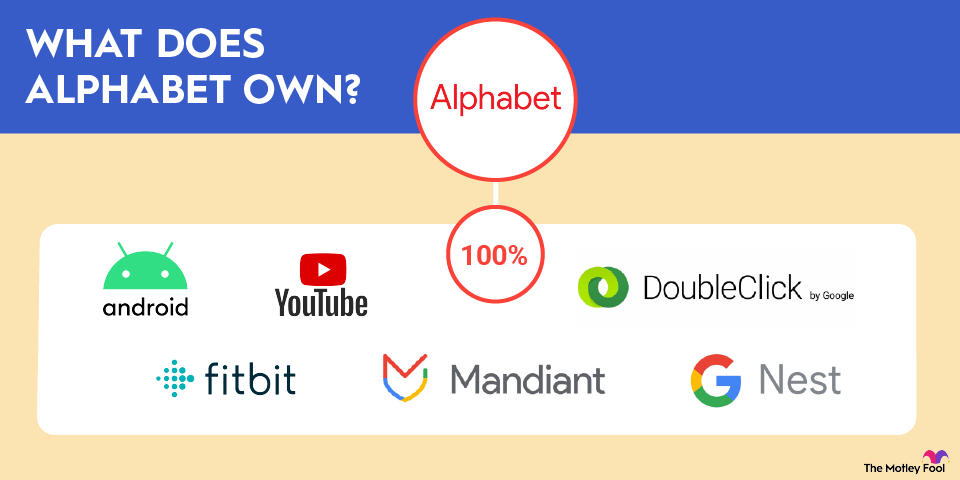
Alphabet is no stranger to in-house innovations, but many of its most important business projects entered the company by way of acquisitions.
This strategy helps the company extend its reach far beyond its original search engine roots, pursuing a future where its technology intersects with almost every aspect of our lives. From artificial intelligence (AI) and autonomous vehicles to health technology and cloud computing, Alphabet's acquisitions reflect its commitment to leading innovation and diversifying its portfolio.
With each buyout, Alphabet not only gains access to new technologies and markets but also reinforces its position as a technology titan, leading by example as the digital world evolves.
Alphabet's approach to acquisitions is both strategic and visionary. It targets companies that offer unique technologies or capabilities that complement its existing business lines or open new avenues for growth. Equipped with some of the deepest pockets on the planet, Alphabet's acquisitive strategy has maintained its competitive edge while adapting to the rapidly changing technological landscape.
4. Nest Labs: $3.2 billion, 100% ownership since 2014
Speaking of smart home devices, the company baked up its first Google Assistant devices from scratch. The resulting Google Home system could control Nest thermostats and smoke alarms as early as 2011, but Google wanted more control over its partner. So, Google boosted its stake in Nest Labs from 12% to 100% in a multibillion-dollar cash deal.
5. Fitbit: $2.1 billion, 100% ownership since 2021
Nest and Fitbit represent the majority of Alphabet's non-Google business these days. Both operations were brought in as fully realized product lines and established development teams. Alphabet is happy to spend billions of dollars on these solid businesses, especially since their presence can elevate the company's smart hardware and related services on a larger scale. Fitbit and Nest are great examples of these tactics, giving Alphabet an instantly competitive presence in Internet of Things markets that the company had largely left alone.
6. Wiz: $32 billion, announced in March 2025
Google has acquired at least a dozen cybersecurity companies over time, but the Wiz acquisition announced in 2025 casts a deep shadow over the smaller deals. It's the largest buyout in Alphabet's history.
This deal, pending at the time of writing in April 2025, addresses a rising need for advanced cybersecurity solutions. AI is growing more and more powerful, and widespread cloud adoption also creates new security challenges for organizations.
Wiz developed a practical platform that connects to major cloud providers and helps prevent cyber threats for all types of organizations. Google plans to combine its in-house AI expertise with Wiz's technology to create more automated security systems that work efficiently across different cloud environments.
The move positions Alphabet to protect its own vast data ecosystem, and also makes it a leading provider of cross-platform security solutions in an increasingly multicloud world.
7. Motorola Mobility: $12.5 billion, 100% ownership in 2011, sold to Lenovo in 2014
Here's the one that got away.
The $12.5 billion Motorola Mobility deal was Google's largest buyout at the time, meant to give the company a powerful phone brand that could compete directly with Apple's iPhone line. However, Google's Motorola phones never rose to the challenge, and Alphabet sold most of it to Chinese technology giant Lenovo (LNVG.Y -1.49%) three years later. That deal excluded "the vast majority" of Motorola's mobile patent collection, so Alphabet still holds on to some small part of Motorola. Lenovo only paid $2.9 billion for the smartphone business and supporting assets.
So, Alphabet went back to the lab again, working up a new mobile hardware strategy. Two years later, the first Google Pixel phones showed up, developed by Alphabet but manufactured by various third-party hardware specialists.
Related investing topics
The fundamental facts on companies owned by Alphabet
Not every buyout has been a raging success, and Alphabet's more than 200 acquisitions have certainly included many efforts of limited value. But it only takes a couple of massive success stories, such as YouTube, Android, and DoubleClick, to make investors forgive and forget those fizzled efforts.
All in all, Alphabet has generated game-changing business results and shareholder value from its buyout-based strategy.
The company's knack for making calculated bets has reshaped the tech landscape, setting new standards for what's possible. From transforming the way we access information and connect with each other to pioneering advancements in AI and digital advertising, Alphabet continues to push the boundaries, turning ambitious visions into tangible realities. And the company is not afraid to pick up smaller rivals and innovators along the way, usually with price tags too small to merit reporting.
The company is larger and richer than ever and will surely make more acquisitions in the coming years. The Alphabet structure that CFO Ruth Porat built a decade ago has proven flexible and useful. Alphabet's long-term future may rely on unexpected operations such as self-driving car services or medical research, which would seem strange in a Google-branded company structure but perfectly normal with the Alphabet architecture.
FAQ
About the Author

Suzanne Frey, an executive at Alphabet, is a member of The Motley Fool’s board of directors. Anders Bylund has positions in Alphabet. The Motley Fool has positions in and recommends Alphabet and Apple. The Motley Fool has a disclosure policy.