If the thesis hasn't changed, you can continue holding or potentially increase your investment. However, if you found that the thesis is busted, you can sell your investment and move on.
How to write an investment thesis
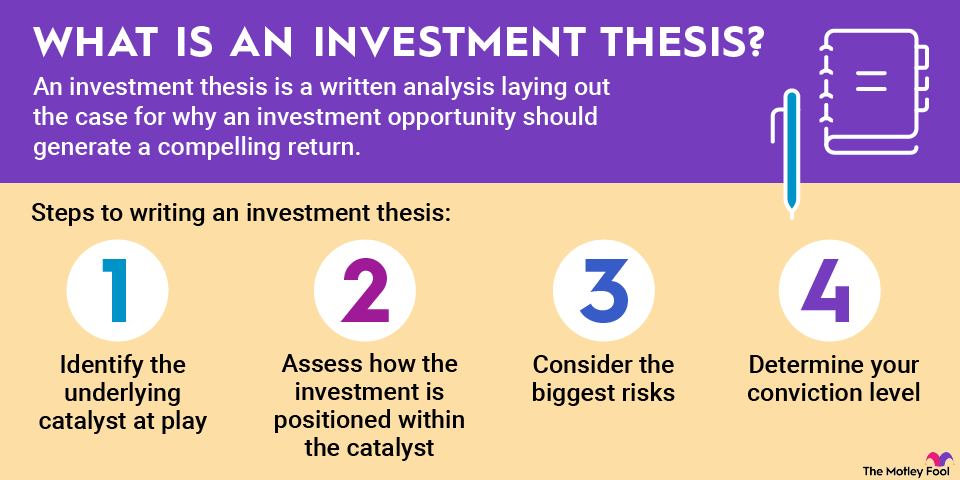
It's important to take the time to write a well-thought-out and thoroughly researched investment thesis. That will allow you to easily make sense of it for future reference. Here are four easy steps for writing an investment thesis.
Identify the underlying catalyst at play
The first step in writing an investment thesis is to determine and then outline the catalyst driving your investment thesis. For example, are you interested in the long-term upside from a secular trend or economic supercycle, or a shorter-term rebound from the economic cycle or a bear market? Write out the primary reason you believe this investment has attractive upside potential.
Assess how the investment is positioned within the catalyst
Next, look at how the particular investment opportunity compares to others that benefit from the same catalyst. Is it the largest publicly traded company focused on this opportunity? Smaller but with more upside potential? Does it align with a particular long-term investment strategy? Will it help you with balancing your portfolio? Write out why this investment is a solid choice to benefit from this catalyst.
Consider the biggest risks
As the saying goes, the best-laid plans often go awry. That's why it's vital to consider what will happen to this particular investment opportunity if something goes wrong. Some examples to consider:
- Can it withstand a recession?
- Could Congress enact legislation that would damage its prospects?
- Is there a lot of competition within the industry?
- Does it have too much debt, volatile cash flows, or an otherwise weaker financial profile?
- Is the price high? Could that result in underperformance if the catalyst doesn't play out according to plan?
Consider and jot down anything that could negatively impact this investment.
Determine your conviction level
Finally, write down your expected return from this investment and how much conviction you have in its ability to achieve that return. Then, given the catalyst, its position within that catalyst, the risk/reward profile, and your conviction level, is it worth the investment?
By going through these steps and writing a detailed investment thesis, you can proceed with confidence. Further, you can reference it in the future to ensure your thesis is playing out as expected. If not, you can make changes to your investment.