The solar energy industry designs and installs devices to capture solar energy and convert it into electric power. Companies in the industry are working to transition the global economy from fossil fuels such as oil and natural gas to renewable energy sources. It will take trillions of dollars and many years to complete the transition, making the solar energy industry a compelling opportunity for long-term investors.
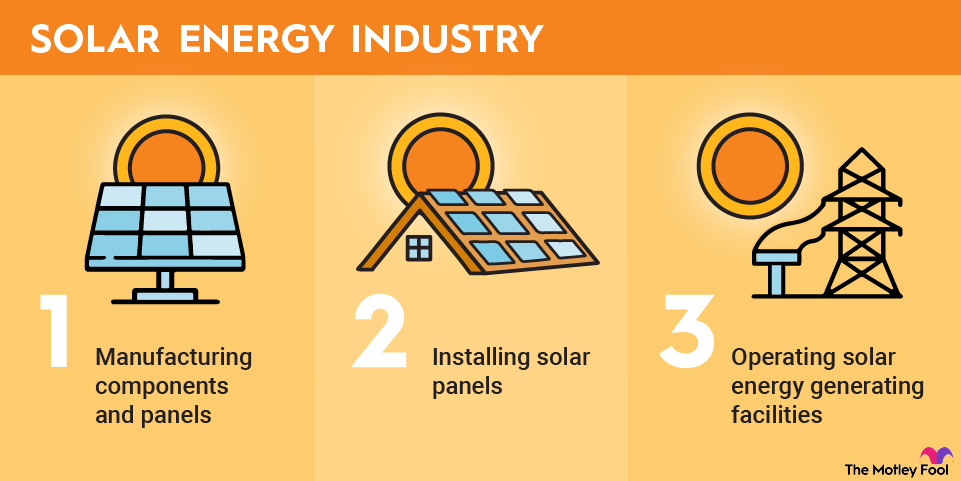
The sector encompasses a wide variety of companies with the following functions:

Top solar stocks to consider
| Name and ticker | Market cap | Industry |
|---|---|---|
| Enphase Energy (NASDAQ:ENPH) | $6.0 billion | Semiconductors and Semiconductor Equipment |
| Brookfield Renewable (NYSE:BEPC) | $7.7 billion | Independent Power and Renewable Electricity Producers |
| First Solar (NASDAQ:FSLR) | $25.6 billion | Semiconductors and Semiconductor Equipment |
| Array Technologies (NASDAQ:ARRY) | $1.8 billion | Electrical Equipment |
| NextEra Energy (NYSE:NEE) | $190.1 billion | Electric Utilities |
1. First Solar

NASDAQ: FSLR
Key Data Points
First Solar (FSLR -2.29%) is a global leader in developing solar energy solutions. It develops, manufactures, and sells advanced solar modules.
One thing that sets First Solar apart from other solar panel makers is its focus on manufacturing a proprietary, advanced thin-film module. In less-than-ideal conditions, such as low light and hot weather, its panels perform better than competing silicon modules. They're also larger, which helps reduce the cost per watt. Those factors make them ideal for utility-scale solar energy projects.
First Solar also distinguishes itself from its peers in the solar sector by having one of the strongest balance sheets. It routinely has more cash than debt (it anticipates closing 2025 with between $1.6 billion and $2.1 billion in net cash), giving it the financial flexibility to continue expanding its manufacturing capacity. First Solar is in an excellent position to thrive as the solar industry grows.
First Solar also has a lot of growth lined up. As of early 2026, the company had 54.5 gigawatts (GW) of total bookings in its backlog, which it expects to deliver over the next several years. Meanwhile, it had another 79.2 GW of potential booking opportunities in its pipeline. It's investing heavily in expanding its solar panel manufacturing capacity to capitalize on the sector's growth. In late 2025, First Solar inaugurated its new $1.1 billion AI-enabled manufacturing facility in Louisiana. Additionally, it selected South Carolina for its next U.S. production facility. First Solar expects to invest $300 million into the facility, which should begin commercial operations in the second half of 2026.
2. Brookfield Renewable

NYSE: BEP
Key Data Points
Brookfield Renewable (BEP +0.57%) is an energy company that generates renewable energy that it sells under long-term power purchase agreements. Brookfield's business model provides it with steady cash flow to pay an attractive dividend yield (over 3.5% in early 2026).
Brookfield Renewable has a globally diversified renewable energy portfolio. It's a global leader in hydroelectric power plants, with 8.3 GW of capacity and 44% of its funds from operations (FFO). It complements those facilities with rapidly expanding onshore wind energy (17.4 GW and 21%), utility-scale solar (14.7 GW and 17%), distributed energy (e.g., rooftop solar), and energy storage platforms (8.3 GW and 9%). The company also has a growing sustainable solutions business (9%), which includes carbon capture and storage, biofuel production, nuclear services, and solar panel manufacturing.
The clean energy company believes solar could make up the majority of its production capacity within the next decade -- not because it doesn't see a bright future for wind or hydro, but because it sees greater opportunity in solar. Declining costs are making solar development projects increasingly lucrative. Utility-scale solar energy accounts for 53% of its over 230 GW global development pipeline, while distributed energy accounts for another 4%.
Brookfield's solar-focused development project pipeline should add 4% to 6% to its annual FFO per share through 2030. Add that to its other organic growth drivers and acquisitions, and Brookfield believes it can grow its FFO per share by more than 10% annually through 2030. That should support the company's plan to increase its high-yielding dividend by 5% to 9%. Its dividend growth makes it one of the top renewable energy dividend stocks. Meanwhile, its overall combination of growth and income should enable Brookfield Renewable to generate attractive total returns in the coming years.
3. Enphase Energy

NASDAQ: ENPH
Key Data Points
Enphase Energy (ENPH -3.89%) is a pioneer in the solar industry. The company launched its revolutionary microinverter technology in 2006. It helps convert the direct current (DC) produced from sunlight into alternating current (AC) used in homes and businesses. The company has since expanded its capabilities to provide battery storage, EV chargers, energy management systems, and an installer platform.
As of early 2026, Enphase has shipped 86.4 million microinverters. It has also supplied more than 5.1 million systems to over 160 countries and shipped 2.4 GWh of energy storage systems.
That's only the beginning. The company's innovation has opened up new market opportunities, giving it an expanding share of potential revenue generated by each residential solar installation.
4. Array Technologies

NASDAQ: ARRY
Key Data Points
Array Technologies (ARRY -6.75%) is a leading global provider of utility-scale solar tracking technology. The company's highly engineered trackers and sophisticated software empower solar power companies to maximize their energy production. As of early 2026, the company's trackers had helped deliver 95 GW of power worldwide.
In 2025, Array acquired APA Solar for $179 million. APA is a leading provider of engineered foundation solutions and fixed-tilt mounting systems for solar projects. The acquisition expands the company's total addressable market by 40% by adding the $1.2 billion U.S. utility-scale tracker foundations market. The deal enables Array to offer customers an integrated tracker and foundation system.
That acquisition helped drive 65% year-to-date revenue growth and a 74% increase in volume in the third quarter of 2025. The company expects 2026 to be a year of continued growth, built on the launch of its new integrated tracker, foundation, and software solutions.
5. NextEra Energy

NYSE: NEE
Key Data Points
NextEra Energy (NEE +0.46%) is one of the largest electric utilities and energy infrastructure companies in North America. It owns Florida Power & Light (FPL), the largest electric utility in the country, with about 12 million customers. Meanwhile, NextEra Energy Resources owns, operates, and develops energy infrastructure, including renewable energy projects, electricity transmission lines, and gas-power infrastructure such as pipelines and power plants.
FPL owns and operates a nearly 8 GW solar energy portfolio, the largest utility-owned solar portfolio in the country. FPL plans to add over 17 GW of solar and another 7.6 GW of battery storage over the next decade to support its customers' growing electricity needs. By 2034, FPL expects to get about 35% of its power from solar energy, up from 9% this year.
Meanwhile, NextEra Energy Resources had more than 38 GW of generation and storage capacity in operation in 2025 (21% of which was solar). The company expected to add 31.5-41.5 GW of new solar energy capacity by 2032.
Factors to consider when investing in solar energy stocks
Here are some key factors investors should evaluate when selecting solar energy stocks:
- The strength of its financial profile.
- How much visibility it has into its future growth.
- The potential impact of changes in government support or regulations on its business.
- Its business model.
How to invest in solar energy stocks
Here’s a step-by-step guide on how to add solar energy stocks to your portfolio:
- Open your brokerage app: Log in to your brokerage account where you handle your investments.
- Search for the stock: Enter the ticker or company name into the search bar to bring up the stock's trading page.
- Decide how many shares to buy: Consider your investment goals and how much of your portfolio you want to allocate to this stock.
- Select order type: Choose between a market order to buy at the current price or a limit order to specify the maximum price you're willing to pay.
- Submit your order: Confirm the details and submit your buy order.
- Review your purchase: Check your portfolio to ensure your order was filled as expected and adjust your investment strategy accordingly.
Industry outlook and trends
Demand for solar energy is nearly as hot as the sun. "Compared to other sources of power, the rise in solar generation is the fastest in the history of electricity,” according to Daan Struyven, the co-head of global commodities research at Goldman Sachs (GS -1.83%). The investment bank expects global solar installations will rise to 914 GW by 2030, 57% above 2024's levels. Several catalysts are powering red-hot demand for solar, including climate change, falling installation costs, and rising electricity consumption from AI data centers.