Mega backdoor Roth IRA contribution limit
As with all retirement savings, the amount you can contribute to a mega backdoor Roth IRA is capped each year. Calculating what you can contribute depends on maximum 401(k) contribution limits and whether your employer offers a matching contribution on your deposits. Here's how to calculate your mega backdoor Roth IRA contribution limit:
- For 2026, total 401(k) contributions (pre-tax, after-tax, employer matching contributions, and any other non-elective employer contributions) are capped at $72,000, up from $70,000 for 2025. If you're 50 or older, the limit is $80,000 in 2026 and $77,500 for 2025. In 2025, combined contributions up to $81,250 if you're 60-63 are permitted, and this increases to $83,500 for 2026.
- Subtract the pre-tax contribution you make from the annual max 401(k) contribution limit. For example, you'd subtract $23,500 from $70,000 in 2025 to get the maximum mega backdoor Roth IRA contribution of $46,500 in 2025, assuming your employer makes no 401(k) contributions on your behalf.
- If your employer does make matching 401(k) contributions, subtract that amount as well. For example, if you make $200,000 per year and your employer makes a 3% match, subtract the additional $6,000 in matching contribution ($200,000 x 0.03), leaving a maximum mega backdoor Roth IRA limit of $40,500 in 2025.
Mega backdoor Roth IRA taxes
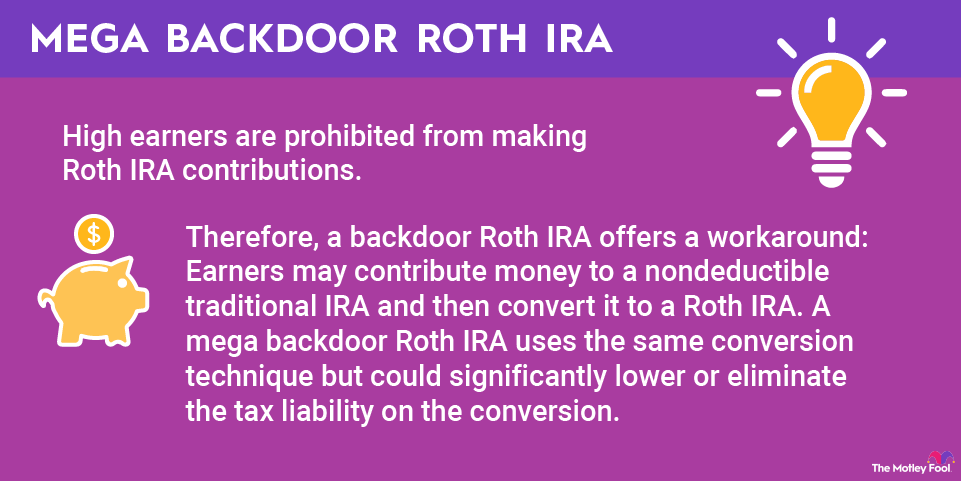
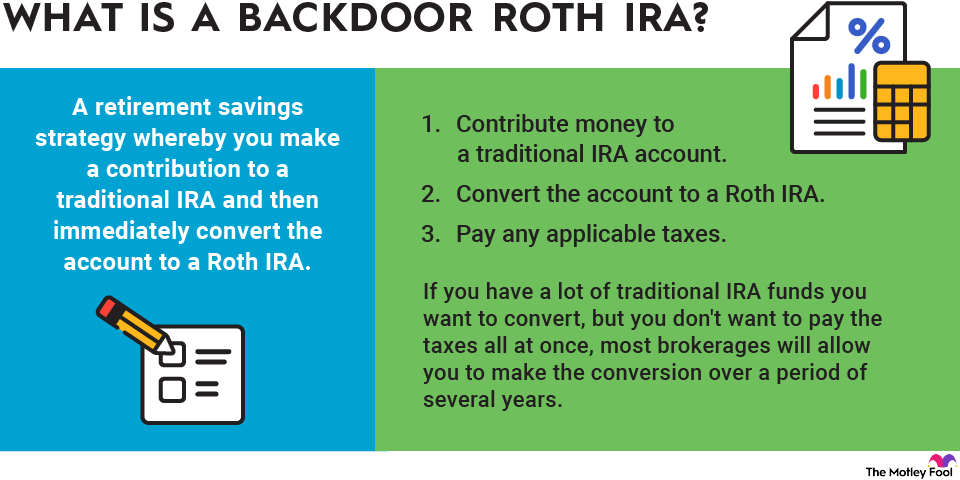
With a normal backdoor Roth IRA, you owe income taxes on the amount of money you converted to a Roth IRA to the extent that your traditional IRA holdings were initially deductible. Similarly, with a mega backdoor Roth IRA, your after-tax contributions are nontaxable. Only investment earnings on after-tax contributions are taxable at your current income tax rate at the time of the withdrawal for deposit to your Roth IRA.
There's a way to avoid those taxes, though. If you make frequent withdrawals of after-tax money (perhaps monthly or quarterly) or you leave your contributions in a money market fund, the earnings should be minimal. Also, if your investments don't yield any return over a given period (or have a tough stretch and lose money), there are no applicable taxes.
This can be tricky if you are making after-tax contributions and your employer doesn't allow for in-service withdrawals. You can still contribute after taxes and transfer the funds to a Roth IRA when you leave your job, but any earnings on after-tax investments could create a sizable tax bill. Consider investing those after-tax funds anyway and transferring the earnings to a traditional IRA instead to avoid the tax bill.
Should I use a mega backdoor Roth IRA?
You should stick with a regular backdoor Roth IRA conversion if your income level isn't high enough. The same applies if you can't max out both your annual 401(k) and traditional IRA contributions, or your employer doesn't allow for in-service withdrawals.
But if you meet the income and savings requirements, a mega backdoor Roth IRA is a great vehicle for diversifying your retirement income -- granting you both tax-deferred income (taxable at the time of withdrawal) on your pre-tax contributions and tax-free income on your after-tax contributions (if funds are transferred to a Roth IRA). Plus, a mega backdoor Roth IRA can avoid the taxable event that a normal backdoor Roth IRA conversion often creates.
Related Retirement Topics