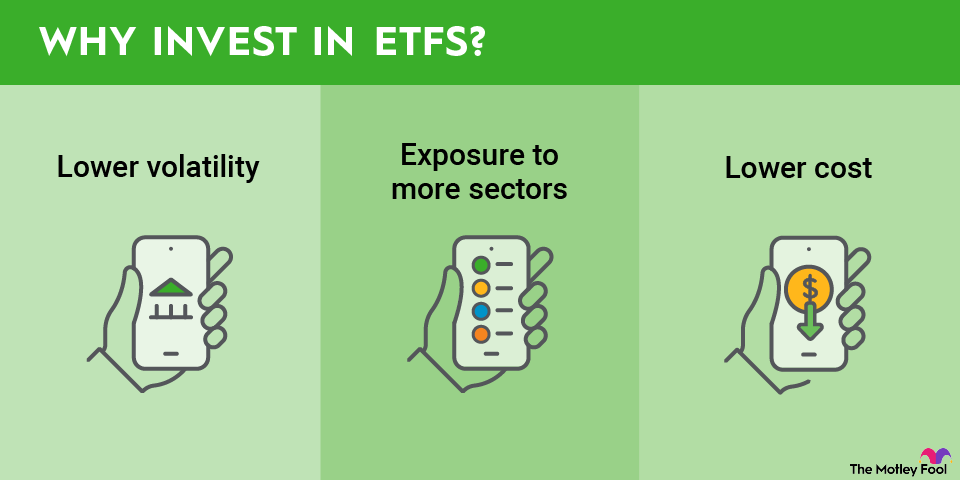
The best long-term ETFs allow investors to easily build a diversified portfolio. They can provide broad exposure across many asset classes, industries, and geographies. This diversification can help an investor reduce risk without sacrificing long-term returns.
There are many exchange-traded funds (ETFs) built for long-term investors. Here's a closer look at several top ETFs that make ideal buy-and-hold investments.
Best long-term ETFs
The best ETFs for the long term hold a diversified portfolio of stocks while charging a very low ETF expense ratio. Although many funds share those two key characteristics, here are the top ETFs for long-term investors:
Exchange-Traded Fund (ETF)
1. Vanguard S&P 500 ETF

NYSEMKT: VOO
Key Data Points
The Vanguard S&P 500 ETF (VOO +0.27%) is an index fund designed to track the S&P 500 index. The index represents 500 of the largest U.S. publicly traded companies. The ETF's goals are to closely follow the S&P 500's returns, the primary benchmark for the overall returns of the U.S. stock market.
It offers a high potential for growth, making it an ideal long-term investment. Over the last 50 years, the average stock market return was 8% annually, as measured by the S&P 500. The Vanguard S&P 500 ETF has only slightly underperformed that benchmark's returns since its inception due to its modest ETF expense ratio.
Like the S&P 500, the ETF uses a market-weighted strategy, giving a higher weighting to the largest companies. Its top 10 holdings made up almost 40% of its total net assets in early 2026, giving investors relatively concentrated exposure to the largest companies in the index.
The ETF offers investors exposure to the largest U.S. stocks for a very low cost. Its expense ratio of 0.03% is significantly less than the 0.22% average expense ratio of similar funds. Investors would only pay $0.30 in annual management fees per $1,000 invested in the ETF, compared to $2.20 per year for every $1,000 invested in the average fund.
2. Invesco S&P 500 Equal Weight ETF

NYSEMKT: RSP
Key Data Points
The Invesco S&P 500 Equal Weight ETF (RSP +0.44%) is also an index fund designed to track the stocks in the S&P 500. However, it uses an equal-weight approach instead of one based on market cap. As a result, the ETF's top 10 holdings represented about 2.5% of its total assets in early 2026.
This approach reduces concentration risk by providing broad exposure across the 500 stocks in the S&P 500. The ETF rebalances its holdings quarterly to ensure each holding remains a relatively equal portion of the fund's assets.
The ETF has a relatively low expense ratio of 0.2%. That's a reasonable fee to gain broad, equal-weight exposure to 500 of the largest public companies in the U.S.
Gross Expense Ratio
3. iShares Russell 1000 Growth ETF

NYSEMKT: IWF
Key Data Points
4. Vanguard Real Estate ETF

NYSEMKT: VNQ
Key Data Points
5. Schwab U.S. Dividend Equity ETF

NYSEMKT: SCHD
Key Data Points
The Schwab U.S. Dividend Equity ETF (SCHD -0.03%) tracks an index focused on holding dividend stocks known for the quality and sustainability of their dividend payments. The ETF enables investors to benefit from the power of dividends in producing attractive total returns for investors over the long term.
The ETF holds roughly 100 dividend-paying stocks. The fund offered a trailing 12-month dividend yield of around 3.8% in early 2026, more than double that of the S&P 500 (1.1% at the time).
Its top 10 holdings made up more than 40% of the total. However, its overall holdings were fairly well diversified in early 2026. Energy stocks had the highest weighting at more than 19% of its holdings. Rounding out the top five sectors were consumer staples (19%), healthcare (16%), industrials (12%), and the financial sector (9%).
The ETF charges an ultra-low expense ratio of 0.06%. That lets investors keep a significant portion of the dividend income generated by its holdings. These features make the ETF a very low-cost way to collect passive income via dividend stocks, which have historically been exceptional long-term investments.
6. iShares Core MSCI EAFE ETF

NYSEMKT: IEFA
Key Data Points
The iShares Core MSCI EAFE ETF (IEFA -0.02%) is an ETF focused on international stocks. It provides investors with broad exposure to companies in Europe, Australia, Asia, and the Far East. That enables anyone to add some international diversification to their portfolio, which has outstanding long-term growth potential.
The ETF held almost 2,600 stocks as of early 2026. It provides fairly broad exposure to global stocks, with its top 10 holdings making up around 11% of its net assets. The ETF is also reasonably diversified by sector and geography:
Top 5 Sectors | Top 5 Geographies |
|---|---|
Financials (23.1% of the fund's holdings) | Japan (23.8%) |
Industrials (20.2%) | United Kingdom (14.5%) |
Healthcare (10.6%) | France (9.6%) |
Consumer discretionary (10%) | Germany (8.9%) |
Information technology (8.8%) | Switzerland (8.8%) |
The iShares Core MSCI EAFE ETF charges a very low expense ratio of 0.07%, allowing investors to add some international exposure to their portfolios at a low cost and benefit from the long-term growth of the global economy. This ETF also had an attractive trailing 12-month dividend yield of 2.9% in early 2026.
7. iShares Core 60/40 Balanced Allocation ETF
Why ETFs are good for long-term investors
ETFs can be great building blocks for long-term investors. They can provide:
- Broad exposure: ETFs allow you to instantly invest across the entire stock market, different countries, and specific industries.
- Diversification: ETFs enable you to build a diversified portfolio quickly.
- Lower risk: They can help reduce the overall risk profile of your portfolio.
- Low costs: Many of the best long-term ETFs have a relatively low expense ratio.
- Passive investments: ETFs are very passive investments. They allow you to invest in the market without actively managing a portfolio of stocks.
Related investing topics
How to find top long-term ETFs
Here are some tips for identifying the best ETFs for a long-term investment:
- Look for a low expense ratio. This will be less of a drag on your returns over the long term.
- Focus more on passively managed funds that track a well-established index.
- Seek out larger funds (ideally over $1 billion in assets under management, or AUM) with long operating track records (at least more than a year) by a well-known financial sponsor (e.g., BlackRock (BLK +5.93%) or Vanguard).
- Look for funds that have a long record of delivering returns that match or exceed their chosen benchmark.
FAQ
About the Author