It's easy to be bullish on travel and tourism stocks. Over the last few years, travel and tourism have boomed back as a top growth industry. Who couldn't use a vacation right now?
U.S. travel spending has historically grown between 2% and 4% annually, according to the U.S. Travel Association. Total U.S. travel spending is projected to reach up to $1.46 trillion (inflation-adjusted) by 2028. Travel and tourism is a broad category with a diverse list of well-known brands.
For people planning to invest money in travel companies, you have plenty of options.
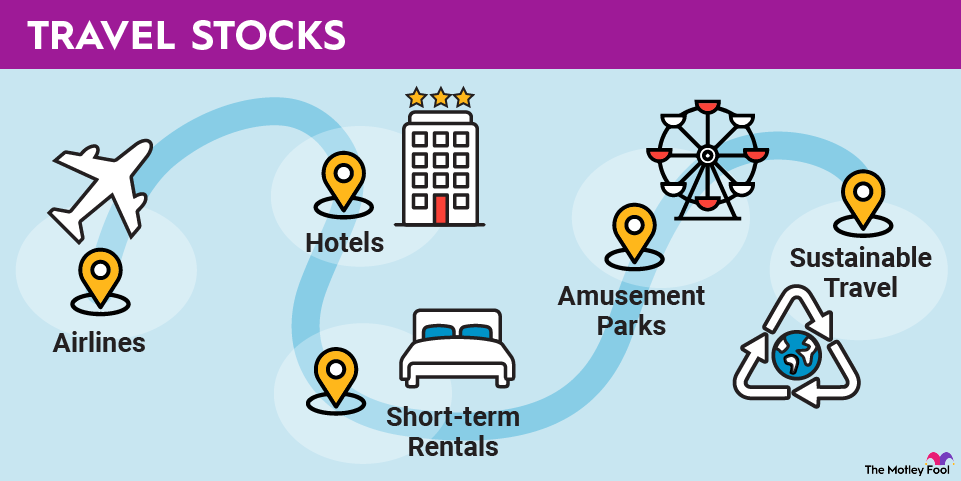
Best travel stocks to buy in 2025
There's a wide range of transportation, lodging, and amusement companies to get you to your destination and make sure you enjoy your stay. Since the companies vary so much, it's hard to nail down a single key metric to watch.
For example, some travel companies are asset-heavy transportation businesses like the airline industry and airline stocks. Many of these companies are broadly performing favorably for investors thanks to travel demand, despite the widely publicized headwinds facing a well-known U.S. company like Boeing (BA -0.79%). Other top picks are essentially tech companies.
The best travel and tourism stocks do share some traits, though -- namely, strong brand recognition, an easy-to-use website or app, and a loyal customer following. Here are some of the top travel and tourism companies.
1. Booking Holdings

NASDAQ: BKNG
Key Data Points
2. Marriott International
3. Airbnb
4. The Walt Disney Company
5. Uber Technologies

Tips for investing in travel stocks
The travel industry is broad, and encompasses everything from airlines and hotels to cruise lines and online travel agencies. Instead of putting all your money into one company, consider diversifying across different types of travel businesses or using a travel-focused ETF to manage your risk exposure in your portfolio.
Focus on financially resilient companies. The travel sector is sensitive to economic shifts, fuel costs, and labor issues. Companies with strong balance sheets, consistent earnings, and effective cost management tend to make the most resilient long-term investments.
Travel is a discretionary expense, so a recession or decline in consumer confidence can lead to a sharp drop in demand. That said, the high-end consumer has also proven more resilient to economic concerns. Companies catering to this demographic may offer more stable returns.
Related investing topics
Key travel industry trends
Travelers seem to be increasingly prioritizing unique, authentic, and immersive experiences over simple sightseeing. This is driving trends like culinary tourism, outdoor adventures, and travel to off-the-beaten-path destinations. A significant number of travelers are planning trips around major events, such as the Olympics, Formula 1 races, or large concerts and festivals.
Film and TV filming locations are also driving destination choices. There's a growing demand for wellness retreats focused on physical and mental well-being, including digital detoxes and spa weekends. Families are making up for lost time by planning large trips that cater to all ages, with quality time being the primary motivator.
The lines between work and leisure continue to blur, with remote work making it easier for people to work while traveling. Travelers are increasingly using AI tools for itinerary suggestions, budget management, and translation assistance.
Consumers are seeking a seamless booking experience and are often willing to book directly with providers to access better deals, loyalty perks, and highly customized options. Booking Holdings, Airbnb, Marriott International, Walt Disney, and Uber Technologies are all examples of companies focused on integrating AI, offering unique experiences, and accommodating the demand for flexible travel.
FAQ
About the Author