Why adjust for inflation?
If we compared GDP for two periods measured on a nominal basis (referred to as "current dollar" GDP estimates), we'd expect GDP to increase over time simply by virtue of the general increases in the prices of goods and services.
However, we're really interested in discovering how economic activity is progressing over time. Stripping out the effect of inflation from current dollar GDP estimates to produce real (or "chained dollar") estimates gets us closer to that goal.
Why calculate a growth rate?
GDP figures from a single quarter are not that useful. Economists, capital markets professionals, and others like to track the growth rate in real GDP to get a sense of changes in economic activity. In fact, that's the single most important figure in the BEA's quarterly releases and the only one mentioned in the first paragraph of the release.
Unsurprisingly, when it comes to GDP data, it's also the most widely cited figure. When people in the financial services industry or the financial media refer to "the GDP number" or "the GDP print," they are referring to one thing: the annual growth rate in real GDP. It's very rare for anyone to mention the dollar amount of GDP.
How does one calculate the real GDP growth rate?
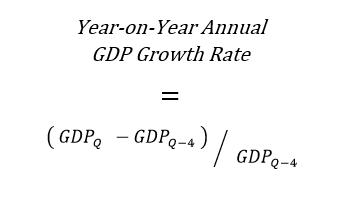
In the U.S., the growth rate the BEA reports is a quarter-on-quarter (QoQ) growth rate, which is the growth in real GDP from one quarter to the next, expressed as a percentage. The growth rate is expressed on an annual basis, so there are two steps to the calculation:
Step 1
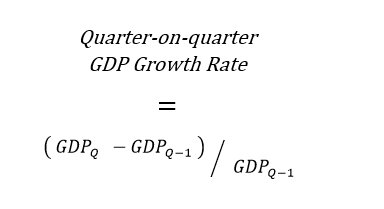
First, we find the quarterly growth rate in real GDP, which is a straightforward percentage calculation that relates the change in GDP during the most recent quarter to the level of GDP in the preceding quarter:
Quarter-on-quarter GDP Growth Rate = (GDPₓ – GDPₓ₋₁) ÷ GDPₓ₋₁