Omega Healthcare Investors (OHI +0.61%) is a REIT focused on investing in the long-term healthcare industry, primarily skilled nursing and assisted living facilities. It owned over 1,100 properties with more than 10,500 beds across the U.S., Canada, and U.K., operated or managed by 97 healthcare companies. Omega reported that it is the largest REIT focused on skilled nursing facilities. That's a differentiator among this group, which focuses more on senior housing or life-science properties.
The REIT invested over $375 million in the first half of 2026 to expand its portfolio. That included purchasing a 9.9% equity interest in Saber through a joint venture, its first investment in Canada. Omega also invests in real estate loans secured by healthcare facilities, including $97 million in funding in the first half of the year.
Omega's stable healthcare real estate portfolio backs its high-yielding dividend. After several years of paying a steady dividend, the REIT resumed dividend growth in July 2026, delivering a 1.5% increase. The REIT's combination of income and growth has supported healthy total returns over the past decade.
How to invest in healthcare REITs
- Open your brokerage app: Log in to your brokerage account where you handle your investments. If you don't have one yet, take a look at our favorite brokers and trading platforms to find the right one for you.
- Search for the stock: Enter the ticker name into the search bar to bring up the REIT's trading page.
- Decide how many shares to buy: Consider your investment goals and how much of your portfolio you want to allocate to this REIT.
- Select order type: Choose between a market order to buy at the current price or a limit order to specify the maximum price you're willing to pay.
- Submit your order: Confirm the details and submit your buy order.
- Review your purchase: Check your portfolio to ensure your order was filled as expected and adjust your investment strategy accordingly.
Benefits and risks of investing in healthcare REIT stocks
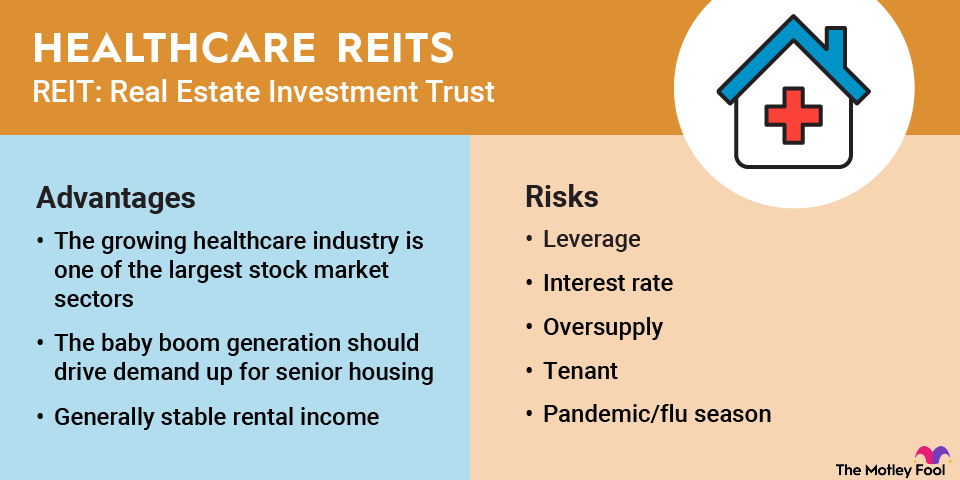
Healthcare REITs benefit from several notable catalysts, including:
- A massive, growing industry: Healthcare is one of the largest sectors of the stock market. According to the Centers for Medicare & Medicaid Services (CMS), U.S. healthcare spending is on track to grow from $5.7 trillion in 2025 to a staggering $9 trillion by 2034.
- Demographics: The aging of the baby boomer generation is a major driver of rising healthcare real estate demand. According to Brookings, the U.S. population aged 70 or older is on track to reach 17.2% by 2045, up from 12.9% in 2025. As a result, companies will need to build more senior housing properties, skilled nursing facilities, and other related real estate to support the aging population.
- Generally stable income: Most healthcare properties generate stable rental income supported by long-term leases.
While healthcare REITs are less risky than other healthcare stocks due to their generally stable rental income, they're not without risk. Here are some of the risks they face:
- Oversupply risk: Healthcare REITs must align their development plans with demand. Given the highly specialized nature of most healthcare facilities, REITs need to be careful not to overbuild, as excess supply may remain vacant.
- Tenant risk: Healthcare REITs rely on their tenants to pay rent and effectively manage senior living facilities. However, healthcare margins are relatively thin, leaving operators vulnerable if they're not vigilant. That can affect rental receipts and force a healthcare REIT to find a new tenant for their facility if an operator can't meet its financial obligations.
- Pandemic/flu season risk: Virus outbreaks can significantly affect healthcare REITs, especially those focused on senior housing. It can cause occupancy to decline as more patients check out than are admitted.
Methodology: How these stocks were chosen
I analyzed the healthcare REIT sector based on the following factors:
- Property focus: I looked for REITs that focus on owning properties benefiting from durable demand (e.g., outpatient medical) and secular growth trends (e.g., senior housing), as these should deliver healthy income growth over the long-term.
- Financial health: I analyzed their financial health, focusing on those with strong balance sheets, durable cash flows, and conservative dividend payout ratios. Healthly financials will help them to withstand risks.
- Portfolio strength: I evaluated the quality of the REIT's tenants and whether it owns high-quality properties that would appeal to potential replacement tenants should existing ones default on their rent.
These five healthcare REITs stood out for their property focus, financial health, and portfolio strength compared to others in the sector. That positions them to deliver the best risk-adjusted total returns in the sector going forward.
Should you invest in healthcare REIT stocks?
Healthcare REITs will benefit from the healthcare sector's continued growth. They offer a lower-risk way to invest in the healthcare sector, as these REITs should grow at healthy rates through a combination of internal growth (contractual rent increases or NOI growth) and external growth (acquisitions and development projects). Welltower, Alexandria, and Ventas offer investors the most growth potential, due to their focus on senior housing or life science properties. Meanwhile, Healthpeak and Omega would be ideal for investors prioritizing income over growth today.