About the Author
Matt DiLallo has positions in Cousins Properties and SL Green Realty. The Motley Fool recommends Easterly Government Properties. The Motley Fool has a disclosure policy.

Invest better with The Motley Fool. Get stock recommendations, portfolio guidance, and more from The Motley Fool's premium services.

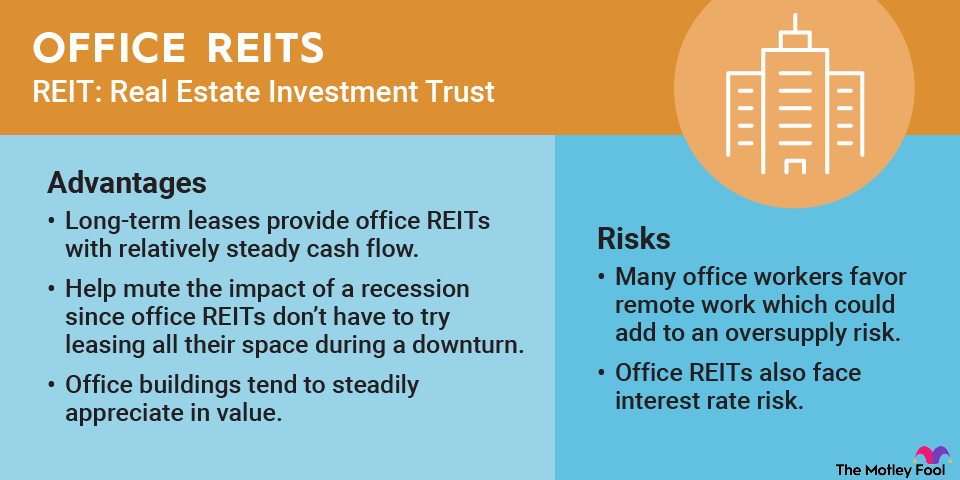
Office REITs have several positive investment characteristics. Some benefits of investing in the sector include:
Investing in office REITs isn't without risk. Here's a look at several of the risk factors investors need to keep in mind before buying shares of an office REIT:
I evaluated office REITs based on the following characteristics:
The five office REITs selected stood out compared to their peers across these five categories.
The office sector has been mired in a multi-year slump. Demand for office space has been sluggish since the pandemic. While it has improved in more recent years, AI is emerging as another potential headwind for the sector. Investors need to balance these and other risks against the benefits of office REITs, including dividend income and growth potential as they develop and acquire new properties to expand their portfolios and earnings. They're best suited for investors with a higher risk tolerance who seek income and upside potential as the sector navigates headwinds and strives to stage a comeback.
Office real estate investment trusts (REITs) own, manage, develop, and rent office space leased to various tenants. These properties range from skyscrapers in the largest U.S. cities to sprawling office campuses in the suburbs. This real estate is crucial for companies that use offices to support their operations.
Most office REITs focus on a specific property type, tenant, or location. Some concentrate on multi-tenant office buildings in central business districts. Other office REITs focus on large office campuses and will often lease entire buildings to a single tenant under long-term triple-net leases. There are also office REITs that focus on specialized office properties to support the needs of specific tenant types. These properties can include highly secure buildings for government agencies, creative space for technology and media companies, or specialized lab space for life sciences companies.
That gives you lots of ways to invest in the office sector. Here's a closer look at investing in office REITs, including their benefits and risks, and some top office REITs to consider in 2026.
In mid-2026, 16 publicly traded REITs focused on owning office properties. Here's a closer look at the five best office REITs for investors to consider:


Formerly Boston Properties, BXP (BXP +1.10%) is the largest publicly traded developer, owner, and manager of premier workspaces. It owns a large portfolio of Class A office properties (164 properties totaling 51.1 million square feet as of mid-2026), which are modern buildings in prime locations.
It focuses on owning properties in six major coastal gateway cities: Boston, Los Angeles, New York, San Francisco, Seattle, and Washington, D.C. The office REIT also has a large and growing life sciences portfolio.
BXP launched a multi-year plan in late 2025 to enhance shareholder value and drive growth. It reset the dividend to retain additional cash for development projects. The office REIT is also selling non-core assets ($1.2 billion generated by the end of the second quarter) and securing private equity partnerships to fund new investments. As of mid-2026, BXP had $3.6 billion in properties under development to drive its continued growth.

| Name and ticker | Current price | Market capMarket cap calculated using publicly traded shares outstanding only. Does not include unlisted, private, or dual-class non-traded shares. Implied market cap may vary. | Dividend yield |
|---|---|---|---|
| Easterly Government Properties (NYSE:DEA) | $23.79 | $1.1 billion | 7.53% |
| Cousins Properties (NYSE:CUZ) | $28.05 | $4.6 billion | 4.58% |
| BXP (NYSE:BXP) | $64.44 | $10.2 billion | 4.39% |
| SL Green Realty (NYSE:SLG) | $52.15 | $3.9 billion | 3.89% |
| Kilroy Realty (NYSE:KRC) | $34.88 | $4.1 billion | 6.20% |

Easterly Government Properties (DEA -0.50%) focuses on owning mission-critical properties, primarily leased to government agencies. It owned 106 properties across the country in mid-2026. That included 93 leased to U.S. Government agencies, including buildings that provide veterans' care (Department of Veterans Affairs outpatient facilities), law enforcement support (FBI regional headquarters), ICE facilities, and courthouses. It also had eight properties leased to state and local governments and five leased to private tenants, such as defense companies.
The REIT grows by investing in the expansion of its portfolio. For example, it bought a three-property campus leased to the Commonwealth of Virginia in January 2026. Easterly also develops properties to meet the highly specific needs of government tenants. It had three properties under development in mid-2026, including two for the U.S. Judiciary and one for the Florida Department of Law Enforcement.
Cousins Properties (CUZ +0.38%) focuses on Class A office buildings in fast-growing Sun Belt markets. It owns modern office buildings across Austin, Atlanta, Phoenix, Charlotte, Tampa, Houston, Dallas, and Nashville.
Cousins Properties' focus on the Sun Belt region has paid off. The region has benefited from significant migration from cold, expensive coastal cities to cheaper, warmer cities in the Sun Belt. Companies are also moving into the region because of better business climates and abundant worker pools.
These migration trends have enabled Cousins Properties to launch new development projects and acquire properties to expand its portfolio. In early 2026, the office REIT bought 200 South Tryon, a premier lifestyle office property in Charlotte, for $317.5 million. It also bought its joint venture partner's 10% interest in 100 Mill for $18.5 million and acquired a preferred equity interest in 5th & Walsh with a $31.5 million funding commitment in 2027. Cousins also closed some non-core asset sales to help fund these new investments.
Kilroy Realty (KRC +0.03%) is a leading publicly traded owner and operator of Class A office and life science properties. It primarily focuses on owning properties on the West Coast (Seattle, San Diego, Los Angeles, and the Bay Area). It also owns offices in Austin, Texas. It owned 17.1 million square feet of office and life science space and 608 residential rental units in San Diego.
The office REIT's West Coast portfolio is benefiting from the trend of more tech companies requiring employees to work in-office. Kilroy is also benefiting from its strategy to invest in life science properties.
The company also routinely invests in new properties to grow its portfolio. In 2026, it bought an interest in 1900 Broadway, a land site capable of supporting a 251,000-square-foot office building. Kilroy expects the project to cost between $330 million and $350 million, with construction beginning in 2027 and delivery anticipated in 2030. These drivers position the REIT to grow shareholder value in the coming years.
Here's a step-by-step guide on investing in office REITs:
SL Green Realty (SLG +1.01%) is Manhattan's largest office landlord, with interests in 54 buildings totaling 30.6 million square feet. That includes properties secured by debt and preferred equity investments (1.4 million square feet). It also manages four buildings, totaling roughly 900,000 square feet, owned by third parties.
The REIT's premier office portfolio generates fairly stable rental income. SL Green pays out a portion of that income via dividends and retains the rest to grow its office portfolio.
It has developed several high-profile office buildings in recent years, including One Vanderbilt and One Madison Avenue. It will also acquire buildings (it bought the Park Avenue Tower for $730 million in early 2026).