Understanding mortgage REITs
Mortgage REITs are a subcategory of the real estate investment trust (REIT) segment that focuses on real estate financing. There are several important aspects of mREITs that investors need to understand, including:
- Business models: These entities purchase or originate mortgages and MBS, earning interest income from their investments. Some mREITs also earn loan origination and servicing fees. These factors make mREITs similar to financial stocks.
- Use of leverage: Mortgage REITs make money differently than other real estate investments. They earn a profit on their net interest margin, which is the spread between the interest income generated by their mortgage assets and their funding costs. Mortgage REITs use various funding sources to originate and purchase mortgages and related securities. This can include common and preferred equity, repurchase agreements, structured financing, convertible and long-term debt, and credit facilities. Their use of financial leverage increases returns and risks.
- Investments: Some mortgage REITs will originate real estate-backed loans that they hold on their balance sheet. Other mREITs will purchase mortgages and MBS originated by banks and other lenders. Additionally, some mREITs will make direct property investments.
Here's an example of how mREITs work. Let's say an mREIT raises $100 million of equity from investors to buy mortgages. It secures another $400 million in capital from other sources, at an average funding cost of 2%, allowing it to purchase $500 million of MBS.
If the loans had an average weighted yield of 3%, they would generate $15 million of interest income annually. Meanwhile, at a 2% cost of funding, it would have $8 million of annual funding costs, allowing the mREIT to generate $7 million of net interest margin each year.
IRS guidelines for mREITs require them to distribute 90% of net income to shareholders via dividend payments, which explains the high dividend yields for most mREITs.
How do mortgage REITs make money?
Mortgage REITs make money in several different ways depending on their business model. Here are some of the different income streams earned by mortgage REITs:
- Loan origination fees: Some mREITs originate real estate-backed loans and earn a loan origination fee.
- Mortgage servicing rights: Some mortgage REITs will service mortgages owned by third parties, earning a fee for serving these loans.
- Interest income: Most mortgage REITs hold mortgages, MBS, and other real estate-backed loans that generate interest income.
- Rental income: Some mREITs will also make direct equity investments in real estate, entitling them to the rental income generated by these properties.
- Asset sales: Mortgage REITs often earn a gain (or book a loss) on the sale of assets, such as mortgages they originated and sell to a third party or MBS they no longer want to hold.
Types of mortgage REITs
There are three main types of mortgage REITs:
- Home financing: These REITs focus on investing in mortgages secured by residential real estate such as single-family homes, multifamily properties, and builder lots.
- Commercial financing: These REITs concentrate on providing financing to the commercial real estate sector. They'll originate real estate-backed loans to fund the acquisition, development, or redevelopment of commercial real estate such as office buildings or warehouses.
- Hybrid: These REITs invest in real estate-backed loans and make direct equity investments in real estate.
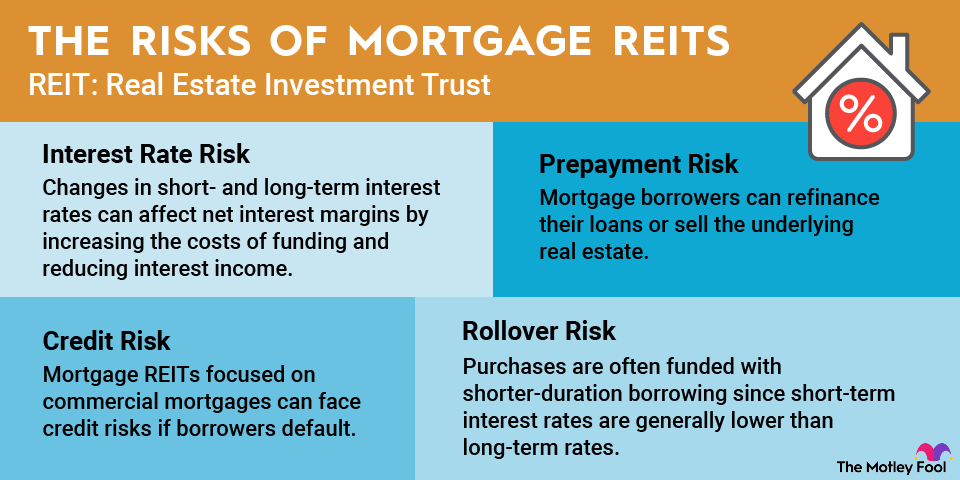
Risks of investing in mortgage REITs