Advanced Micro Devices (AMD +3.95%) spent decades in Intel’s shadow, but that dynamic has flipped. By delivering more competitive chips and expanding into high-growth areas like artificial intelligence, AMD has built a strong position across data center, PC, gaming, and embedded markets.
Its lineup of CPUs, GPUs, and AI accelerators now powers everything from servers to consoles. With multiple growth drivers in play, it’s no surprise investors are taking a closer look.
Here’s how to buy AMD stock and what to consider before adding it to your portfolio.
How to buy Advanced Micro Devices stock
- Open your brokerage account: Log in to your brokerage account where you handle your investments. If you don't have one yet, take a look at our favorite brokers and trading platforms to find the right one for you.
- Search for Advanced Micro Devices: Enter the ticker "AMD" into the search bar to bring up the stock's trading page.
- Decide how many shares to buy: Consider your investment goals and how much of your portfolio you want to allocate to this stock.
- Select order type: Choose between a market order to buy at the current price or a limit order to specify the maximum price you're willing to pay.
- Submit your order: Confirm the details and submit your buy order.
- Review your purchase: Check your portfolio to ensure your order was filled as expected and adjust your investment strategy accordingly.
Is Advanced Micro Devices profitable?
Consistent profitability has been a problem for AMD over the years. However, the company was solidly profitable in 2025. Its net income was $872 million, or $0.54 per share, on $7.7 billion of revenue in the second quarter. That was a significant improvement from prior quarters. Revenue was up 32% year over year and 3% from the sequential quarter.
AMD has been investing heavily to jumpstart growth by launching new products, which is clearly paying off. It has developed a comprehensive portfolio geared toward artificial intelligence (AI), which could help drive accelerated revenue and earnings growth in the future.
Split date | Split ratio |
|---|---|
8/21/2000 | 2-for-1 Stock
Split |
8/22/1983 | 2-for-1 Stock
Split |
10/27/1982 | 3-for-2 Stock
Split |
10/23/1980 | 2-for-1 Stock
Split |
10/24/1979 | 3-for-2 Stock
Split |
10/25/1978 | 3-for-2 Stock
Split |
Every share investors bought at AMD's IPO in 1972 would have grown into 27 split-adjusted shares over the years.
Advanced Micro Devices' last stock split was more than two decades ago. Shares have gained in value since its last split, especially in more recent years.
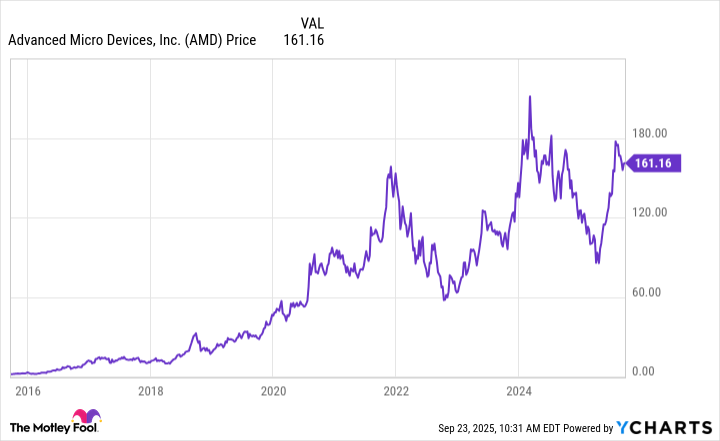
The stock has more than quadrupled since its last split, so AMD could split its stock again in the future to make it even more accessible to investors.
The bottom line
AMD has grown into a global semiconductor leader over the years. It sees much more growth ahead, especially as it begins to capitalize on the emerging AI opportunity, which could reinvigorate its revenue growth and boost its bottom line.
However, AMD faces competition from Nvidia, Intel, and others. So its stock could continue to deliver sluggish returns (as has been the case over the last two decades). Investors need to do their due diligence before buying shares of the semiconductor giant to ensure they understand the risks.
Related investing topics
FAQ
Investing in Advanced Micro Devices FAQ
About the Author