Johnson & Johnson (JNJ -1.24%) is a behemoth in the healthcare sector. The iconic company owns a diversified portfolio of innovative medicine and medical technology (MedTech) businesses. It has invested heavily in research and development (R&D) to launch healthcare innovations while making acquisitions to accelerate breakthroughs and enhance its position.
The diversified healthcare company uses its strong cash flow and a fortress-like balance sheet to acquire companies and products that enhance its core businesses.
It's growth has made Johnson & Johnson a solid company to invest in over the years.
Here are some of the notable companies that Johnson & Johnson has acquired over the years and a look at what ones it might acquire next.
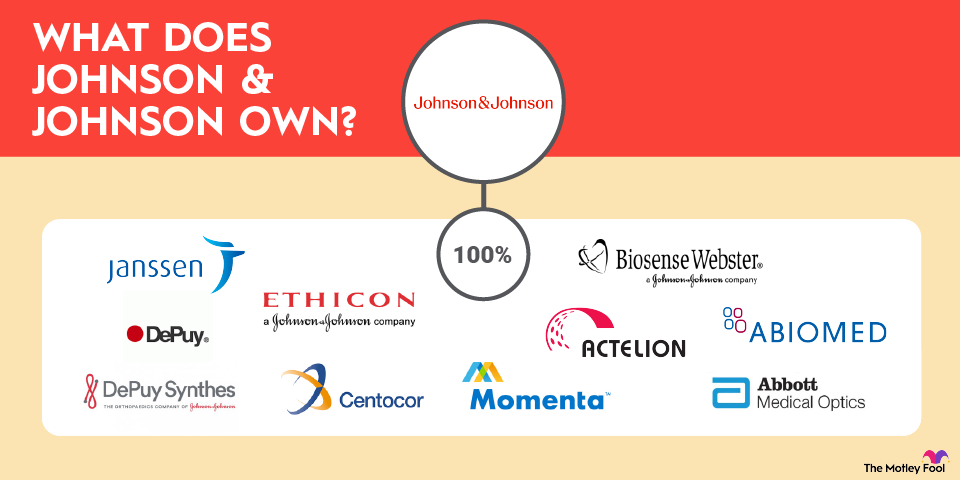
What companies does Johnson & Johnson own?
Johnson & Johnson has two operating businesses:
- Innovative Medicine: The company has a diverse portfolio across many therapeutic areas, including oncology, immunology, neuroscience, cardiovascular, pulmonary hypertension, and retinal diseases.
- MedTech: Johnson & Johnson has a growing medical device and technology division focused on orthopedics, surgery, interventional solutions, and vision care.
The company previously owned a consumer health products business. However, it spun most of that business off to shareholders by creating Kenvue (KVUE +0.59%). While Johnson & Johnson initially retained a minority stake in Kenvue, it exited that position in 2024.
Here's a look at some of the most notable companies Johnson & Johnson has acquired over the years to build its leading Innovative Medicine and MedTech businesses.
1. Ethicon
Johnson & Johnson acquired the company that is now known as Ethicon in 1947. The company makes surgical sutures and wound closure devices. Johnson & Johnson has acquired and merged several other companies into Ethicon over the years, including Mentor Corporation (2008), Acclarent (2009), SterilMed (2011), Verb Surgical (2019), and Auris Health (2019).
2. Janssen Pharmaceutica
Johnson & Johnson bought Belgian research and drug company Janssen Pharmaceutica in 1961. As it is now known, Janssen Pharmaceuticals formed the bedrock of the company's innovative medicine division. Johnson & Johnson has used Janssen to acquire other research companies and drugmakers over the years. Janssen is now Johnson & Johnson Innovative Medicine, which holds its diverse and growing portfolio of therapeutics.
3. DePuy
Johnson & Johnson bought DePuy in 1998 for $3.5 billion. It was one of the world's first orthopedics companies, inventing the first hip and knee replacement implants. Johnson & Johnson combined DePuy with Synthens in 2012 to create the world's largest orthopedic and neurological business.
4. Biosense
Johnson & Johnson bought Biosense in 1997 for $400 million. It would go on to combine that company with its Cordis Webster subsidiary (a company it bought in 1996 for $1.8 billion) to create Biosense Webster, a global market leader in treating cardiac arrhythmia.
5. Centocor Biotech
Johnson & Johnson bought Centocor Biotech for $4.9 billion in 1999 and renamed it Janssen Biotech. Centocor was one of the country's first biotechnology companies. The deal opened the door to a new frontier in medicine for the company. Centocor developed Remicade, a treatment for Crohn's disease, which has become one of the best-selling biotech medications ever developed.
6. Synthes
The company acquired Synthes for $21.3 billion in 2012. The leading manufacturer of orthopedic devices expanded Johnson & Johnson's medical devices and diagnostic segment. It combined Synthes with its subsidiary, DePuy Companies, to create a larger-scale and more innovative orthopedics business.
7. Actelion
Johnson & Johnson acquired Actelion for $30 billion in cash in 2017. The company combined it with Janssen Pharmaceuticals to expand Janssen's portfolio and late-stage pipeline. Actelion developed therapies to treat pulmonary arterial hypertension, including Opsumit, Uptravi, and Tracleer.
8. Abbott Medical Optics
Johnson & Johnson acquired Abbot Medical Optics from Abbott Laboratories (ABT +1.48%) for $4.3 billion in 2017. The company renamed it Johnson & Johnson Vision, combining the surgical ophthalmic portfolio with its ACUVUE contact lens business.
9. Momenta Pharmaceuticals
The company bought Momenta Pharmaceuticals for $6.5 billion in 2020. The transaction expanded Johnson & Johnson's leadership in novel treatments for autoimmune diseases. Momenta developed a pipeline of potential therapeutics led by nipocalimab.
10. Abiomed
The healthcare giant bought Abiomed in 2022 for $16.6 billion. The company was a leader in heart, lung, and kidney support technologies. It helped broaden and strengthen Johnson & Johnson's MedTech product portfolio. Abiomed developed the breakthrough Impella heart pump to treat patients with severe coronary artery disease.
The bottom line
Johnson & Johnson has become a healthcare giant by acquiring companies that enhance and expand its capabilities. The company will likely remain an active acquirer, especially after sharpening its focus on innovative medicine and medical technology by spinning off its consumer health products business. Future deals should help grow the company's earnings and value for shareholders, which could make it a great stock to buy and hold.
Related investment topics
FAQ
Johnson & Johnson FAQ
About the Author