S&P 500 (^GSPC -0.11%) index funds are passive investments that allow investors to match the performance of the S&P 500, an index featuring the 500 largest publicly traded companies in the U.S. They're ideal for investors who want to earn returns in line with the broader market but don't want to own individual stocks. Read on to learn more about these popular funds.
Three best S&P 500 index funds for 2026
These three major S&P 500 index funds are extremely similar in composition since each tracks the performance of the same index:
- Fidelity 500 Index Fund (FXAI.X +0.63%)
- Schwab S&P 500 Index Fund (SWPP.X +0.68%)
- Vanguard 500 Index Fund Admiral Shares (VFIA.X +0.63%)
All three are very low-cost ways to invest in the 500 companies comprising the S&P 500 index. Fidelity has the lowest costs, with a 0.015% expense ratio. Schwab's is only slightly higher at 0.02%, while the Vanguard 500 Index Fund Admiral Shares has a 0.04% expense ratio.
Expense Ratio
Fidelity and Schwab offer their index funds with no minimum investment, making them very accessible to beginning investors. Vanguard has a relatively low minimum investment of $3,000.
Vanguard also offers an exchange-traded fund (ETF) focused on investing in the 500 companies that comprise the S&P 500 index. The Vanguard S&P 500 ETF (VOO -0.11%) has a low minimum investment of one share (around $625 as of mid-November 2025) and a low expense ratio of 0.03%.
This index fund-like product trades on a major stock exchange, allowing investors to buy and sell as they would a stock. Each S&P 500 index fund has very closely replicated the index's performance:
Index or Fund | 1-Year Total Return | 3-Year Total Return | 5-Year Total Return |
|---|---|---|---|
S&P 500 Index | 13.68% | 87.52% | 104.1% |
Vanguard 500 Index Admiral Shares | 13.63% | 87.46% | 103.7% |
Schwab S&P 500 Index Fund | 13.62% | 87.31% | 103.7% |
Fidelity 500 Index Fund | 13.66% | 87.29% | 104.0% |
Negligible differences exist between the performances of the S&P 500 and each of these three index funds that track it. The S&P 500 outperformed each fund slightly, as would be expected when accounting for each fund's expense ratio.
At the S&P 500's rate of return, a $10,000 investment made five years ago would have grown to $20,410 by mid-November 2025. For comparison, a $10,000 investment in the Fidelity 500 index fund would have grown to $20,400 over the same five-year period, with slight variations due to fees and tracking.
With any of these three funds, you can expect your investment to deliver a virtually identical performance to the S&P 500, minus fees. Given its lower expense ratio, Fidelity's S&P 500 index fund will likely continue to slightly outperform the funds from Schwab and Vanguard over the longer term.
Why are they popular?
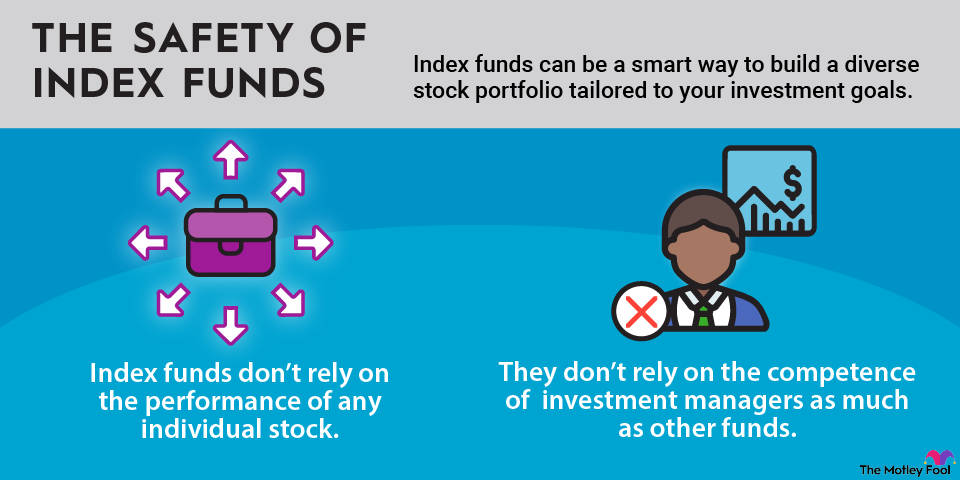
An index fund is designed to mirror the performance of a stock index. An S&P 500 index fund invests in each of the 500 companies in the S&P 500. It doesn't try to outperform the index. Instead, it uses the index as its benchmark and aims to replicate its performance as closely as possible.
S&P 500 funds are the most popular type of index fund by far. However, index funds can be based on practically any financial market, investing strategy, or stock market sector. Index funds are popular with investors for a number of reasons. They offer easy portfolio diversification, with some funds providing broad exposure to hundreds or even thousands of stocks and bonds.
You don't risk losing all your money if one company collapses, as you could with individual investments. However, you also don't have as much upside potential for the astronomical returns that can result from picking a single huge winner.
Index funds are passively managed, meaning you're not paying someone to actively pick and choose investments. Passively managed funds result in a lower expense ratio due to having lower investment management fees than actively managed funds.
Your money will track the market's performance
Historically, the S&P 500's annual returns have been in the range of 9% to 10%. In some years, the index will lose value. For example, during the Great Recession, the S&P 500 lost about half its value. Meanwhile, the index experienced a bear market starting in early 2022 and had declined by more than 20% from its peak by the fall.
However, the index rallied by 24% in 2023. On Nov. 11, 2024, the index crossed 6,000 for the first time. The index rose by another 23% in 2024. Despite a major sell-off in March and April, largely due to concerns about tariffs and higher-than-expected inflation, the S&P 500 was up about 16% year to date as of early December 2025.
The S&P 500 index has a solid history of such rebounds. Over the long term, the index has always recovered. A 20-year investment has never resulted in a loss in the S&P 500's history.
You will keep more of your investment profits in your pocket
S&P 500 index funds are low-cost investments. While active managers are likely to match or even beat the market's performance over time, their fees eat away at your returns. Because they're passive investments with low fees, S&P 500 index funds deliver returns that mirror the index's returns over the long term.
You'll be investing in 500 of the most profitable companies in the U.S.
The corporations represented in the S&P 500 are subject to stringent listing criteria. To join the index, a company must have a $22.7 billion market capitalization, and the sum of its past four quarters' earnings must be positive.
Each company must also get approval from an index committee. The S&P 500's largest holdings include Apple (AAPL -1.28%), Nvidia (NVDA -2.66%), Microsoft (MSFT -1.33%), Amazon (AMZN +1.78%), and Meta (META -1.10%).
You can put your investment decisions on autopilot
The S&P 500 has a flawless track record of delivering profits over long holding periods, allowing you to invest without worrying as much about stock market fluctuations. You also don't have to research or follow individual companies.
You can simply budget a certain amount and automatically invest it on a regular schedule. This practice is known as dollar-cost averaging. Even if you pick individual stocks, S&P 500 funds are a good foundation for your investment portfolio since you're guaranteed the returns of the stock market.
Advantages and disadvantages of investing in the S&P 500
Advantages of investing in the S&P 500 include:
- Solid historical performance: The S&P 500 has a well-established history of building wealth over time, with an average annual return of about 10%.
- Automatic diversification: Because you're investing across 500 different companies and all stock market sectors, investing in an S&P 500 index fund provides a level of diversification that would be virtually impossible to create with a DIY portfolio.
- Low costs: You can invest in S&P 500 index funds without spending much on investment fees. For example, the Fidelity 500 Index Fund has an expense ratio of 0.015%, which translates to $15 in fees on a $10,000 investment.
Disadvantages of investing in the S&P 500 include:
- You can't achieve market-beating returns: An index fund aims to track its benchmark index as closely as possible, rather than outperform it. After you account for fees, your returns will be slightly lower than the returns of the S&P 500 index.
- No small-cap or mid-cap exposure: Though large companies like those included in the S&P 500 index tend to be stable and profitable, small- and mid-cap stocks tend to have greater potential returns. However, they also carry greater risk.
- Potential for short-term volatility: The S&P 500 has a great track record of delivering long-term profits, but investing in stocks is risky in the short term. Because of the potential for a market downturn, it's best to avoid investing money in stocks if you expect you'll need the money within three to five years.
Be wary of leveraged S&P 500 index funds
Be wary of leveraged funds advertised as S&P 500 ETFs. Leveraged ETFs use borrowed money and/or derivative securities to amplify investment returns or to bet against the index. For example, a 2x-leveraged S&P 500 ETF is intended to return twice the index's daily performance. So, if the index rises by 2%, the ETF's value rises by 4%. But if the index falls by 3%, the ETF loses 6%.
These leveraged products are intended to be day-trading instruments and have an inherent downside bias over the long term. In other words, a 2x-leveraged S&P 500 ETF will not return twice the index's performance over the long term.
Investing in S&P 500 index funds is one of the safest ways to build wealth over time. But leveraged ETFs -- even those tracking the S&P 500 -- are highly risky and don't belong in a long-term portfolio.
How to choose the right S&P 500 index fund
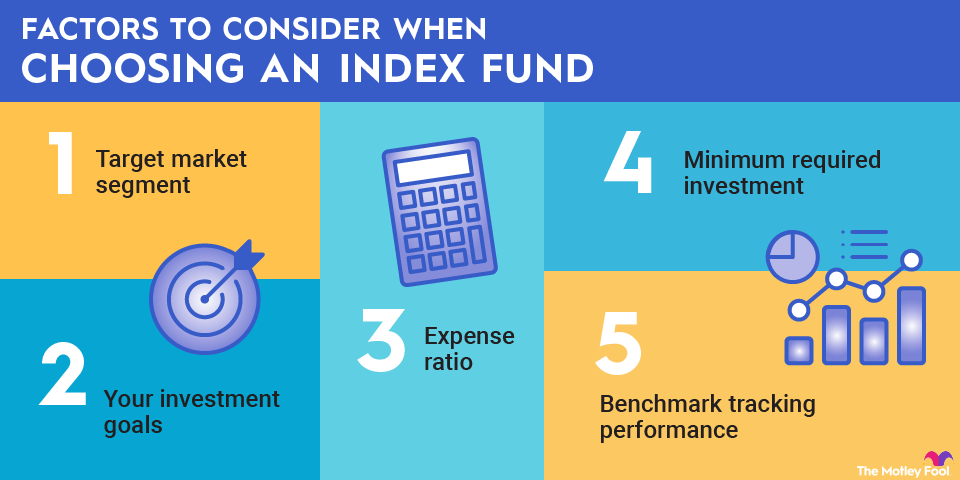
Here are a few factors to consider when you choose an S&P 500 index fund:
- Expense ratio: Look for a fund with a low expense ratio to minimize the amount you spend on fees and maximize the amount of money that actually gets invested.
- Minimum investment: Some S&P 500 index funds have a minimum investment that can run as high as $3,000. However, several funds have no minimum investment or allow you to start investing by buying a single share.
- Tracking error: A low tracking error means a fund closely replicates the underlying index's returns. Many S&P 500 index funds have a tracking error as low as 0.01% or 0.02%.
Related investing topics
How to invest in S&P 500 index funds
You can easily invest in S&P 500 index funds by following these steps:
- Open your brokerage app: Log in to your brokerage account where you handle your investments.
- Search for the index fund: Enter the ETF or mutual fund's ticker or name into the search bar to bring up the stock's trading page.
- Decide how many shares to buy: Consider your investment goals and how much of your portfolio you want to allocate to this index fund.
- Select order type: Choose between a market order to buy at the current price or a limit order to specify the maximum price you're willing to pay.
- Submit your order: Confirm the details and submit your buy order.
- Review your purchase: Check your portfolio to ensure your order was filled as expected and adjust your investment strategy accordingly.
FAQ
About the Author