While artificial intelligence (AI) often grabs headlines through chatbots like ChatGPT, most real-world business value comes from less visible applications.
Today’s most impactful uses of AI tend to fall into a few categories:
- Automation: Replacing or augmenting repetitive human tasks
- Decision intelligence: Making better predictions using large data sets
- Personalization: Tailoring products, content, or ads at scale
- Physical AI: Powering robotics, autonomous vehicles, and industrial systems
The ten companies below illustrate how AI is being deployed across these areas in meaningful ways.
Ten companies leveraging AI in compelling ways
| Name and ticker | Market cap | Dividend yield | Industry |
|---|---|---|---|
| Amazon (NASDAQ:AMZN) | $2.6 trillion | 0.00% | Multiline Retail |
| JPMorgan Chase (NYSE:JPM) | $810.5 billion | 1.95% | Banks |
| Meta Platforms (NASDAQ:META) | $1.7 trillion | 0.32% | Interactive Media and Services |
| Netflix (NASDAQ:NFLX) | $393.5 billion | 0.00% | Entertainment |
| Alphabet (NASDAQ:GOOGL) | $4.0 trillion | 0.25% | Interactive Media and Services |
| Upstart (NASDAQ:UPST) | $4.4 billion | 0.00% | Consumer Finance |
| Tesla (NASDAQ:TSLA) | $1.5 trillion | 0.00% | Automobiles |
| Boeing (NYSE:BA) | $197.5 billion | 0.00% | Aerospace and Defense |
| Johnson & Johnson (NYSE:JNJ) | $530.4 billion | 2.33% | Pharmaceuticals |
| ExxonMobil (NYSE:XOM) | $569.2 billion | 2.96% | Oil, Gas and Consumable Fuels |
AI as operational leverage
1. Amazon

NASDAQ: AMZN
Key Data Points
Amazon (AMZN -0.08%) uses AI across nearly every layer of its business.
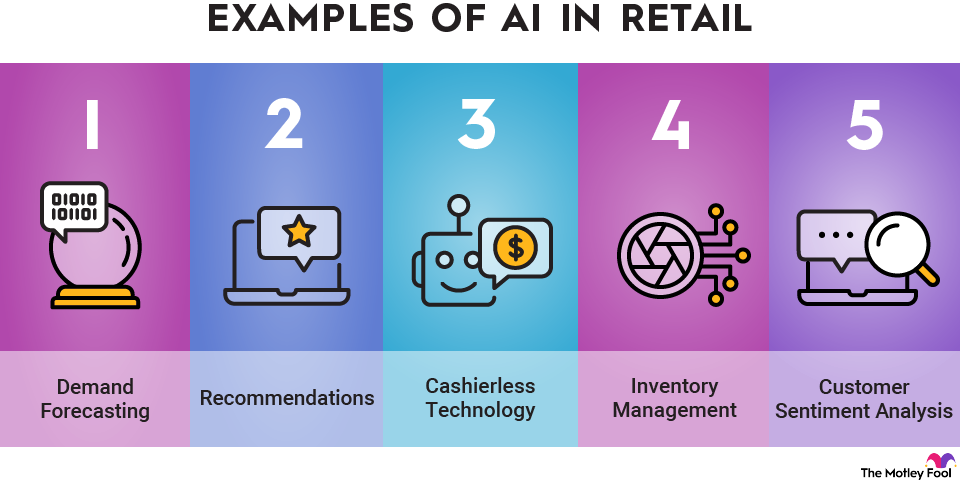
Behind the scenes, AI models forecast demand, optimize inventory, route deliveries, and manage warehouses. In customer-facing roles, AI improves product recommendations, search results, and voice interactions through Alexa+.
Amazon’s “Just Walk Out” technology shows AI in the physical world using computer vision and machine learning to eliminate checkout lines entirely.
For Amazon, AI isn’t a feature. It’s a cost-reduction and efficiency engine operating at massive scale.
2. JPMorgan Chase

NYSE: JPM
Key Data Points
JPMorgan Chase (JPM +0.83%) uses AI to process enormous volumes of financial data more efficiently.
Its applications include:
- Fraud detection
- Credit risk assessment
- Algorithmic trading
- Internal research tools for employees
The bank has reported that AI tools save workers hours each day by surfacing relevant information quickly. In a data-heavy industry, those time savings translate directly into productivity gains.
AI as personalization and engagement
3. Meta Platforms

NASDAQ: META
Key Data Points
Meta Platforms' (META +2.29%) advertising empire depends on AI.
Its algorithms determine what users see, what ads they’re shown, and how effectively advertisers reach their audiences. AI also moderates content, powers translations, and enables chatbots across its platforms.
More recently, Meta has pushed generative AI into ad creation and consumer-facing tools, positioning AI as a way to improve both engagement and monetization.
4. Netflix

NASDAQ: NFLX
Key Data Points
Netflix (NFLX -0.19%) Netflix relies on AI to personalize nearly every aspect of its service.
Machine-learning models decide:
- Which titles appear on your homepage
- Which artwork you see
- How content is localized and dubbed globally
Netflix is also experimenting with generative AI in production workflows, using it selectively for visual effects and creative efficiency.
AI as product differentiation
5. Alphabet

NASDAQ: GOOGL
Key Data Points
Alphabet (GOOG +1.97%) (GOOGL +2.05%) applies AI across search, advertising, cloud computing, and autonomous vehicles.
Its Gemini models power chat, search enhancements, and developer tools, while Waymo applies AI to real-world driving. Google Cloud offers AI services that help businesses deploy their own models securely.
Few companies integrate AI as deeply across as many products as Alphabet does.
6. Upstart

NASDAQ: UPST
Key Data Points
Upstart (UPST +0.02%) uses AI to rethink credit underwriting.
Instead of relying solely on traditional credit scores, its models evaluate borrowers using thousands of data points. The company says this improves approval rates while maintaining risk standards.
AI isn’t a side feature here, it’s the company’s core product.
AI in the physical world
7. Tesla

NASDAQ: TSLA
Key Data Points
Tesla's (TSLA -2.71%) push toward autonomous driving is fundamentally an AI challenge.
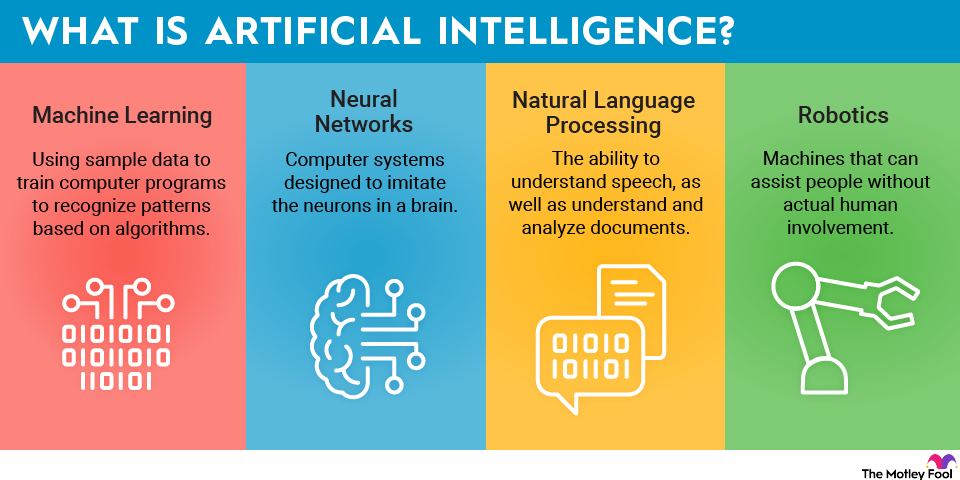
Its systems use real-time camera data and neural networks to interpret the driving environment. Tesla is also developing humanoid robots designed to operate autonomously in industrial settings.
While timelines remain uncertain, Tesla’s AI investments aim to create entirely new revenue streams.
8. Boeing

NYSE: BA
Key Data Points
9. Johnson & Johnson

NYSE: JNJ
Key Data Points
10. ExxonMobil

NYSE: XOM
Key Data Points
Top industries embracing artificial intelligence
Not surprisingly, the technology industry is rapidly responding to the AI shift. Semiconductor and hardware companies are racing to develop more powerful components to deliver AI computing, and software companies are also embracing AI to make them more useful and relevant, as AI-driven software can be a significant time-saver.
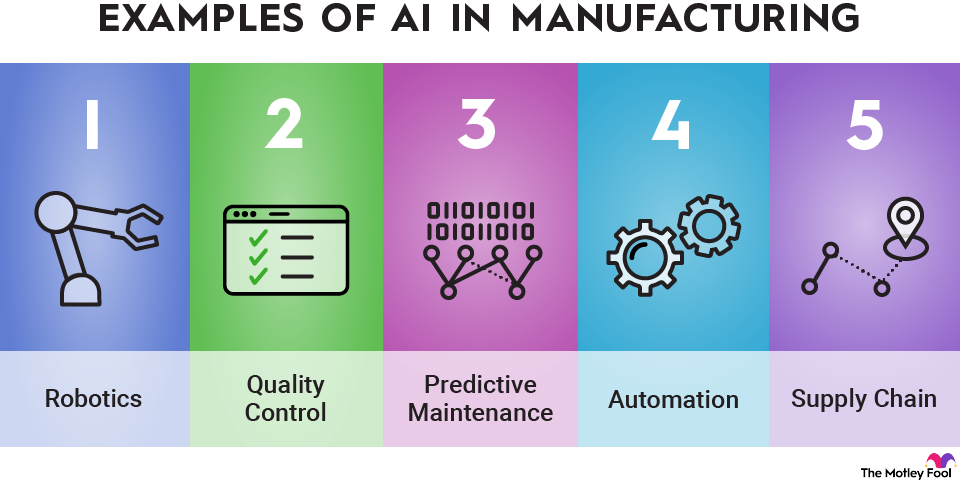
Industrials are also being affected by AI. Manufacturers like automakers are using AI to design cars with optimized aerodynamics and to power driver-assist systems and autonomous driving. In factories, AI is also being implemented through tools like collaborative robots and algorithmically for functions like inventory management and predictive maintenance.
In finance, AI is being used for fraud detection and prevention, risk management and credit scoring, and planning and forecasting. Industries with a lot of data tend to be well-suited to AI, and finance fits the bill there.
Challenges of utilizing AI in the business world
While AI is valuable in a number of ways, it can also present challenges for businesses.
- AI is expensive: We're still in the expansion or "land grab" phase of AI, with companies rapidly opening data centers and spending billions of dollars to do so. That means both hardware and software companies are going to have to pay for the AI capabilities that are currently being built out.
- Privacy concerns: There is a long history of AI raising privacy issues. For instance, Amazon's facial recognition tool, Rekognition, was the focus of much controversy when it rolled out to police.
- Workforce disruption: AI is already changing the workforce as entry-level coding jobs are becoming much harder to find, a sign that work is being replaced by AI. We'll likely see the new technology disrupt other jobs in the coming years.
- Misinformation: Generative AI tools like ChatGPT and Google's AI Overviews are known for "hallucinating" at times, or making up facts. It's important for AI users to double-check information from chatbots with verifiable sources.
How many companies use AI?
AI adoption is growing rapidly, and the launch of ChatGPT in November 2022 was a pivotal moment, showing how powerful AI had become. According to research from Stanford University, 78% of organizations surveyed were using AI in 2024, up from 55% in 2023.
Still, many companies have not deployed it across the business. Almost two-thirds of respondents to a McKinsey survey said they had yet to scale it, meaning they were still in the experimentation and piloting phase.
AI is still relatively new. At this stage, businesses seem to know that it's important, but don't quite know how to leverage it. A Massachusetts Institute of Technology (MIT) report said that 95% of generative AI pilots are failing, showing that there's still a gap between available technologies like AI agents and how they're being implemented.
Related investing topics
FAQ
FAQ: Companies Using AI
About the Author