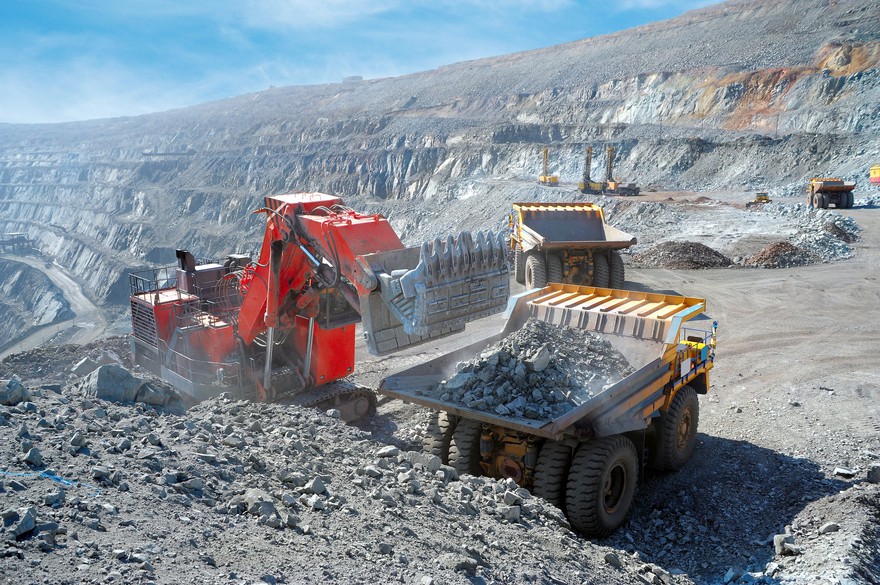
Iron stocks don’t always grab headlines, but the industry behind them is anything but small. Iron is a core ingredient in steel, and steel is everywhere, from apartment buildings and bridges to cars, appliances, and massive cargo ships. Without iron, much of the modern world simply wouldn’t function.
Iron stocks are publicly traded companies that mine and process this essential metal, supplying the raw materials that keep global construction and manufacturing moving. And after a few turbulent years, the landscape is shifting. Commodity prices have cooled from their pandemic-era highs as supply chains have normalized, leaving investors to ask an important question: Is now a smart time to invest?
Below, we’ll break down how iron mining stocks work, what to watch for as an investor, and which iron stocks stand out right now.

Top iron stocks in 2026
Most iron mining companies are not pure-play iron stocks. They mine other industrial metals such as copper, and many have downstream operations, including smelting and even steel production. With that in mind, let's take a look at some of the metal stocks that play a role in the iron stock market sector.
1. BHP Group

NYSE: BHP
Key Data Points
If large and diverse is what you're looking for from your iron stocks, you can't beat BHP Group. With operations in steel-making commodities such as iron and metallurgical coal and high-tech base metals such as copper and nickel, BHP has a lot of growth levers to pull.
For the fiscal year ending in June 2025, BHP produced 263 million tons of iron ore used for infrastructure and manufacturing, making it one of the biggest global iron ore producers. The company says it's the lowest-cost major iron ore company in the world, giving it a competitive advantage since it can earn a wider margin than its peers. For fiscal 2026, it expects a production cost of $18.00 to $19.50 per ton at its Western Australia Iron Ore operation, where almost all of its iron ore comes from. In fact, in 2024, it reported an earnings before interest, taxes, depreciation, and amortization (EBITDA) margin of 63% in iron ore. It's targeting at least 305 million tons of annual production over the medium term. BHP's dividend fluctuates according to performance, but the stock offered a generous 3.6% yield in December 2025.
2. Rio Tinto

NYSE: RIO
Key Data Points
Like BHP, Rio Tinto is a large, diverse company that focuses exclusively on mining metals and minerals such as diamonds. Iron ore made up $29.3 billion of the company's $53.7 billion in sales in 2024 as lower prices weighed on revenue and profits.
Iron ore volume fell slightly from 331.5 million tons to 328 million tons, and iron revenue declined from $32.2 billion to $29.3 billion due to lower prices for the key steel input. Underlying EBITDA in the segment fell 19% to $16.2 billion, showing how profitable those operations are (at least before backing out depreciation, which tends to be an expensive line item for mining companies).
Current management is focused on recovering from the 2020 scandal when it blasted a 4,000-year-old Aboriginal site in Australia, an issue that led to the resignation of both the CEO and board chairman, and business performance has been steady since.
The company named Simon Trott as its new CEO in August 2025. He had previously led the company's iron ore division. Under Trott, the company is focused on streamlining the business by cutting costs and selling non-core assets.
Rio Tinto is also an attractive dividend stock, offering a dividend yield of 4.9%.
3. Vale

NYSE: VALE
Key Data Points
If you're looking for a pure-play iron mining stock, Vale is about the best you're going to do. In 2024, 83% of its $38.1 billion in revenue came from ferrous minerals or iron-based metals, most of which were iron ore. Copper and nickel made up most of the remainder of its revenue.
Operating income fell 24% to $10.8 billion as falling commodity prices weighed on Vale, and gross margin declined from 42.3% to 36.2%. Through the first three quarters of 2025, the business has stabilized as commodity prices have been relatively stable.
Vale has sharpened its focus on safety after its Brumadinho dam in Brazil collapsed in 2019, killing 270 people. The disaster led to financial, legal, and reputational damage for Vale, and senior managers in charge of the dam were arrested. As a result, the company is decommissioning 30 dams and aiming for zero high-risk injuries by 2025.
Like the other large miners, Vale is also a dividend powerhouse and currently offers a yield of 11.4%.
4. Anglo American

OTC: NGLOY
Key Data Points
Anglo American is a diversified miner with four business segments: diamonds, base metals, including copper and nickel, platinum and related metals, and iron ore. The company entered an agreement in 2024 to sell its steelmaking coal and nickel businesses for $5.3 billion.
In 2024, iron ore was its second most profitable segment after copper, with $2.7 billion in EBITDA out of a total of $8.4 billion. Iron ore profits were down roughly a third from 2023 due to falling prices, and overall EBITDA fell 1% to $8.5 billion. Its iron ore business bounced back with volume doubling and an EBITDA margin of 44%.
The stock currently offers a dividend yield of 2.5%, considerably lower than its peers. The company's opening of the Quellaveco copper mine in Peru in 2022 was a major accomplishment. Quellevaco produces more than 300,000 tons of copper annually. The mine is powered by renewable energy, helping the company accomplish its goal of reducing its carbon footprint.
5. ArcelorMittal

NYSE: MT
Key Data Points
Based in Luxembourg, ArcelorMittal is the largest steel producer in Europe and one of the largest in the world. In 2024, it produced 54.3 million tons of steel and 42.4 million tons of iron ore. Production was roughly flat in 2024, though revenue declined due to the same pricing pressures that its peers faced. Through the first three quarters of 2025, revenue was up 3%.
As a market leader in steel, the company has a number of competitive advantages. In automotive steel, it has production facilities around the world, giving it a proximity advantage in supplying nearby manufacturers since transporting these materials can be expensive. Unlike most steel manufacturers, ArcelorMittal is vertically integrated with its own iron mining operations, and the company believes it can use those materials more efficiently than its peers since it has more control over them. Vertical integration also helps with procurement and lowering logistics costs, and ArcelorMittal can focus its mining operations on iron, which is highly valued for steel. It has also expanded through acquisitions. In June 2025, it bought Nippon Steel's 50% stake in AM/NS Calvert, one of North America's most advanced steel-making facilities.
Still, like any mining company, Arcelor Mittal is sensitive to commodity prices, and it finished 2024 with an EBITDA margin of 11%. The stock offers a dividend yield of 1.2%.
6. Cleveland-Cliffs
Should you invest in iron stocks? What to know before you buy
Iron stocks are driven more by commodity forces than company-specific headlines, which makes them different from most other equities. Understanding what actually moves the sector can help you avoid common pitfalls.
Prices matter more than predictions.
Iron miners don’t set the price of iron ore, the global market does. That means profits can swing sharply when prices rise or fall. While prices are hard to forecast, stronger companies tend to stand out by growing production efficiently and keeping costs low when the cycle turns.
Cost control and scale are competitive advantages.
Low-cost producers can stay profitable even when iron prices weaken. Large miners with efficient operations, long-lived assets, and strong logistics networks are often better positioned to weather downturns than smaller, higher-cost players.
Vertical integration can reduce risk.
Some companies mine iron ore and also produce steel or finished products. That added control can help smooth results, lower logistics costs, and reduce exposure to raw commodity price swings.
Dividends can be generous -- and volatile.
Many iron stocks offer high dividend yields, but payouts often fluctuate with profits. A double-digit yield isn’t guaranteed income, and it can shrink quickly if prices fall. It’s worth understanding whether dividends are fixed or tied directly to earnings.
Debt levels matter in a cyclical industry.
Iron mining is capital-intensive, and high debt can become a problem during downturns. Companies with stronger balance sheets tend to have more flexibility when prices soften or demand slows.
Global demand, especially from China, plays a major role.
China is the world’s largest consumer of iron ore, so its economic health has an outsized impact on prices. Infrastructure spending, construction activity, and manufacturing trends all feed directly into demand.
Operational and regulatory risks are real.
Mining carries safety, environmental, and regulatory risks. Major incidents can lead to costly shutdowns, legal trouble, and long-term reputational damage, making operational discipline an important factor for investors.
How to invest in iron stocks
1. Open your brokerage app: Log in to your brokerage account where you handle your investments.
2. Search for the stock: Enter the ticker or company name into the search bar to bring up the stock's trading page.
3. Decide how many shares to buy: Consider your investment goals and how much of your portfolio you want to allocate to this stock.
4. Select order type: Choose between a market order to buy at the current price or a limit order to specify the maximum price you're willing to pay.
5. Submit your order: Confirm the details and submit your buy order.
6. Review your purchase: Check your portfolio to ensure your order was filled as expected and adjust your investment strategy accordingly.