A small-cap index fund is an exchange-traded fund (ETF) that tracks a small-cap stock index, like the Russell 2000, holding all its constituent stocks to match its performance. Small-cap companies typically have market caps between $300 million and $2 billion, and are often younger, faster-growing businesses.
These funds offer four key advantages: portfolio diversification across sectors, risk reduction through broad exposure, bull market outperformance relative to large caps, and attractive long-term growth potential, though with greater volatility during downturns.
If you want broad small-cap exposure, the four ETFs below are strong options.
Top small-cap index funds to consider
| Name and ticker | Market cap | Dividend yield | Industry |
|---|---|---|---|
| iShares Trust - iShares Russell 2000 Growth ETF (NYSEMKT:IWO) | $0.0 thousand | 0.00% | Capital Markets |
| iShares Core S&P Small-Cap ETF (NYSEMKT:IJR) | $0.0 thousand | 0.00% | Capital Markets |
| Schwab Strategic Trust - Schwab U.s. Small-Cap ETF (NYSEMKT:SCHA) | $0.0 thousand | 0.00% | Capital Markets |
| Vanguard Small-Cap Value ETF (NYSEMKT:VBR) | $0.0 thousand | 0.00% | Capital Markets |
1. iShares Russell 2000 Growth ETF

NYSEMKT: IWO
Key Data Points
As its name implies, the iShares Russell 2000 Growth ETF aims to track Russell 2000 stocks that exhibit growth characteristics.
This ETF has performed well in bull markets but also falls faster when stocks are down. It is at its best when investors are putting money into smaller, more speculative companies. As the fund's name notes, it is focused on growth: It aims to provide exposure to small companies with earnings that are expected to grow at an above-average rate relative to the market.
A growth-oriented fund such as the iShares Russell 2000 Growth ETF carries more inherent risk, but it has a reasonable expense ratio of 0.24% for investors looking for small-cap growth.
2. Schwab U.S. Small-Cap ETF

NYSEMKT: SCHA
Key Data Points
The Schwab U.S. Small-Cap ETF tracks the small-cap holdings of the Dow Jones U.S. Total Stock Market index. This is sort of a middle-of-the-road index fund ETF. It is neither overly conservative nor too aggressive with its holdings. Since it holds a mix of high-risk and low-risk stocks, the risk is lower than it would be for a purely growth-oriented fund. If you're a believer in diversification, this fund provides it.
A cheap expense ratio of 0.04%, along with a 10-year compound annual growth rate of more than 7%, including dividends, makes the ETF an appealing way to invest in domestic small-caps. The fund also pays a dividend at a yield of 1.26% of the share price.
3. iShares Core S&P Small-Cap ETF

NYSEMKT: IJR
Key Data Points
Exchange-Traded Fund (ETF)
4. Vanguard Small-Cap Value Index ETF

NYSEMKT: VBR
Key Data Points
The Vanguard Small-Cap Value Index Fund ETF tracks the CRSP U.S. Small Cap Value index. As a value-oriented index tracking fund, the ETF doesn't offer the highest share price growth potential, but it should outperform in bear markets. That's because valuations, especially of high-priced stocks, tend to compress in recessions.
Investors need to be clear about the trade-off they are making when they consider a value fund. This and other value-oriented investments tend to underperform when the markets are soaring, but can provide valuable ballast at times when markets are under pressure.
Currently, the fund offers a dividend of 2% and an attractive expense ratio of 0.07%.
How small-cap index funds work
Small-cap index funds work by passively tracking a small-cap stock market index, like the Russell 2000. The fund aims to hold the same stocks in similar proportions to mirror the index's performance, offering broad diversification in smaller, high-growth companies with lower costs than active funds, but with higher volatility.
In this way, small-cap index funds provide a simple way to gain exposure to potentially explosive growth from emerging businesses, balancing risk across hundreds of companies instead of picking individual stocks.
Benefits of small-cap index funds
- Portfolio diversification: Investing in a small-cap index fund exposes your portfolio to a wide range of small-cap stocks across different sectors. Diversified portfolios generally perform better than non-diversified holdings because owning the stocks of many different companies ensures that your portfolio's performance is not strongly correlated with the performance of any specific stock and is more resistant to bear markets.
- Risk reduction: Small-cap stocks can be risky since they tend to move cyclically with the broader economic cycle. They are also more volatile than large-cap stocks. Investing in an index fund eliminates some of the risk because the fund gives you a stake in dozens of companies.
- Bull market gains: Although large-cap companies are more likely to be profitable, have better access to capital, and can better withstand recessions, small-cap companies tend to outperform during bull markets, which occur when the stock market is on the rise.
- Attractive growth potential: The stocks of small-cap companies have historically outperformed those of large caps thanks to their greater growth potential.
Key factors to consider when choosing a small-cap index fund
Small-cap stocks are generally considered more volatile than larger companies and can be more vulnerable to market fluctuations and economic headwinds. Investors who tend to worry about market volatility might want to limit their exposure to small-caps.
The best remedy for volatility is time in the market. Small-cap stocks and the funds that hold them tend to be better suited as long-term investments, providing the time needed to ride out economic cycles.
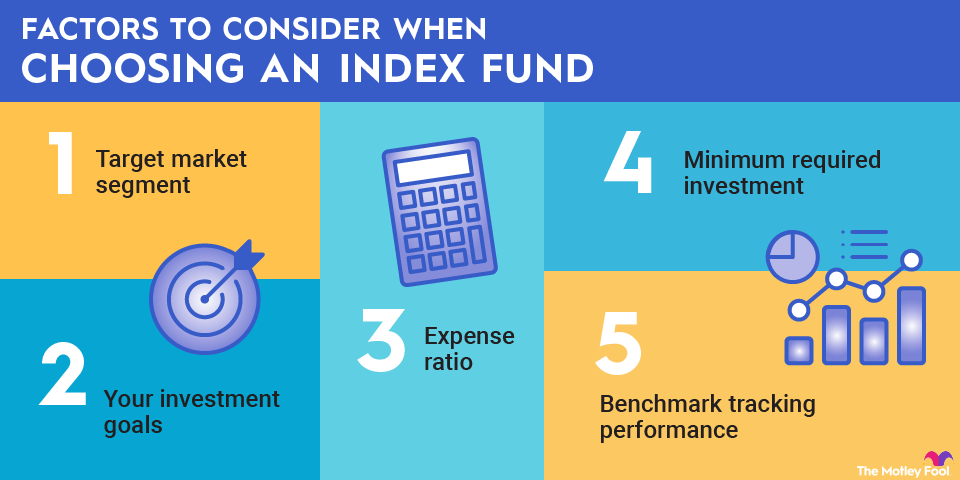
When picking between individual funds, investors should be focused on cost-effectiveness. You can't control the direction of the market or the performance of individual stocks. But you can control the fees you pay on your investments. Look for the expense ratios listed on individual fund websites, and try to find low-cost options.
Is a small-cap index fund right for you?
As you can see from the list above, small-cap investing doesn't have to be complicated. The four index fund ETFs offer a range of benefits, including growth, value, and income, and all have solid track records. With thousands of small-cap stocks available on the market, buying one of these is a smart and convenient way to reduce the risk of investing in the sector by gaining exposure to a wide range of companies with just one or two investments.