Real estate has long been a cornerstone of diversified portfolios, prized for its income potential, inflation protection, and lower correlation to traditional stocks and bonds. But not everyone wants to deal with the headaches of being a landlord.

That's where real estate exchange-traded funds (ETFs) come in. The funds let you invest in professionally managed portfolios of real estate companies without owning physical property.
Exchange-Traded Fund (ETF)
Unlike rental properties, real estate ETFs offer instant diversification, no tenants to manage, no maintenance or repair costs, no mortgages, and no property taxes. Better yet, you can hold them in tax-sheltered accounts such as a Roth IRA (individual retirement account), making them a hassle-free way to tap into the real estate market.
What are real estate ETFs, and how do they work?
A real estate ETF is essentially a basket of securities that trades like a stock on an exchange. Instead of owning one company, you get exposure to a group of real estate-related firms in a single trade.
Most real estate ETFs invest primarily in real estate investment trusts (REITs) -- companies that own, operate, or finance income-producing properties such as apartment buildings, shopping centers, warehouses, and office spaces. REITs are required by law to distribute at least 90% of their taxable income to shareholders as dividends, making them popular with income-focused investors.
These ETFs can be passively managed, meaning they track a real estate index and simply replicate its holdings, or actively managed, with portfolio managers handpicking a mix of REITs and other real estate companies based on their outlook for the sector.
Not all real estate ETFs are purely REITs, though. Some include real estate operating companies (REOCs) and real estate service providers. Unlike REITs, REOCs don't have the same income distribution requirements and may reinvest profits instead. REOCs might include property developers, real estate brokerages, or firms that provide services such as title insurance or property management.
So, while the majority of real estate ETFs are REIT-heavy and income-oriented, some offer broader exposure to the entire real estate ecosystem, making it easy to tailor your exposure depending on your goals.

How to invest in real estate ETFs
Before buying a real estate ETF, it's essential to clarify why you want exposure to this sector. Investors typically consider real estate ETFs for one of three reasons:
- As a liquid alternative to owning physical property, with a focus on earning steady, above-average real estate-linked income
- As a way to speculate on macro tailwinds, such as falling interest rates, which could boost real estate asset prices
- As a long-term sector bet on real estate growth or to express a view on a specific subsector, such as data centers, healthcare properties, or industrial warehousing
Your reason matters because it helps determine which type of real estate ETF fits best. A broad REIT ETF is likely the most suitable if your priority is income and liquidity. If you're trying to capitalize on falling rates, a mortgage REIT ETF may be more responsive. And if you're targeting growth in a particular segment, there are specialized ETFs that focus on areas like data centers or office properties.
Once you've narrowed your focus, be sure to evaluate each fund's historical risk metrics. Look at the standard deviation to understand how volatile the fund has been over time, as well as the maximum drawdown to see how far it has fallen in past downturns.
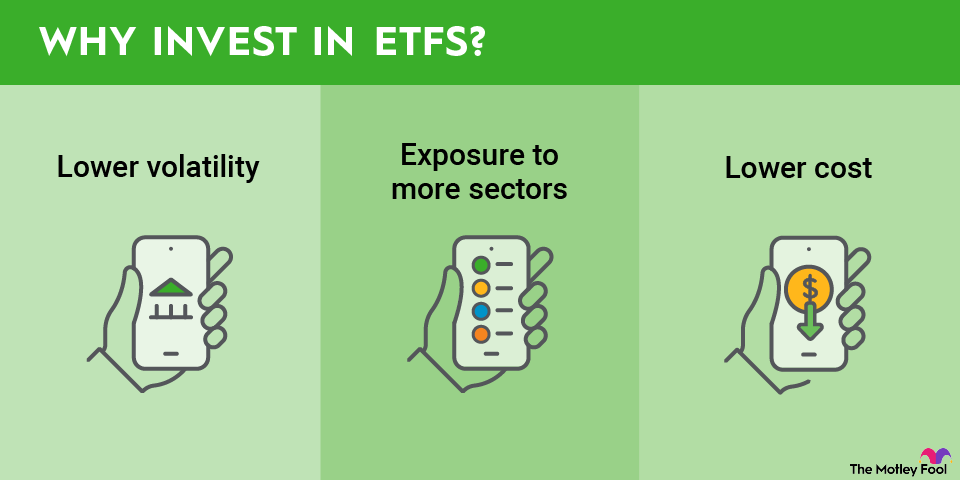
Also consider the expense ratio, which reflects how much the fund costs to own annually. For example, a 0.25% expense ratio would cost you $25 a year on a $10,000 investment.
Real estate ETFs can be bought through any self-directed brokerage account, and many are eligible to be held in retirement accounts like a Roth IRA, depending on your provider's platform. Once you've selected the right fund, investing is as simple as entering a buy order like you would for any other stock.
Should I invest in real estate ETFs?
Before investing, it's important to weigh both the benefits and the drawbacks of real estate ETFs, especially if you're deciding between owning a fund or a physical property.
Pros:
- Highly liquid: They trade on public exchanges during market hours, just like a stock, with real-time pricing through bid and ask spreads.
- Diversified exposure: A single ETF often holds REITs from multiple real estate sectors, and each REIT owns a portfolio of properties. So, you're instantly diversified across asset types and regions.
- No mortgage required: You don't need to take out a loan to gain exposure; if you want leverage, you can use margin through your brokerage.
- No tenant hassles: There is no screening, managing, or dealing with tenants. Income comes from REIT dividends, not monthly rent checks.
- No property taxes or maintenance: You're not directly responsible for the recurring costs associated with physical ownership.
Cons:
- Market risk: Because they trade like stocks, real estate ETFs are exposed to stock market volatility, even when real estate prices are stable or rising.
- Dilution risk: Some REITs may issue new shares to raise capital, which can dilute existing shareholders' value.
- Tax inefficiency: You can't deduct costs such as mortgage interest, property taxes, or depreciation like you could with a rental property, making them less flexible from a tax-planning perspective.
Practical tips and strategies for investing in real estate ETFs
Start by assessing your existing exposure. If you already own a home, especially with a mortgage, you already have meaningful exposure to residential real estate. A primary residence is effectively a leveraged real estate investment, so adding more real estate through ETFs increases concentration risk.
Next, consider account placement. REITs and real estate ETFs are generally not very tax-efficient. A large portion of distributions is often taxed as ordinary income rather than as qualified dividends. For higher earners, this can create a noticeable drag on returns in taxable accounts. Using tax-sheltered accounts, such as an IRA, can help preserve more of the income.
Then decide how specific you want to be. Broad real estate ETFs provide exposure across many property types, while sector-focused ETFs concentrate on niches such as residential apartments, industrial warehouses, healthcare facilities, retail properties, data centers, or self-storage. Narrower exposure can increase volatility but may better align with a specific thesis.
Finally, choose between passive and active management. Passive ETFs track a real estate index and tend to offer lower fees and predictable exposure. Actively managed real estate ETFs aim to add value through property selection and cycle management but come with higher costs and manager risk.
Related investing topics
Current trends in real estate ETF investing
One of the strongest structural trends is the growth of data center REITs. Rising demand for cloud computing, artificial intelligence, and digital infrastructure has increased the need for data storage and processing capacity, supporting long-term demand in this segment.
Office REITs remain in recovery mode following post-pandemic disruptions. Vacancy rates are still elevated in many markets, though performance varies widely. Core downtown locations with newer buildings are seeing more stability, while older properties continue to face pressure. These mixed fundamentals have made office-focused ETFs more volatile than other real estate segments.