Know your 401(k) contribution limits
The IRS caps how much you can contribute each year. Here are the limits for 2025 and 2026:
Invest better with The Motley Fool. Get stock recommendations, portfolio guidance, and more from The Motley Fool's premium services.
If you want to retire someday, and retire well, a 401(k) is one of the most powerful tools available to you. It's a retirement savings account sponsored by your employer that lets you invest a portion of each paycheck, grow that money tax-advantaged, and potentially collect free money from your employer along the way.
Here's everything you need to know to use it well.
A 401(k) is a retirement savings plan offered through your employer. You contribute a percentage of your paycheck, invest those funds in the market, and benefit from significant tax advantages while your money grows.
The name comes from the section of the IRS tax code that created it -- not the most inspiring origin story, but the account itself is genuinely one of the best wealth-building tools available to working Americans.

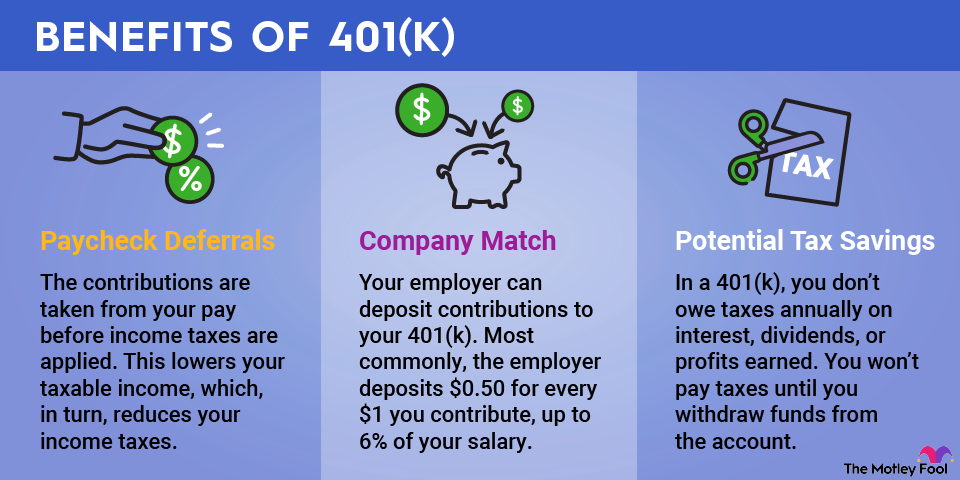
When you enroll in your employer's 401(k) plan, you choose a contribution rate, the percentage of your salary that gets deposited into the account each pay period. That money is deducted from your paycheck before income taxes are applied, which lowers your taxable income for the year.
For example, if you earn $60,000 a year and contribute 10%, you're putting $6,000 into your 401(k) annually. But because those contributions are pre-tax, you're not actually losing a full $6,000 from your take-home pay -- the tax savings offset some of the difference.
Once the money is in your account, you invest it. Your plan will offer a menu of investment options, typically mutual funds, index funds, and target-date funds. Your money then grows tax-deferred, meaning you don't owe taxes on dividends, interest, or gains until you withdraw funds in retirement.
Many employers sweeten the deal by matching a portion of your contributions. A common structure is a 50% match on contributions up to 6% of your salary, meaning if you contribute 6%, your employer adds another 3% on top.
That's effectively a 50% instant return on part of your investment, which is why financial advisors consistently say: always contribute at least enough to get the full employer match.
However, there's an important catch: vesting schedules. Employer contributions often don't fully belong to you until you've worked at the company for a certain number of years. Common structures include:
If you leave a job before you're fully vested, you forfeit the unvested portion of your employer's contributions. Your own contributions are always 100% yours from day one.
Contribution Type | 2025 Limit | 2026 Limit |
|---|---|---|
Standard employee contribution | $23,500 | $24,500 |
Catch-up contribution (age 50+) | $7,500 | $8,000 |
Super catch-up (ages 60–63) | $11,250 | $11,250 |
Total including employer contributions | $70,000 | $72,000 |
A few things to keep in mind:
Opening a 401(k) is step one. Choosing how to invest the money is just as important, and where many people get stuck.
Most 401(k) plans offer a menu of funds to choose from. Here's what you'll typically encounter:
One thing to always check: the expense rat to invest the money is just as important and where many people get stuck. compounds significantly over decades. A $100,000 portfolio with a 1% expense ratio will be worth roughly $30,000 less over 20 years than the same portfolio with a 0.5% expense ratio.
Many employers now offer a Roth 401(k) option alongside the traditional version. The key difference is when you pay taxes:
Traditional 401(k) | Roth 401(k) | |
|---|---|---|
Contributions | Pre-tax (reduces taxable income now) | After-tax (no immediate tax break) |
Investment growth | Tax-deferred | Tax-free |
Withdrawals in retirement | Taxed as ordinary income | Tax-free |
RMDs | Required starting at age 73 | No longer required (as of 2024) |
Which should you choose? A useful rule of thumb:
The 401(k) is designed for retirement, and the IRS enforces that with penalties for early access.
Standard withdrawals: You can take penalty-free withdrawals starting at age 59½. If you leave your employer at age 55 or older, you may be able to access the funds penalty-free under the "Rule of 55."
Early withdrawals: Withdrawals before age 59½ are generally subject to a 10% penalty plus ordinary income taxes. Exceptions include:
Required minimum distributions (RMDs): Starting at age 73, you must begin taking annual withdrawals from a traditional 401(k) whether you need the money or not. The amount is calculated based on your account balance and life expectancy. Roth 401(k)s are no longer subject to RMDs as of 2024.
401(k) loans: Some plans allow you to borrow against your balance — typically up to 50% of your vested balance or $50,000, whichever is less. You repay yourself with interest, but if you leave your job, the loan usually becomes due by your next tax filing deadline. Unpaid loans are treated as distributions and taxed accordingly.
Understand all the ways you can take money out of your 401(k)
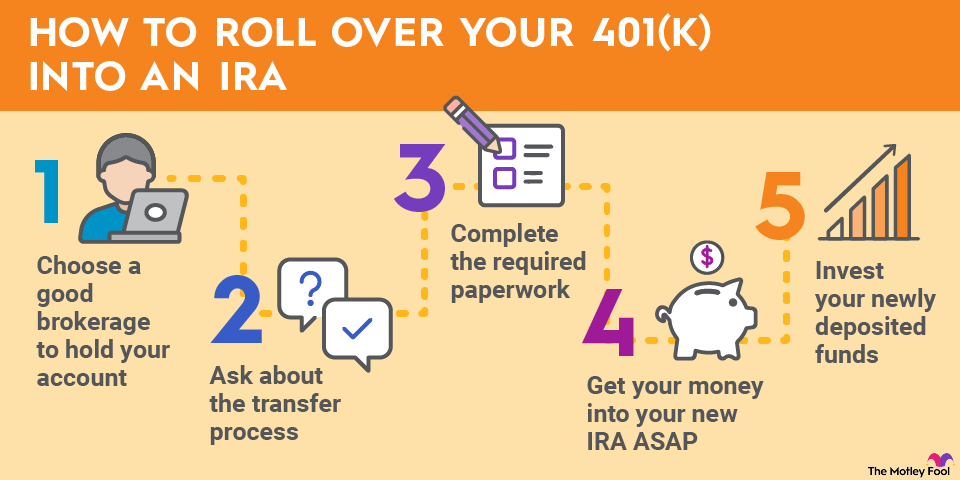
When you leave a job, you have four options for your 401(k):
If you do roll over, always opt for a direct rollover -- your plan administrator sends the money straight to the new account. If the check comes to you instead, 20% will be withheld for taxes, and you'll have 60 days to deposit the full original amount (including the withheld portion) into a new account or face taxes and penalties on the difference.
Not everyone has access to an employer-sponsored plan. If that's your situation:
The 401(k) is one of the most effective wealth-building tools available, especially when you start early, capture the full employer match, keep fees low, and let compound growth do its work over decades. The mechanics take a few hours to understand. The payoff lasts a lifetime.