The best index funds can help you build wealth by diversifying your portfolio while keeping fees low. Unlike investing in individual stocks or bonds, index funds spread your risk across hundreds of securities, meaning your returns aren't tied to the fate of any single company.

Top index funds to consider
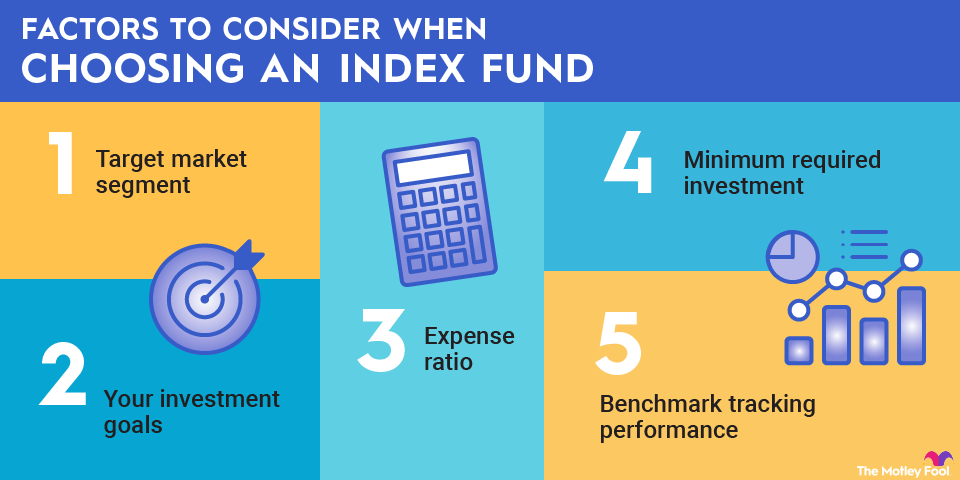
Our picks for the eight best index funds for this year can help you accomplish a variety of investment goals. Plus, they have low expense ratios and low minimum investments.
Many of the funds listed below soared in 2025 in spite of substantial volatility earlier in the year. The rocky performance earlier in the year was largely due to fears of a trade war due to President Trump's tariffs. But remember: Index investing is about building wealth for the long haul, so try not to focus on short-term ups and downs.
1. Fidelity ZERO Large Cap Index Fund

NASDAQMUTFUND: FNILX
Key Data Points
2. Schwab S&P 500 Index Fund

NASDAQMUTFUND: SWPPX
Key Data Points
3. Vanguard Growth ETF

NYSEMKT: VUG
Key Data Points

NYSEMKT: SDY
Key Data Points
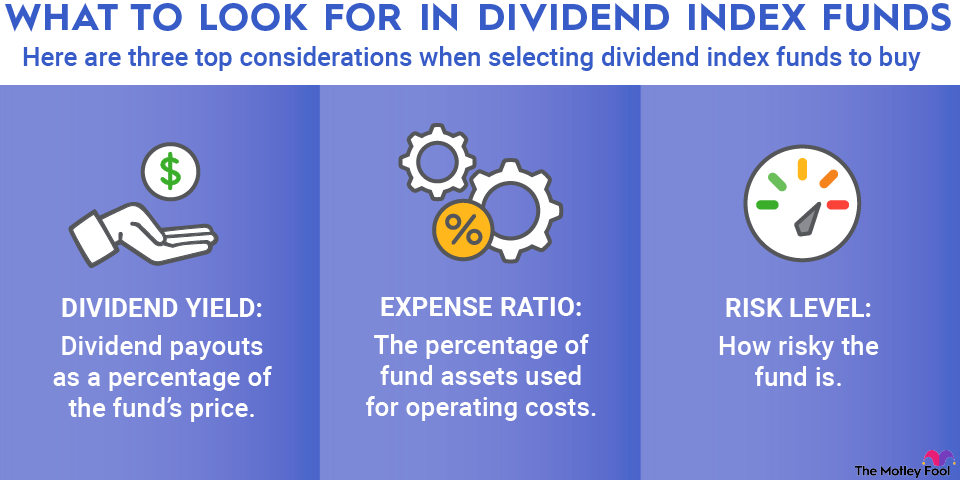
Dividend Yield

NYSEMKT: VNQ
Key Data Points
6. Vanguard Russell 2000 ETF

NASDAQ: VTWO
Key Data Points

NYSEMKT: ROBO
Key Data Points
Artificial Intelligence
The ETF offers investors a way to capture the growth of several booming trends. Robotics offers huge cost savings to companies; the industry is forecast to have a compound annual growth rate of 14% through 2030. Interest in artificial intelligence (AI) stocks has surged since late 2022, when ChatGPT launched. However, the ETF has still underperformed the stock market since then, posting three-year average annualized returns of less than 15% through the end of 2025, compared to about 21% for the S&P 500 over the same period.
8. Schwab Emerging Markets Equity ETF

NYSEMKT: SCHE
Key Data Points
Benefits and risks of investing in index funds
Index funds are often the backbone of a retirement portfolio for good reason: They're an effortless, beginner-friendly way to invest. However, there are a few pros and cons to be aware of first.
Benefits of investing in index funds:
- Low fees: Perhaps the biggest benefit of investing in a passively managed index fund is the low cost because you're not paying fund managers to handpick investments. Many funds have expense ratios of 0.1% or less.
- Diversification: Because an index fund invests in many different companies, you get far more diversification than you can typically get by building a portfolio on your own, particularly if the fund tracks a major index like the S&P 500.
- Good tool for long-term investing: Shares of individual companies can rise and fall dramatically based on rumors, speculation, or a single earnings call. Though the overall stock market isn't immune to investor sentiment, the highs and lows are less pronounced compared to individual stocks.
Risks of investing in index funds:
- You can't beat the market: Some investors hesitate to invest in index funds because they don't beat the market -- index funds aim to replicate an index's performance, so at best, your results will be on par with the underlying index's results, minus fees.
- Not all indexes are the same: Funds that track the entire stock market or a large segment of it, like the S&P 500, have been solid winners over time, but some indexes are incredibly niche and far more vulnerable to market hype.

Index fund fees
Index fund fees are expressed as the expense ratio. If you invest $10,000 in an index fund with a 0.1% expense ratio, $10 of your investment goes toward fees, and the remaining $9,990 is invested. Expense ratio fees cover costs of management, administration, and marketing.
Because they're passively managed and have low overhead, most index funds have extremely low fees. The average index fund expense ratio is 0.06%, according to Morningstar research. By comparison, the average actively managed fund fee is 10 times higher at 0.6%.
The bottom line on index funds for long-term investors
There are two ways to make money from index funds: sell the investment for a gain or earn dividends. A growth-focused index fund, like the Vanguard Growth ETF, has the potential for big gains.
However, higher rewards come with greater risk, and dividend payments will likely be minimal. If you want investment income, a dividend fund like the SPDR S&P Dividend ETF is a good choice. There's less potential for big gains, but you can earn reliable dividend income.
Although there's no single best index fund to invest in, a couple of good options are an S&P 500 index fund, which tracks about 80% of the U.S. stock market, or a total stock market fund, which tracks the entire U.S. stock market. These tend to be good choices because they're well diversified and allow you to lock in the historical growth of the domestic stock market.
All investments carry some risk, but S&P 500 index funds have been historically safe investments for the long term since the S&P 500 has always delivered positive returns over long periods. The S&P 500's average annual returns are about 10%.