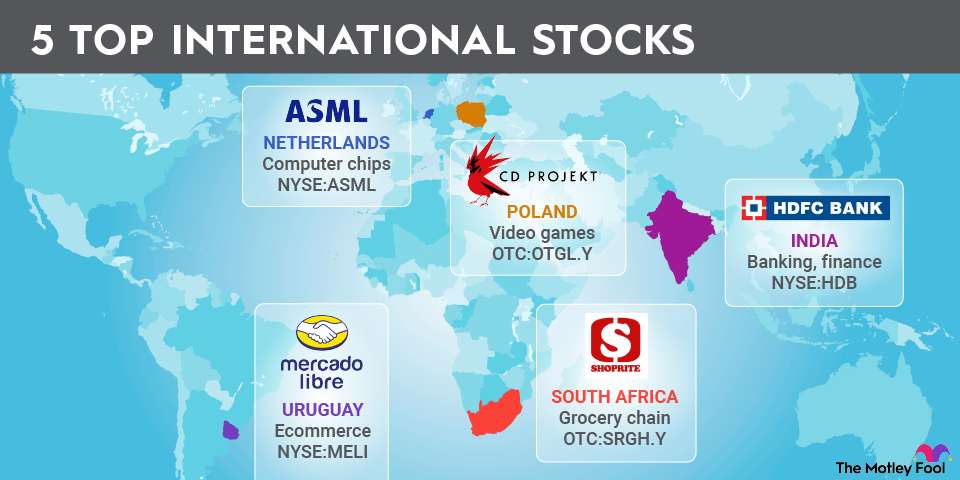
International stocks give investors access to growth happening outside American borders, and many compelling opportunities trade at lower valuations than comparable domestic stocks. Most investors should consider allocating at least a portion of their portfolios to international markets to broaden their exposure to global economic trends.
Here's what to know about investing internationally, along with our top stock picks to get you started.

Top international stocks to consider
| Name and ticker | Market cap | Dividend yield | Industry |
|---|---|---|---|
| ASML (NASDAQ:ASML) | $518.7 billion | 0.57% | Semiconductors and Semiconductor Equipment |
| CD Projekt (OTC:OTGLY) | $6.5 billion | 0.42% | Entertainment |
| MercadoLibre (NASDAQ:MELI) | $84.7 billion | 0.00% | Multiline Retail |
| Shoprite (OTC:SRGHY) | $8.3 billion | 2.87% | Food and Staples Retailing |
| HDFC Bank (NYSE:HDB) | $144.8 billion | 1.33% | Banks |
1. ASML Holding

NASDAQ: ASML
Key Data Points
Headquartered in the Netherlands, ASML Holding (ASML +2.25%) is one of the world's leading providers of semiconductor manufacturing equipment. Semiconductors extend beyond powering computers and mobile devices and providing the hardware foundations for big leaps forward in artificial intelligence.
Semiconductors are now essential components for automobiles, appliances, and a wide range of everyday products and services. And access to chip supplies is a major national security issue for countries around the world.
As a result, there's a big push for localized chip production in the U.S., Europe, and other major markets. ASML's extreme ultraviolet lithography (EUV) machines are unmatched when it comes to manufacturing state-of-the-art chips. The company is set to play a big role in expanding global manufacturing capacity.
2. CD Projekt

OTC: OTGLY
Key Data Points
Based in Poland, CD Projekt (OTGL.Y +1.34%) has established itself as a strong player in the video game industry. The company is best known for games such as The Witcher and Cyberpunk 2077, but it also operates an online marketplace and sharing platform for digitally distributing games.
Demand for interactive entertainment is still poised for huge growth over the long term. CD Projekt has compelling opportunities as it releases content expansions for existing titles, launches new properties, and taps into emerging trends, including augmented reality and the metaverse.
3. MercadoLibre

NASDAQ: MELI
Key Data Points
MercadoLibre (MELI +3.28%) is a leading provider of e-commerce and fintech services in Latin America. The company was founded in Argentina and is still growing quickly there, but it actually does most of its business in Brazil and generates a major portion of its revenue in Mexico.
MercadoLibre has continued to increase sales rapidly despite macroeconomic headwinds, and it's actually making a big hiring push at a time when many other businesses are reducing their employee counts. MercadoLibre's forefront positions in online retail and fintech point to huge expansion potential as these services become more popular in Latin America.
4. Shoprite Holdings

OTC: SRGHY
Key Data Points
5. HDFC Bank

NYSE: HDB
Key Data Points
India's largest private sector lender, HDFC Bank (HDB +2.98%), is in a favorable position to benefit as the country's economy continues to develop. The company has more than 7,800 bank branches across more than 3,800 cities and towns. HDFC is also a player in the digital payments space.
How to invest in international stocks
There are three main ways for U.S. investors to access international markets.
Invest in internationally focused funds
This is the simplest approach. Funds like the Vanguard FTSE Europe ETF (VGK +1.36%) and the iShares MSCI Emerging Markets ETF (EEM +2.54%) offer exposure to hundreds or thousands of international companies in a single investment. Sector-focused funds, like the iShares Semiconductor ETF (SOXX +2.66%), can also include major international players like ASML Holding and NXP Semiconductors (NXPI +1.43%)
Buy American depositary receipts
Many foreign companies list on U.S. exchanges through ADRs, which represent equity stakes in the underlying company and can be purchased through any domestic brokerage. Some international stocks that don't list on major U.S. exchanges are also available through over-the-counter markets. Note that ADRs typically do not carry voting rights.
Gain direct international access through a broker
Some investors open accounts that allow them to trade directly on foreign exchanges. This approach offers the most direct exposure but can involve additional fees, taxes, and regulatory requirements, and investments are not protected by U.S. securities laws.
Political instability is a risk to weigh when investing internationally.
Pros and cons of investing internationally
Pros
- Foreign markets present opportunities you miss if your holdings are strictly limited to U.S.-based stocks.
- International stocks allow investors to diversify and gain exposure to growth in other countries.
- While foreign companies sometimes come with added risks, international companies tend to have lower price-to-sales (P/S) and price-to-earnings (P/E) multiples relative to comparable businesses in the U.S.
- Many investors prefer to pay more for domestic stocks, and that can result in potentially explosive international stocks trading at discounted valuations.
Cons
- Business growth in international markets is generally considered less reliable than growth for U.S.-based businesses.
- International stocks tend to receive less coverage from U.S. analysts and media outlets, which can result in weaker valuation performance even when business results are strong.
- International companies can face outsized macroeconomic and geopolitical risks.
- In some cases, investing in international stocks means that investors have to embrace high levels of risk related to lower levels of financial visibility and the trustworthiness of reported results.
What risks come with investing in international markets?
Although the rewards of investing in international stocks can be high, there are some risks to consider.
- International markets often see outsized impacts when economic conditions worsen.
- Political instability and other developments in the country can devalue an investment, and the values of currencies fluctuate.
- Geopolitical dynamics can result in the withdrawal of support from institutional investors and lead to poor stock performance.
- Investors can face higher levels of risk related to visibility on business operations and the reliability of reported financial results.
Taxes on international stock investments
International stocks may be subject to additional tax requirements beyond the standard tax liabilities that come with stocks of U.S.-based companies. In some cases, shareholders may owe taxes to both the U.S. and the country in which the company is domiciled.
Taxes on international stocks will vary based on the rules of the underlying company's home country. This means there is no one-size-fits-all breakdown for how taxes on foreign companies are handled, and investors should familiarize themselves with the relevant tax structures before establishing significant positions in foreign equities.
U.S.-based investors will always owe taxes to the U.S. government on gains generated from international stocks, but they will also sometimes owe foreign taxes. The good news is that U.S. investors can either receive a tax credit or a deduction on foreign taxes that have been paid on international stocks. This avoids double taxation.
If a U.S. citizen owns shares of a foreign stock that pays a dividend, the payout will typically be taxed based on the rules of the country in which the company is located. On the other hand, investors usually don't have to do anything to fulfill this tax liability. Part of the dividend payment will automatically be withheld and transferred to the government of the country where the business is headquartered.
When U.S. investors look at the 1099-B form connected to the dividend paid by the international stock, they will see that they have received a tax credit. This effectively prevents the shareholder from having to pay taxes on the dividend to both the U.S. and the country where the company is located.
Key differences between international and U.S. stocks
International companies with stocks that primarily trade on foreign exchanges may have different financial auditing, reporting, and visibility requirements compared to U.S. stocks that are subject to requirements put in place by the Securities and Exchange Commission (SEC). Because of these differences, international stocks can come with added risks that investors need to consider.
International stocks may also not trade directly on major U.S. exchanges. Instead, these stocks may be available to U.S. investors through American Depositary Receipts or traded over the counter.
For instance, many countries in Latin America have seen inflation levels even higher than in the U.S. and relatively weak economic recoveries on the heels of the coronavirus pandemic. While foreign stocks often trade at low price-to-earnings (P/E) and price-to-sales (P/S) multiples relative to comparable domestic companies, they also tend to be even more sensitive to macroeconomic shifts. The current backdrop suggests plenty of potential for volatility.
Foreign companies are also more likely to fail to meet most U.S. investors' communications and reliability expectations. Even foreign companies approved by the SEC to list ADRs on U.S. exchanges sometimes fail to meet reporting expectations. It's vital to understand how well and by what means an international company communicates with investors.
Before investing in international stocks, consider how much risk you're comfortable with. While emerging markets grow faster, they also tend to be more volatile, so you may prefer to focus on developed economies. By establishing a clear strategy for your non-domestic portfolio, you are better positioned to endure market turbulence and pursue long-term gains.
Key trends in international stocks
While international stocks as a broad category have underperformed U.S. stocks in recent decades, international stocks have recently been outperforming in a big way. Here are some of the trends that have contributed to strong returns for international stocks over the last year.
- Geographic diversification momentum: After a long stretch in which U.S. stocks dramatically outperformed international stocks, investors have been aiming to identify market inefficiencies and opportunities that can deliver strong returns. A combination of domestic and international political dynamics has caused some investors to increase their exposure to companies based outside the U.S., and continued weakening of the U.S. dollar has also supported growth for foreign investments.
- Diversification away from the "Magnificent Seven": The Magnificent Seven companies have played a huge role in powering gains for the broader market over the last five years. These companies have generally been delivering strong sales and earnings growth, and their leading positions in artificial intelligence have helped support bullish momentum. On the other hand, investors are also weighing valuation risks and looking for opportunities that could deliver the next stretch of big returns -- and that's encouraged bullish trading on top international stocks.
- Diversification away from other U.S. software stocks: In conjunction with concerns about AI-related disruption, U.S. software stocks have been facing strong valuation pressures. Some of the investment capital flowing out of these companies has rotated into international stocks in the fintech and industrials sectors. U.S. software stocks have traditionally commanded valuation premiums compared to international software stocks, but international tech stocks have been seeing valuation support as investors seek out companies that still offer appealing deals from a valuation perspective.
Related investing topics
FAQ
Investing in international stocks FAQ
About the Author
Keith Noonan has no position in any of the stocks mentioned. The Motley Fool has positions in and recommends ASML, MercadoLibre, NXP Semiconductors, and iShares Trust - iShares Semiconductor ETF. The Motley Fool recommends CD Projekt and HDFC Bank. The Motley Fool has a disclosure policy.