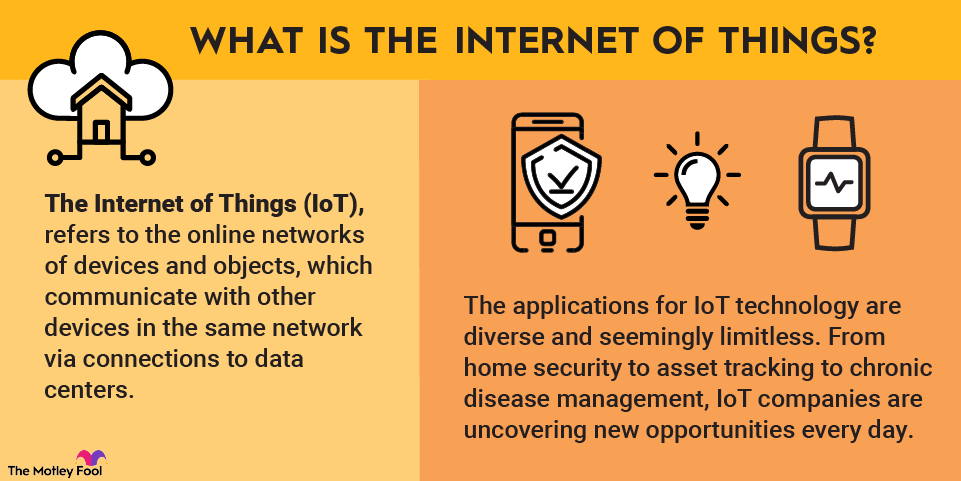
Computers and smartphones aren't the only devices connecting to the internet. Everyday objects such as lights, televisions, major appliances, cars, and even doorbells are being brought online -- and they're frequently found in American homes. According to Horowitz Research, 48% of U.S. homes have at least one smart device. The Internet of Things (IoT) refers to the networks of devices and objects that communicate with other devices in the same network via connections to data centers.
Best IoT stocks in 2026
These six top IoT stocks range from a diversified tech giant to a pure-play IoT company:
1. Cisco Systems

NASDAQ: CSCO
Key Data Points
Cisco Systems (CSCO +2.97%) is the leading provider of enterprise networking hardware. Because its products form the backbone of the internet, the tech giant benefits from the explosion of internet-enabled devices.
Cisco sells networking hardware designed for handling large numbers of connected devices, including rugged, durable products aimed at industrial applications. On the software side, the company provides the Cisco Edge Intelligence platform and other tools for managing IoT data and devices.
Cisco is also one of the largest cybersecurity companies. The company offers hardware, software, and services aimed at securing networks against threats, including those specifically targeting IoT systems.
Cisco is a low-risk way of investing in IoT. The company is supremely profitable, having generated net income of $10.3 billion on revenue of $53.8 billion in fiscal 2025. And it's not only on the income statement that Cisco shines. In fiscal 2025, Cisco generated about $13.3 billion in free cash flow.
The company is sensitive to global economic conditions, given that its customer base includes many large companies, organizations, and governments. However, investing in the stock is a good way to gain exposure to IoT without taking big risks. Cisco remains as dominant as ever, and the company is poised to benefit from the growth of the IoT market.
2. Alarm.com
While Cisco's (ALRM -0.59%) market cap borders $274 billion, cloud software provider Alarm.com is valued at just a few billion. Its relatively small size makes it riskier than the tech giant, but the company has plenty of growth potential.
Alarm.com provides a cloud-based software platform for managing a connected home or business. Subscribers use the software to manage internet-enabled devices, including security cameras, lights, locks, thermostats, and a range of other supported products.
Alarm.com partners with service providers to sell its platform to consumers and businesses. The company currently works with about 12,000 service providers in more than 70 countries, and its products are found in about 67 million properties worldwide.
Recognizing both steady top- and bottom-line growth from 2016 through 2024, Alarm.com has increased revenue at a 17.4% compound annual growth rate (CAGR) and adjusted earnings before interest, depreciation, and amortization (EBITDA) at a 17.3% CAGR.
In addition to revenue of $990 million to $996.4 million, Alarm.com projected adjusted EBITDA of $195 million to $196.5 million for 2025. If the company achieved the midpoints of both of these metrics, it would have recognized year-over-year growth of 5.7% and 11.2%, respectively.
Revenue
Management recognizes ample growth opportunities, identifying more than 500 million serviceable properties. Since only a small fraction of homes are currently using Alarm.com’s platform, the IoT company has a long growth runway.
With the smart home trend here to stay, Alarm.com -- and its millions of subscribers -- is an early leader.
3. DexCom

Total spending on consumer and industrial IoT technology is expected to pass $1 trillion in 2025.
5. Intel

NASDAQ: INTC
Key Data Points
Semiconductor
6. Samsara

NYSE: IOT
Key Data Points
What to look for in IoT stocks
Just as there are various ways to gain IoT exposure, investors should look for different things in IoT stocks. While all companies should be reporting increases in revenue, investors should recognize that more established companies may be growing revenue at a slower rate than younger companies.
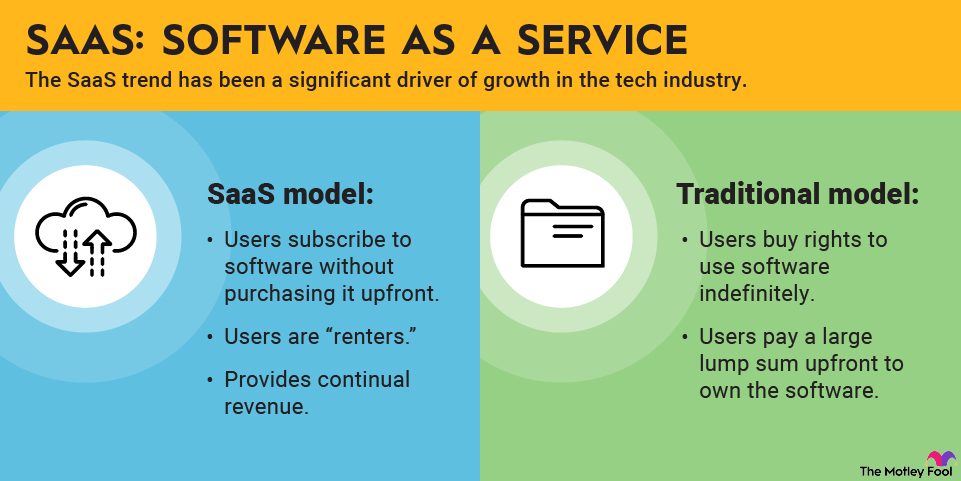
For companies offering software-as-a-service (SaaS), like Alarm.com, investors will want to see that the company has achieved a high SaaS revenue retention rate, indicating that customers are happy with the company's offerings and are maintaining their relationships. Similarly, investors will want to look for companies that report strong ARR, as Samsara does, as another green flag.
Perhaps the most favorable quality for investors to see in IoT stocks is strong free cash flow. Since many IoT companies don't require consistently hefty capital expenditures, they're far more capable of generating free cash flow than companies in other industries. While Intel hasn't generated positive free cash flow recently, it's worth remembering that the company's IoT exposure is far less than some of the other companies on this list.
Related investing topics
Future of the IoT industry
For those questioning whether there's much growth opportunity left for companies specializing in the IoT, the answer is a resounding yes. According to research from business intelligence provider IoT Analytics, the number of connected devices totaled about 21 billion at the end of 2025 and is expected to soar to 39 billion in 2030, representing a 13.2% CAGR.
Unsurprisingly, perhaps the greatest tailwind for the IoT right now is artificial intelligence (AI). From the increasingly advanced ability of generative AI to aggregate data that IoT devices produce and present it to users in a simplified manner to the advantages of using AI in edge computing, the growth potential for the IoT is substantial.
FAQ
Internet of Things Stocks FAQ
About the Author