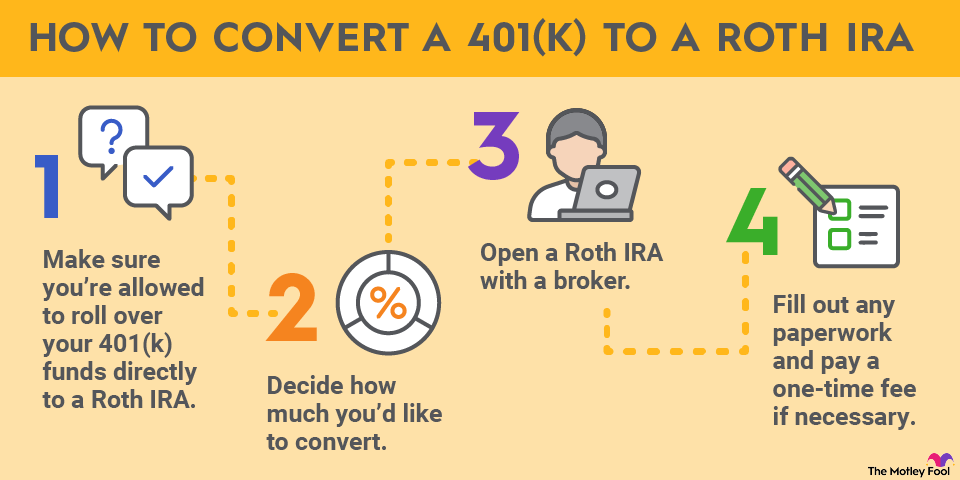
The effect on your tax bill depends on how much you convert and how much other taxable income you've earned during the year. If you're not careful, your 401(k) to Roth IRA conversion could significantly increase your tax rate, meaning you'll lose a higher percentage of your income to the government. You can avoid this by staying mindful of your tax bracket and taxable income throughout the year.
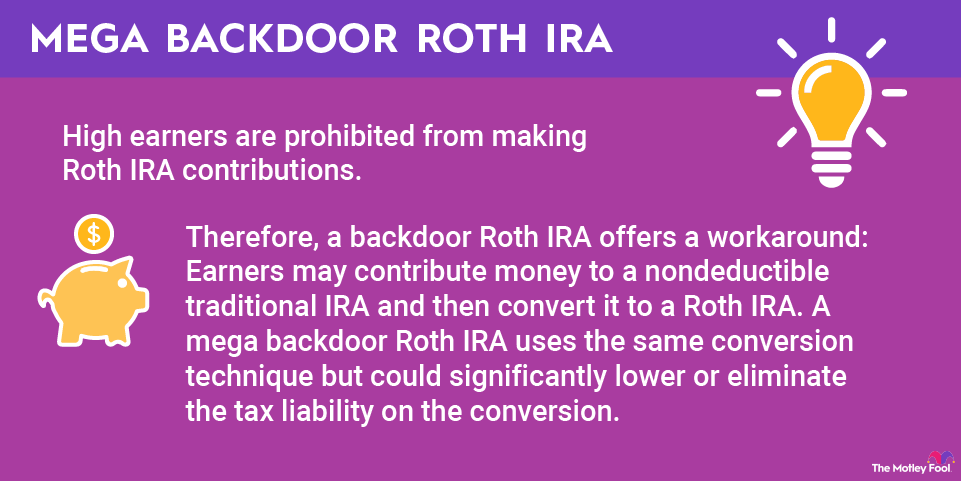
You may not owe taxes on the full amount of your 401(k) to Roth IRA conversion if you've made nondeductible 401(k) contributions in the past. But that's where things get a little hairy. Nondeductible 401(k) contributions are funds you contribute to a traditional 401(k) but don't get an immediate tax break for. You pay taxes on your contributions, but earnings grow tax-deferred until you withdraw them.
Not all plans allow nondeductible 401(k) contributions, but if yours does, you must understand how the government handles these withdrawals. If you're converting only some of your savings, the government looks at the proportion of nondeductible versus deductible contributions and taxes you accordingly.
For instance, let's say you have $100,000 in your 401(k), $10,000 of which is nondeductible contributions. If you wanted to convert $10,000 to a Roth IRA, only 10% of the converted amount, or $1,000, would be considered nondeductible contributions since only 10% of your total 401(k) contributions were nondeductible.
If you decide to roll over your entire 401(k) balance, you can roll all your pretax dollars into a traditional IRA and all your nondeductible contributions into a Roth IRA. You wouldn't pay taxes on this type of conversion because you already paid taxes on your nondeductible contributions the year you made them.