Investing in growth stocks can be a powerful way to build long-term wealth -- but it’s not always a smooth ride. Growth stocks tend to outperform when the market rewards future potential, but they can fall hard when investors grow more cautious.
The upside is real. So is the volatility. The goal is to invest in growth companies that can keep compounding through good markets and bad, and to build a strategy that helps you stick with them.
What is a growth stock?
A growth stock is a company expected to increase revenue and earnings faster than the broader market (or faster than most peers). Many growth companies win by doing at least one of the following:
- Taking a share of a large existing market.
- Expanding into new markets.
- Creating a new product category altogether.
Because investors are paying for future potential, growth stocks often trade at higher valuations than the average stock. That doesn’t mean they’re “overpriced,” but it does mean expectations are high, and the stock can drop quickly if growth slows.
Why they can be volatile: Growth stocks are especially sensitive to interest rates and inflation because a larger share of their value is tied to earnings expected years in the future. That’s why downturns can hit them harder.
Top growth stocks to consider
| Company name | Company ticker | Market cap | Industry |
|---|---|---|---|
| Meta Platforms | NASDAQ:META | $1.5 trillion | Interactive Media and Services |
| Shopify | NASDAQ:SHOP | $152.7 billion | IT Services |
| Uber Technologies | NYSE:UBER | $147.6 billion | Road and Rail |
| Block | NYSE:XYZ | $35.9 billion | Diversified Financial Services |
| MercadoLibre | NASDAQ:MELI | $88.3 billion | Multiline Retail |
| Nvidia | NASDAQ:NVDA | $4.3 trillion | Semiconductors and Semiconductor Equipment |
| Netflix | NASDAQ:NFLX | $417.2 billion | Entertainment |
| Amazon | NASDAQ:AMZN | $2.3 trillion | Multiline Retail |
| Salesforce | NYSE:CRM | $168.9 billion | Software |
| Alphabet | NASDAQ:GOOG | $3.7 trillion | Interactive Media and Services |
How to find growth stocks
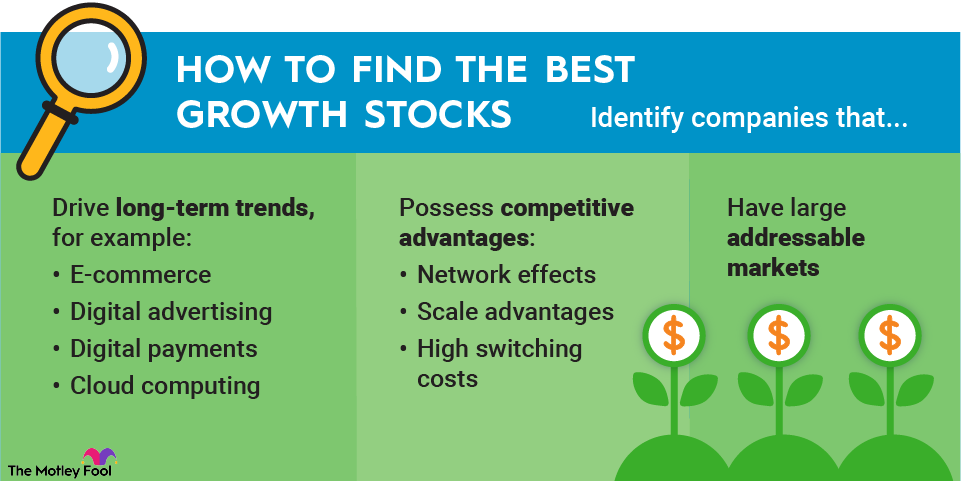
To find great growth stocks, you'll need to:
- Identify powerful long-term market trends and the companies best positioned to profit from them.
- Narrow your list to businesses with strong competitive advantages.
- Further narrow your list to companies with large addressable markets.

Prioritize companies with competitive advantages
It's also important to invest in growth companies that possess strong competitive advantages. Otherwise, their competitors may pass them, and their growth may not last long. A strong competitive advantage will help companies survive and thrive through market downturns, while those without one will struggle.
If you can identify stocks of companies with strong competitive advantages being sold off along with the rest of the market, it can be an opportunity to generate massive returns as they recover. Some competitive advantages are:
- Network effects: Meta's Instagram is a prime example here. Each person who joins the social media platform makes it more valuable to other members. Network effects can make it difficult for new entrants to displace the current market share leader. Meta's 3.5 billion users across its family of apps certainly make it unlikely that a new social media company will displace it.
- Scale advantages: Size can be another powerful advantage. Amazon is a great example in this category because smaller rivals will find it extremely difficult to replicate its massive global fulfillment network.
- High switching costs: Switching costs are the expenses and difficulties associated with switching to a rival's product or service. Shopify, an online retail platform used by more than 1 million businesses, is a perfect example of a business with high switching costs. Once a company begins using Shopify as the core of its online operations, it's unlikely to go through the hassle of switching to a competitor.
Growth Stocks | Dividend Stocks |
|---|---|
Fast-growing young companies in evolving industries. | Slow-growing mature businesses in stable industries. |
Reinvest profits in expanding the business and growing market share. | Pay out a large portion of profits as dividends for shareholders. |
May produce little or negative free cash flow as management invests in the business. | Steady and predictable growth in free cash flow over time. |
Higher volatility. | Lower volatility. |
The biggest risk is management's execution on the long-term outlook. | The biggest risk stems from mismanaging capital allocation, leading to a dividend cut. |
Typically trade for high valuations. | Typically trade for low valuations. |
Investors can generate great returns from either type of stock. Understanding what to look for when investing in growth stocks or dividend stocks is key to getting the most from either strategy.
How to manage a portfolio of growth stocks
Not every growth stock you buy will pan out. As such, it's best to start with small positions in multiple growth stocks. If a business's financial performance lines up with your investment thesis, you might increase your position in that stock, as you should now have more confidence in its future growth. However, if you start to see evidence that your thesis was wrong, you should start trimming your position, or possibly exit it altogether.
As mentioned, growth trends can last a very long time, so you should avoid selling a stock too early. However, since growth stocks are more volatile than value stocks, it may be smart to limit your biggest positions to a certain percentage of your portfolio. That way, a big swing in the stock price won't crater your whole portfolio.
Related investing topics
FAQ
FAQ: Growth stocks
Expert Q&A on growth stocks
About the Author
Adam Levy has positions in Alphabet, Amazon, Meta Platforms, Microsoft, Netflix, Salesforce, and Uber Technologies. The Motley Fool has positions in and recommends Alphabet, Amazon, Block, Etsy, MercadoLibre, Meta Platforms, Microsoft, Netflix, Nvidia, Oracle, PayPal, Salesforce, Shopify, Tesla, Uber Technologies, and Vanguard Index Funds - Vanguard Small-Cap Growth ETF. The Motley Fool recommends BYD Company and Gartner and recommends the following options: long January 2027 $42.50 calls on PayPal and short March 2026 $65 calls on PayPal. The Motley Fool has a disclosure policy.