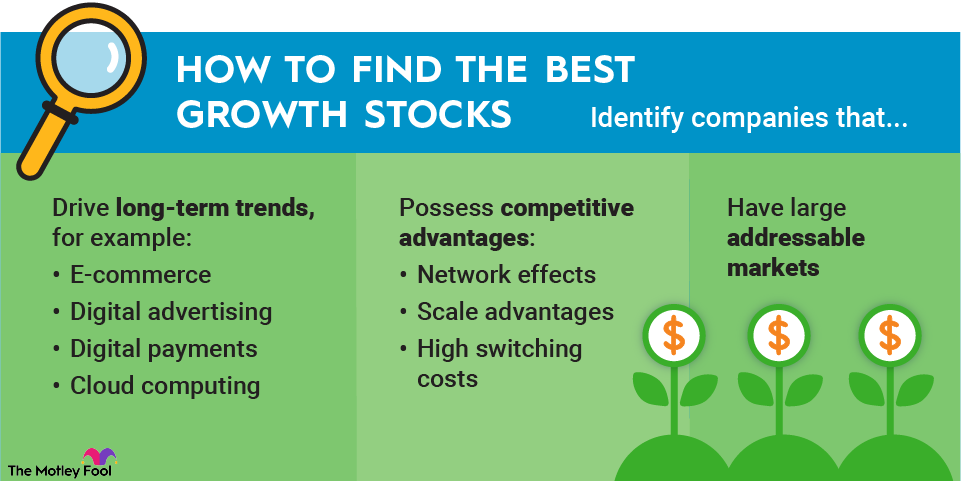
If you can identify stocks of companies with strong competitive advantages being sold off along with the rest of the market, it can be an opportunity to generate massive returns as they recover. Some competitive advantages are:
- Network effects: Meta's Instagram is a prime example here. Each person who joins the social media platform makes it more valuable to other members. Network effects can make it difficult for new entrants to displace the current market share leader. Meta's 3.5 billion users across its family of apps certainly make it unlikely that a new social media company will displace it.
- Scale advantages: Size can be another powerful advantage. Amazon is a great example in this category because smaller rivals will find it extremely difficult to replicate its massive global fulfillment network.
- High switching costs: Switching costs are the expenses and difficulties associated with switching to a rival's product or service. Shopify, an online retail platform used by more than 1 million businesses, is a perfect example of a business with high switching costs. Once a company begins using Shopify as the core of its online operations, it's unlikely to go through the hassle of switching to a competitor.
Find companies with large addressable markets
Finally, you'll want to invest in businesses with large addressable markets and long runways for growth still ahead. Industry reports from research firms -- such as Gartner (IT -2.24%) and Insider Intelligence, which provide estimates of industry sizes, growth projections, and market share figures -- can be very helpful.
The larger the opportunity, the larger a business can ultimately become. And the earlier it is in its growth cycle, the longer it can continue to grow at an impressive rate.
Why invest in growth stocks?
- They have high return potential.
- Less demand for immediate capital returns allows management to invest in the future.
- They can add diversification to your portfolio across market segments and sectors.
- Participate in major economic trends.
- One excellent growth stock investment can make up for a handful that don't work out.
Risks of investing in growth stocks
Growth stocks can offer excellent long-term returns, but there are no free lunches in the stock market. The cost of better returns is greater risk.
Growth stocks generally exhibit greater price volatility. That's partly due to their higher valuations. Any changes in expectations for the future are multiplied by a greater factor when valuations are high. As such, investors need to be able to stomach severe drawdowns in the value of their growth stocks.
Individual growth stocks also hold significantly more risk than individual value stocks. By their nature, growth stocks are less predictable, so an individual investment could face setbacks from poor execution, challenges scaling the business, or another company disrupting its product or market. So, growth stock investors should maintain a portfolio of companies across industries and in different phases of growth.
Strategies for investing in growth stocks
Growth stocks can produce market-beating returns, but they can also quickly drag your portfolio lower. A key strategy to successful growth stock investing is to build a portfolio of stocks based on the opportunities and risks presented by each company you're considering.
If two companies are highly correlated (perhaps they're both highly exposed to growing AI spending), you might reduce your exposure to both stocks while increasing your allocation toward another company that's not related to that industry.
You only need a handful of great growth stocks to build a good portfolio. Each stock you add beyond your best ideas could detract from your long-term returns, but if it has the potential to smooth out the ride, it could be worth owning.
Growth stocks versus dividend stocks
While some growth stocks might pay dividends, growth stocks and dividend stocks usually don't overlap. Here are the key differences: