Cybersecurity spending has soared in recent years. Organizations have faced new security challenges as cloud computing and remote work have become essential and widely used business tools. As a result, many cybersecurity stocks were top performers during the COVID-19 pandemic, boosted by strong demand for next-gen security software.
A bear market in 2022 clobbered some of the highest-flying stocks, followed by a wide range of shifting results. However, cybersecurity stocks often bounce back quickly from sudden market challenges, and the industry remains a top investment theme for the decade.

Why should you consider investing in cybersecurity stocks?
The cybersecurity threat landscape continues to evolve rapidly, driving massive investment in protection:
- Record-breaking breach activity: Identity Theft Resource Center reports show data breaches hitting an all-time high in 2023, with incidents jumping 71% from the previous 2021 record. 2024 held steady at this new plateau.
- Evolving attack strategies: Hackers shifted from mass attacks to more targeted fraud in 2024, with victim counts tripling year over year in 2024 as criminals adapted to tougher defenses.
- Massive market growth: Global cybersecurity spending is expected to exceed $200 billion annually by 2028, according to IDC research.
- Long-term growth trajectory: The industry will likely remain a high-growth industry for years as digital threats multiply.
With cybersecurity stocks representing a red-hot niche of the tech industry, knowing how to invest in them can yield significant returns in the decade ahead.
Top cybersecurity stocks in 2025
Here are some of the top cybersecurity stocks to own in the long run:
| Name and ticker | Market cap | Current price | Industry |
|---|---|---|---|
| Palo Alto Networks (NASDAQ:PANW) | $132.3 billion | $193.65 | Software |
| CrowdStrike (NASDAQ:CRWD) | $129.6 billion | $523.29 | Software |
| Fortinet (NASDAQ:FTNT) | $61.7 billion | $82.76 | Software |
| Zscaler (NASDAQ:ZS) | $38.5 billion | $243.61 | Software |
| Okta (NASDAQ:OKTA) | $14.4 billion | $86.36 | IT Services |
| SentinelOne (NYSE:S) | $5.5 billion | $16.95 | Software |
| Datadog (NASDAQ:DDOG) | $54.9 billion | $155.80 | Software |
| Akamai Technologies (NASDAQ:AKAM) | $12.5 billion | $87.99 | IT Services |
Cloud security, identity management, and legacy security vendors
As cloud computing has quickly grown into an industry worth hundreds of billions annually, sales of cloud-native (built-in and for the cloud) security software have skyrocketed. The leaders in this space have some of the best long-term potential.
1. Palo Alto Networks
Hailing from an era that predates cloud technology, Palo Alto Networks' specialty is rooted in firewalls -- devices that protect traffic into and out of physical locations such as offices and data centers. While its legacy services still experience plenty of demand, the real growth is in the cloud.

NASDAQ: PANW
Key Data Points
The company's highly profitable platform has helped it acquire more than a dozen smaller cloud-native businesses in the past few years. As a result, Palo Alto Networks has given its security operations a serious makeover.
Management predicts double-digit percentage revenue growth in the years ahead for its next-gen security portfolio geared for the cloud era. This steady growth and market leadership helped make its stock one of the best performers among cybersecurity companies in the post-COVID-19 era.
Palo Alto Networks is the largest pure-play cybersecurity operation in terms of revenue and market cap. Now also a leading cloud security provider, this legacy business is highly competitive in the cybersecurity industry. Shares trade for a relative value compared to its younger, high-flying, cloud-native rivals.
2. CrowdStrike Holdings
As a cloud-native software company, CrowdStrike Holdings provides endpoint security -- protection for devices such as laptops, PCs, smartphones, and any other device connected to a network. Because it's cloud-based, CrowdStrike is particularly well suited for supporting remote work.

NASDAQ: CRWD
Key Data Points
CrowdStrike's software uses machine learning to detect security breaches and hunt down threats. It's also easy to deploy to the millions of people working from home and the billions of machines connected to the internet.
The company has steadily expanded the number of modules on its platform to better serve its customers. It also has new integration agreements with other tech companies to ensure data protection consistency across an organization's entire IT infrastructure.
The premium-priced stock was hit hard in 2022, and its security network suffered a painful outage in July 2024. CrowdStrike's sales have been booming nonetheless, and the artificial intelligence (AI)-driven stock rose 16% in 2024 despite the outage.
The company is also highly profitable in terms of free cash flow. In an increasingly mobile world with more devices continually coming online, CrowdStrike is poised to continue growing at a brisk rate.
3. Fortinet
Fortinet, another legacy security software provider, is also one of the world's largest cybersecurity companies by revenue and market cap. Like its peer Palo Alto Networks, it has maintained double-digit percentage growth and is highly profitable. But unlike Palo Alto Networks' acquisition spree, Fortinet has invested in its organic development of cloud security to remain competitive.

NASDAQ: FTNT
Key Data Points
One of its developments is a software-based internet security product being built and deployed with one of Europe's leading telecom providers, Telefónica (TEF +0.36%). In August 2025, the company also announced a partnership with Singapore's Quantum Engineering Programme to develop next-gen security for quantum computing.
Fortinet is also a top provider of firewalls. Its best-in-class hardware continues generating more revenue as many organizations turn to Fortinet for help building new data centers and 5G mobile networks. For investors seeking strongly profitable sales growth, Fortinet stands out as one of the top security stocks on the market.
4. Zscaler
Zscaler, another cloud-native security vendor, works in tandem with endpoint security services to help keep data secure. The company has been increasing its sales rapidly and is another of the largest pure-play cybersecurity stocks as measured by market cap. Zscaler continues to deliver profitable revenue growth.

NASDAQ: ZS
Key Data Points
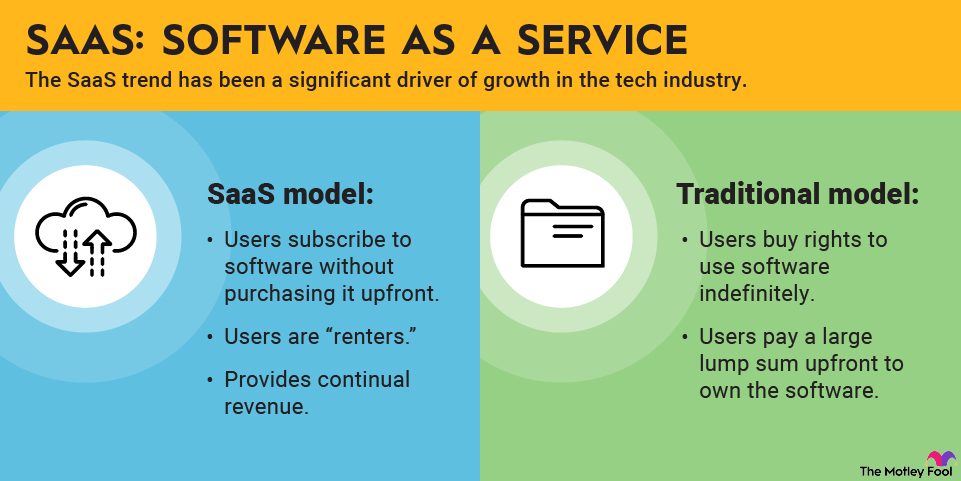
Zscaler started with a software-as-a-service (SaaS) product designed for network protection in the modern cloud computing era. It has since added new internet security and end-user monitoring products.
End-user monitoring is increasingly valuable with so many people now working remotely. With global spending on cloud computing expected to exceed $1 trillion annually this decade, Zscaler is poised to profit from a massive secular growth trend.
5. Okta
Okta is a pioneer of identity and access management, which rethinks traditional security by using zero-trust architecture. This type of identity management constantly requires user verification before allowing access to data and applications.

NASDAQ: OKTA
Key Data Points
In an increasingly mobile and cloud-based world, Okta's identity management software has been in high demand. Businesses often have a complicated web of stakeholders, including employees, third-party contractors, suppliers, and customers.
Okta is a leader in this branch of security. However, a cyberattack in January 2022 affected two of its largest customers, accelerating the stock's decline during the inflation-driven bear market. Even so, Okta remains in long-term growth mode as new customers adopt its software to manage identity and access security.
6. SentinelOne
SentinelOne is another recent pure-play cybersecurity company to be publicly listed. Its initial public offering (IPO) in June 2021 raised $1.2 billion in cash and valued the company at $10 billion, making SentinelOne's IPO the largest ever for a cybersecurity company at the time.

NYSE: S
Key Data Points
SentinelOne is also making steady progress toward turning a profit. It operates a cloud-based endpoint security platform, which puts it in direct competition with CrowdStrike. Its ability to automatically detect and resolve cybersecurity threats is well received in the market.
As a high-growth segment of the tech industry, cybersecurity offers investors lots of upside in the decade ahead.
Infrastructure monitoring and content delivery networks
Cloud computing creates, uses, and stores more digital data, and an organization's IT infrastructure can quickly become more complex by an order of magnitude. Companies that help monitor these cloud-based operations are critical to cybersecurity, as are companies that manage the web content and apps themselves. Here are some top names to consider.
1. Datadog
Datadog is a cloud-native platform built to collect, monitor, and yield insights on cloud-based data and operations. The company uses AI to help automate the process of monitoring large and complex data sets, relieving some of the burden of busy IT teams.

NASDAQ: DDOG
Key Data Points
It's also been steadily expanding its platform's capabilities with new modules that include cloud-based security and data monitoring. Data analytics software is a large, fast-growing segment of the tech world, which bodes well for Datadog. Elastic (ESTC +3.69%) and Dynatrace (DT -1.09%) are two other promising software makers to consider in this space.
2. Akamai
As a content delivery network (CDN), Akamai ensures that data arrives securely at its intended destination. With the amount of data traveling across the internet steadily on the rise, CDNs are becoming increasingly important.

NASDAQ: AKAM
Key Data Points

Top cybersecurity ETFs in 2025
If you'd rather not have to choose among individual cybersecurity stocks, you can consider several exchange-traded funds (ETFs) that enable investors to participate in the growth of the cybersecurity industry as a whole. Our top picks for cybersecurity ETFs include.
1. First Trust NASDAQ CEA Cybersecurity ETF
With $11.2 billion of assets under management in November 2025, First Trust NASDAQ CEA Cybersecurity ETF (CIBR +1.31%) is the largest of its kind. The ETF is composed of 30 stocks in the cybersecurity industry and has an annual expense ratio of 0.6% (or $6 in annual fees for every $1,000 invested), making it an affordable option.
Related investing topics
How to invest in cybersecurity stocks
When considering how to identify the best cybersecurity stocks, remember that cloud-native companies have a natural competitive advantage with the latest software technology. However, legacy companies generate ample profit margins and have the cash to make updates.
Companies monitoring cloud-based operations and those managing web content and apps are also increasingly important to companies' online security. Cybersecurity ETFs are another great option and can be purchased with your favorite cybersecurity stocks.
For all your investments, stay focused on the long-term potential of these fast-growing companies since individual stock prices can be highly volatile. Technology that helps the digital world stay safe is rapidly evolving and proliferating, and cybersecurity companies will reap the financial benefits accordingly.